
 换一换
换一换 


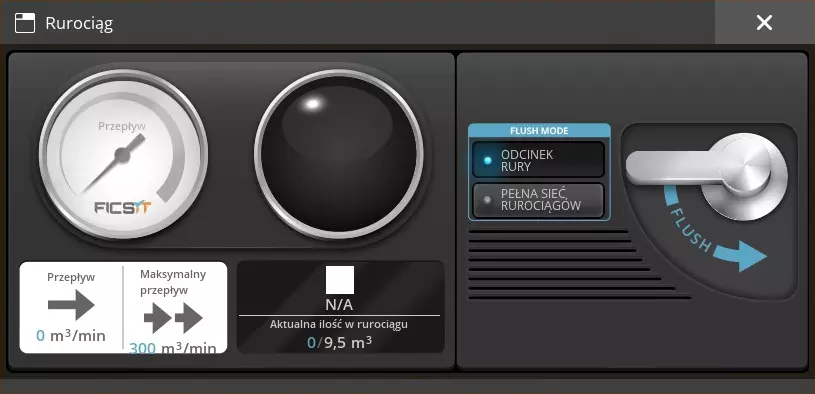
The following is a list of general tips that can help both the beginner and veteran in their factory development. Additionaly, you will find useful information for setting up various power generation systems in the game. Please use the Table of Contents to get around, as this guide is extensive. If you have any questions or suggestions, feel free to ask in the comments. Satisfactory Resources Websites, Tools, and Guides Here is a list of common resources for Satisfactory SCIM Sattisfactory calculator and Interactive Map Satisfactory Calculator Main Page[satisfactory-calculator.com] Satisfactory Interactive Map[satisfactory-calculator.com] You can find an interactive map in which you can upload your save file. It will show you where your buildings are and you can even move, modify, edit, delete, add, or change your structures through this editor. It also shows exact positions of all resource nodes. Satisfactory Tools Satisfactory Tools[www.satisfactorytools.com] This is a calculator used to create production plans. It will tell you exactly what is required for a given product. Satisfactory WIKI Satisfactory Wiki[satisfactory.wiki.gg] Here, you can search for just about anything related to the game. Many articles exist about buildings, items, even some production chain ideas. Pipeline Manual Pipeline Manual[satisfactory.wiki.gg] This is a direct link to one of the most useful documents in the wiki. Its a detailed guide of how pipes, and fluids work in the game. Tips and Tricks List 1. Take your time. Do not rush progress. Learn how the different production processes work. Late game production can be quite complex. Do not be afraid to dismantle and try again! 2. Build up! Take advantage that you can build vertically. You can build up to 2 Km into the sky. In the Awesome Shop are double ramps and walkways. These are the best to get too higher floors. From sea level, you can build approximately 244 meters below, into the void for example. 3. The void is the common name for the endless pit you see on the edges of the map, and a few areas in the middle. 4. Practically, your common bottlenecks in the game are belts and pipes. Fundamentally, the bottleneck is resource extraction. Belts and pipes can be removed as a bottleneck through careful planning and factory layouts, but resource limits can never be avoided. 5. Belts are rated by items moved per minute, the tiers are 60 / 120 / 270 / 480 / 780 items per minute. 6. Pipes have two tiers, similar to belts. MK1 pipes have a maximum flow-rate of 300m3, and MK2 have a maximum flow-rate of 600m3. 7. Head lift is the ability to move liquids against the force of gravity. Starting from some source of head-lift (e.g. a pump or building). Liquids can only ever reach that far up relative to said source of head-lift. You can go down and then back up, but a T1 pump at 37 meters elevation will only ever be able to move liquids up to 59 meters elevation. Head-lift doesn't directly stack: you can't have four pumps at 37 meters and pump fluids up to 125 meters; you have to have pumps at 37, 59, 81 and 103 meters elevation. 8. Most fluid-related buildings (e.g. water extractors) provide 10 meters head-lift. T1 pumps provide 22 meters of head-lift, and T2 pumps provide 55 meters of head-lift. 9. This relatively simplified fluid dynamics can lead to interesting results when merging multiple pipelines: This can even be exploited by building a water tower for example. 10. Pumps also act as one-way valves. 11. In the game, there is another pipe related part called a "valve". This valve provides no head-lift. It can be used to control the flow direction of a pipe, and how much fluid is allowed through. For example, you may only need 150m3 of water. You can use a valve to limit the flow to that 150m3 goal. Keep in mind that valves are not perfect. There can be some fluctuation. 12. If you route your pipes downhill, you can get around head-lift altogether up to where the pipe begins to go downhill. 13. The simplest way to construct chains of machines is by use of the manifold system. Please reference this Wiki article for more information on manifolds: https://satisfactory.wiki.gg/wiki/Manifold 14. A manifold is a set of machines in a single, straight line. With the use of splitters, mergers, or pipe junctions, simply take one belt or pipe and branch it off in series. The only downside is that it can take a while for the system to become 100% efficient. This is because each machine in the line needs to fill its internal storage. This system is also commonly known as overflow. This allows easy expansion. 15. Overflow spiter mode, found in smart and programmable splitters can be used to siphon off excess resources to another production chain, or an AWESOME Sink. This is very important in any processes that have byproducts. For example, oil processing. The same effect can be accomplished with normal splitters, there is just no filtering mode with a normal splitter. 16. You can also balance your factories using a more traditional balancer. A balancer is similar to what is commonly used in games like Factorio. They are a set of splitters and mergers designed to create different outcomes. For example, you may have 4 belts that you need to merge into two belts, but those two belts need a different item per minute total. Here is a wiki article on some different balancer ideas.: https://satisfactory.wiki.gg/wiki/Balancer 17. Exploration is quite important. You will want to find crash sites and power slugs. 18. Crash sites give you a hard drive. In your M.A.M, you can research that hard drive an discover an alternate recipe. You get 3 random choices per hard drove and you may select one at once. There are currently more hard drives on the map than alternate recipes. An example of a useful, early game alternate recipe is "Stitched Iron Plate". This is an alternate for Reinforced Iron Plates, and is far more efficient than the normal recipe. Some alternates are straight-up improvements, while others replace a common resource with a rare one. Some are a trade-off. 19. Power slugs can be processed into power shards, which allow you to overclock your buildings. 21. How do i get out of being stuck in between 2 things? ( asked by @red) It depends on what your stuck on. Machine you built? Dismantle it. A tree or foliage? chainsaw. If all else fails, press C to crouch, should dislodge you. Coal Plant Water Setups Water is probably the most complicated part of coal power, here I will show you some examples of how to setup your water. PLEASE NOTE: This note is for endgame builds. Now that Mark 2 pipes have been added to the game, they can be used for coal power setups as shown here. This guide will not show Mk2 pipe setups yet. I may add that in later. For now, if you wish to use a Mk2 pipe in your coal power plant, use the charts shown below as a baseline and simply double their size. Instead of 6 coal generators for a 300m3 supply of water, double it to 12 for example. The Basics This is all based off 100% clock speed. 45m3 per minute water is needed for each coal generator each water extractor will pump 120m3 water each pipe can have a flow rate of 300m3 fluid maximum Different Water Setups One Water Extractor This setup will produce 120m3 water at 100% clock speed, and can support 2.66 coal generators on its own. For simplicity sake, this will be reduced to two coal generators.
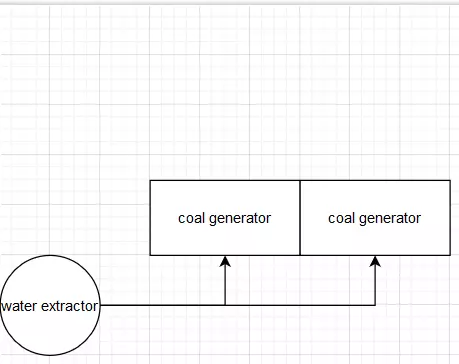
三个抽水机 此配置中所有3个抽水机均降频至75%运行。这将产生每分钟270立方米的总水量,足以供应6台燃煤发电机。
3个水泵搭配8台燃煤发电机 这种方法效率最高,但也最为复杂。3台水泵以100%功率运行时,每分钟可产生360立方米的水。然而,一根管道每分钟最多只能输送300立方米的流体,这该如何实现呢?具体如下:将第三台水泵接入管道的下游位置,使其在前面的燃煤发电机消耗掉部分水之后,再提供120立方米的水,从而实现系统的平衡。
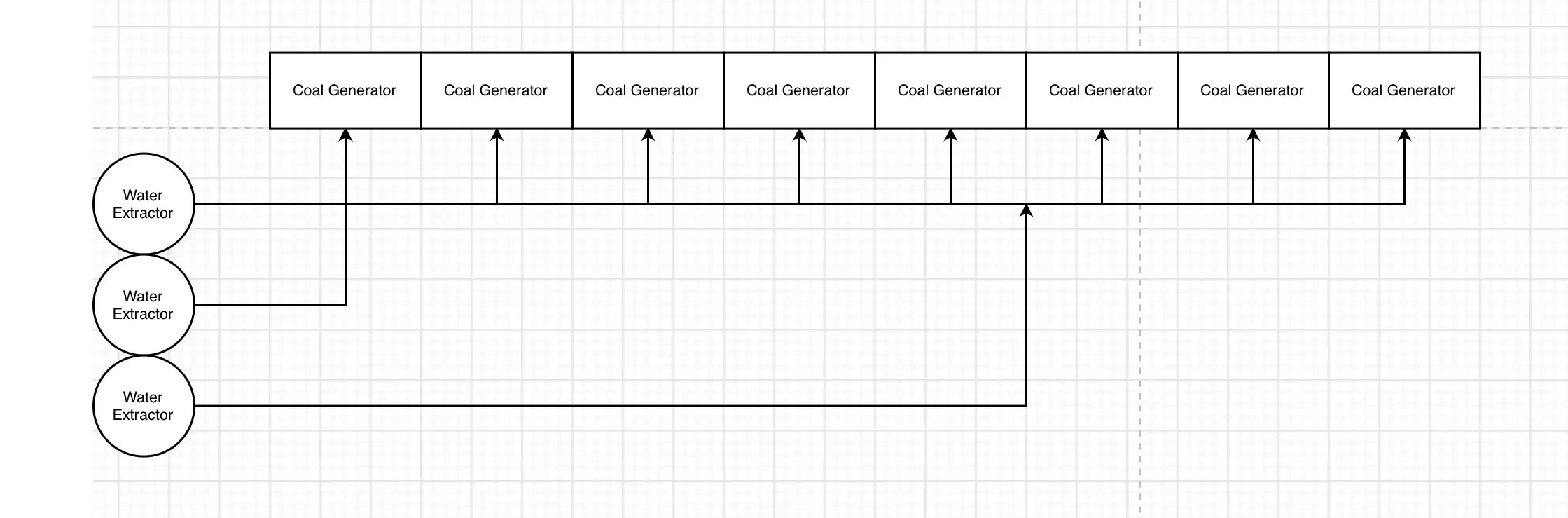
另一个例子:
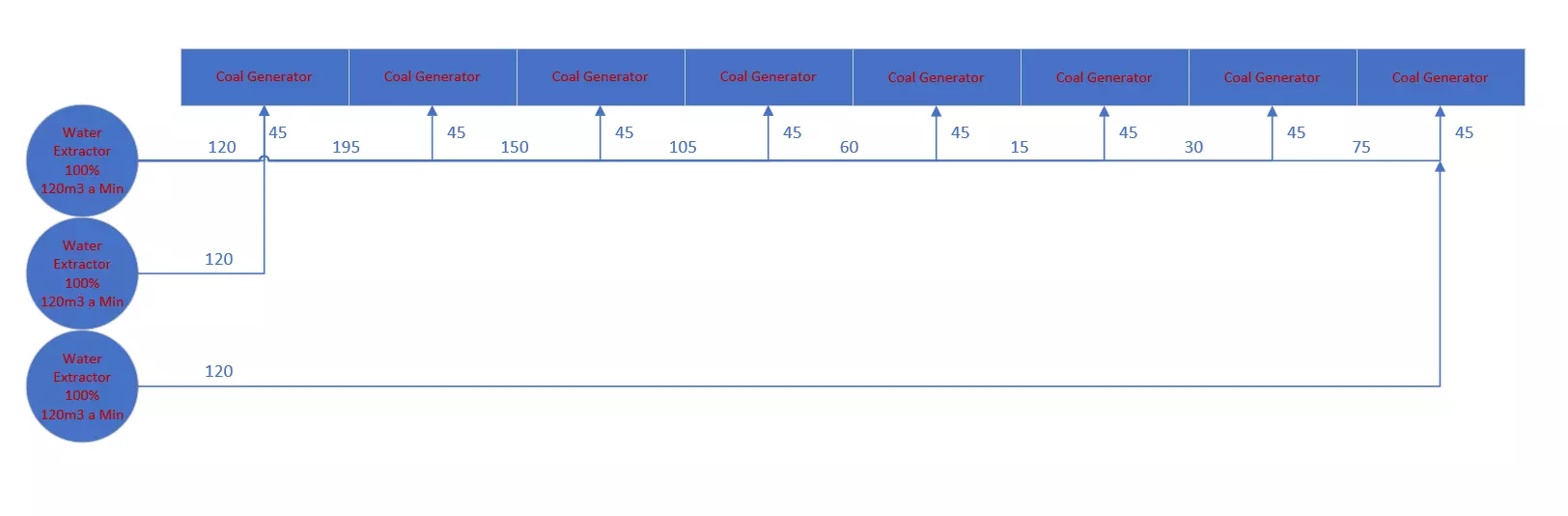
另一个由kwjcool321#7200(Discord用户名)创建
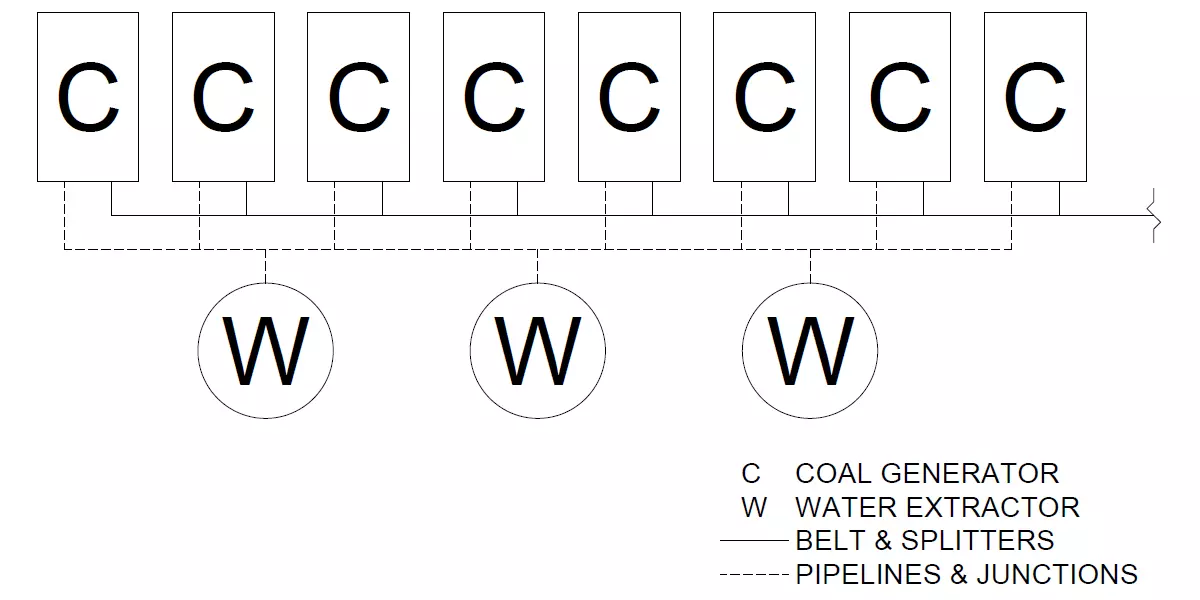
此设计是对上述3:8方法的扩展。最佳做法是先构建上半部分,然后再添加下半部分。这种方法具有无限扩展性。
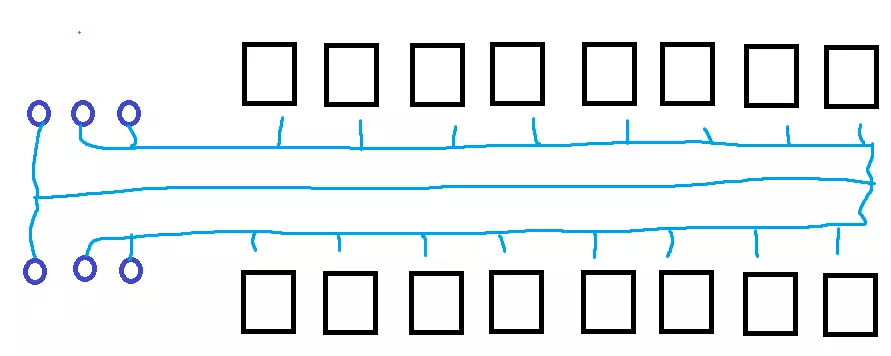
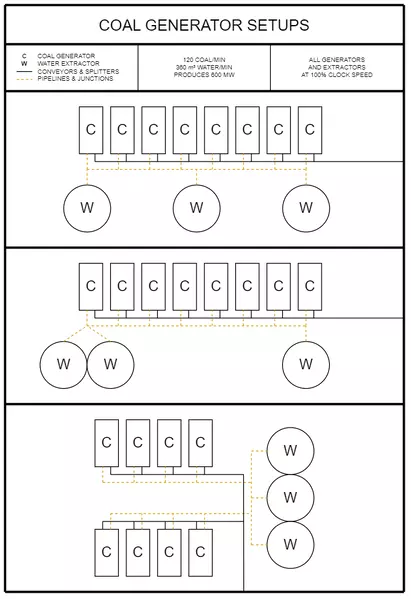
另一个煤炭发电机布局图表
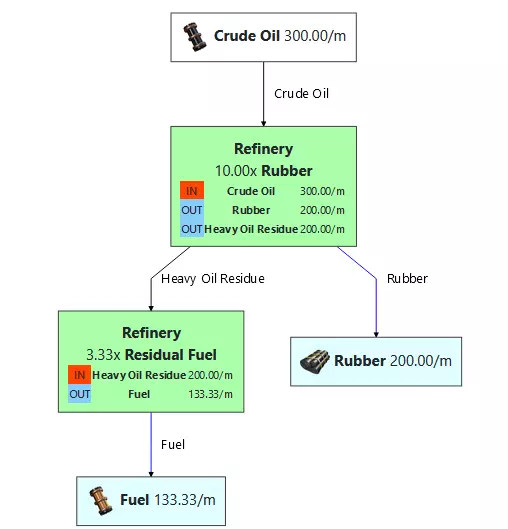
Coal Power: Burn Rates and What You Can Burn To understand coal power, we first must break down the numbers. Coal Generator Basicsphysical connections 1 pipe input 1 belt input Requirements 15 coal a minute 45m3 water a minute produces 75 MW of power at 100% Coal is not the only item you can burn in a coal generator. In total there are three resources that can be used in a coal generator: Coal Compacted Coal Petroleum Coke These resources have different burn times, how much is consumed per minute. Resource Burn Rate Coal 15 Compacted Coal 7.14 Petroleum Coke 25 Coal Coal is easily found through resource nodes on the map. Depending on the node quality and miner tier, you will get different rates per minute. Compacted Coal Compacted coal is a alternate recipe you can unlock randomly by researching hard drives at the M.A.M. Sulfur is a raw resource required to make Compacted Coal. Sufur is a very rare resource on the map and is required for other items such as nuclear fuel rods, batteries, and black powder. Compacted Coal is the most efficient resource to use in a Coal Generator, but the trade-off is not kind. You are using a rare resource that will become very scarce in the later stages of the game. The recipe takes per minute 25 sulfur IN 25 coal IN 25 compacted coal OUT Petroleum Coke Petroleum Coke is a byproduct from oil processing. You get it from converting your heavy oil residue into petroleum coke in a refinery. Petroleum Coke is a reasonably efficient option. The recipe for petroleum coke is 40m3 heavy oil residue IN 120 petroleum coke OUT Coal Power Tables Fuel Consumption Charts Mk1 Belt, 60 a minute Fuel Source Coal Gens Supported Total Power Capacity Total Water Required Total Water Pipes Required Coal 4 300 MW 180m3 1 Compacted Coal 8.4 630 MW 378m3 2 Petroleum Coke 2.4 180 MW 108m3 1 Mk2 Belt, 120 a minute Fuel Source Coal Gens Supported Total Power Capacity Total Water Required Total Water Pipes Required Coal 8 600 MW 360m3 2 Compacted Coal 16.8 1260 MW 756m3 3 Petroleum Coke 4.8 360 MW 216m3 1 Mk3 Belt, 270 a minute Fuel Source Coal Gens Supported Total Power Capacity Total Water Required Total Water Pipes Required Coal 18 1350 MW 810m3 3 Compacted Coal 37.81 2835.75 MW 1702m3 6 Petroleum Coke 10.8 810 MW 486m3 2 Mk4 Belt, 480 a minute Fuel Source Coal Gens Supported Total Power Capacity Total Water Required Total Water Pipes Required Coal 32 2400 MW 1440m3 5 Compacted Coal 67.22 5041.5 MW 3025m3 11 Petroleum Coke 19.2 1440 MW 864m3 3 Mk5 Belt, 780 a minute Fuel Source Coal Gens Supported Total Power Capacity Total Water Required Total Water Pipes Required Coal 52 3900 MW 2340m3 8 Compacted Coal 109.24 8193 MW 4915.8m3 17 Petroleum Coke 31.2 2340 MW 1404m3 5 Power Production Disclaimer All forms of Automated power plants now will consume 100% of the imputted resources. this includes Coal Generator Fuel Generator Nuclear Power Plant You must supply these power facilities with the required materials, or they will stop working. Geothermal Plants Geothermal Power now works of a curve. Each gyser node now has a rarity like other resource nodes in the game. Depending on rarity, you will get a different level of power output. Bio- Fuel Generators These are still the first power generator type you unlock. They still are the only non-renewable form of energy in the game. Nuclear Power Plants Nuclear power produces waste. Before update 4, you could do nothhing with waste. It had to be stored. Now, it can be refined in the Plutonium Fuel Rod production process. Plutonium rods can then be sunk in an AWESOME Sink, or used in more nuclear power plants. If you choose to use them in more power plants, they will produce more waste, but at a considerably less quantanty than Uranium based waste. Fuel Generators WIP This section is in progress Fuel Generators Introduction Fuel Generators are the next step above coal generators. Inputs 1 Fluid Input Requirements liquid fuel pipe attached produces 150MW of power at 100% What different material can be burned? Fuel TurboFuel Burn Rates for the various Fuel types Fuel Source Burn Rate Per Minute Fuell 12m3 TurboFuell 4.5m3 Because Fuel Generators have to be supplied by a fluid, pipe limitations come into play. A pipe can only move 300m3 worth of fluids a minute. Mark 2 pipes have a maximum of 600m3 of fluids a minute. Maximum amount of Fuel Generators a single pipe can support Fuel Source Burn Rate Per Minute Max Supported Fuel Gens Fuell 15m3 20 TurboFuell 4.5m3 66.66 Making Fuel The hardest part for using Fuel Generators is actually making the fuel. Unlike Coal generators, a refining process has to happen before the fuel is even ready to send into a Fuel Generator. Alternate Recipes can change this process, but for this section we will start with the basic methods and work our way up to more advanced processes. What you will need Oil node Oil Pump Refinery AWESOME Sink Smart or Programmable Splitters (OPTIONAL) Oil Node Rarity quality Oil Node Rarity Max ]Oil Per Minute Impure 150m3 Normal 300m3 Pure 600m3* This is a basic process. This process assumes a full Mk1 pipe of oil. If you wish to use less or more than 300m3 oil you will need to calculate down. If you wish to use mk2 pipes, you will need to double this process. This method will produce 200m3 fuel and 150 Polymer Resin a minute. End Product What You Do with It Fuel Send to Fuel Generators Polymer Resin Send to AWESOME SINK Why not use the Resin in Residual Rubber or Residual Plastic recipes? You can do this, but it is advisable to not mix plastic/rubber making with power generation. Your fuel generators will not run at 100% for a long time anyway, thus you will not be producing the max amount of Resin as well. Its better to sink it in a AWESOME sink just to keep one potential failure point from being a issue. ______________________________________________________________________________ Residual Fuel Method Residual fuel is a standard recipe that turns Heavy Oil Residue into fuel. This method takes the Heavy Oil Residue byproduct made from Plastic Rubber Heavy Oil Residue ALT ** This is an alternate recipe that turns Crude Oil directly into Heavy Oil Residue and Polymer Resin. Here are two examples of how you can use the Residual Fuel recipe to make fuel for power generation. 1. Using Rubber to make the Heavy Oil Residue.
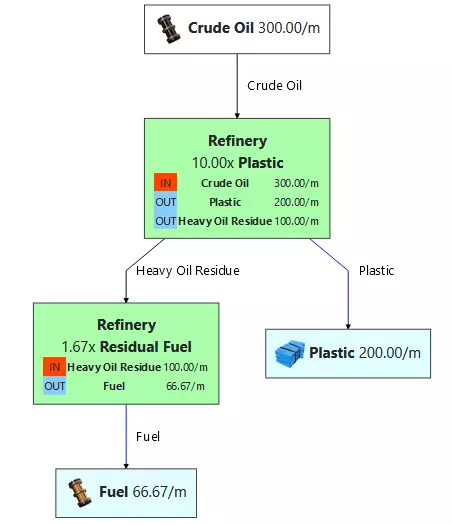
使用塑料制造重质油残渣
3. 使用重油残渣的替代配方。*2
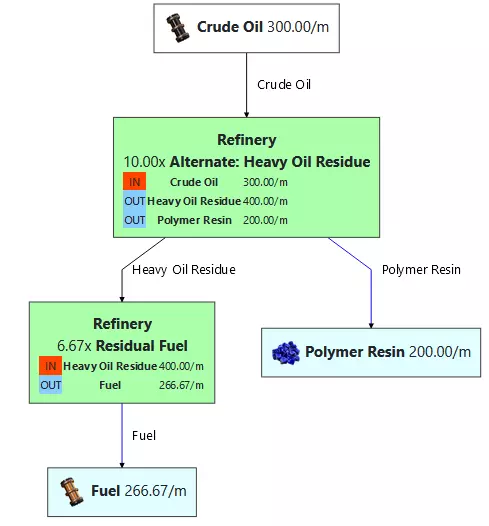
为什么橡胶的产量比塑料高?这是因为标准的橡胶配方能产出两倍的重油残渣。 这种使用重油残渣替代配方的方法,也是游戏中一个规模更大、更复杂的链条的一部分,该链条被认为是石油最高效的利用方式。 让这些方法奏效的关键在于确保所有物料持续流动。不能让塑料积压,否则燃料生产会中断;也不能让重油残渣积压,否则塑料生产会中断。你需要想办法使用【AWESOME 回收站】,或许还可以在残油精炼厂的末端设置一个石油焦精炼厂,以确保不会有任何物料积压。 高级燃料生产 在上一节“制作燃料”中,我们讨论了生产燃料的基本方法。接下来我们将探讨更高级的方法。 由于这些方法较为高级,我会使用更多的液体量,适用于Mk2管道。 关于为何管道内流体总量不超过400立方米,请参见下方的免责声明。 稀释包装燃料 第一种高级方法需要一些替代配方才能发挥作用。 重油残渣替代配方 稀释包装燃料 此图表展示了完整流程:
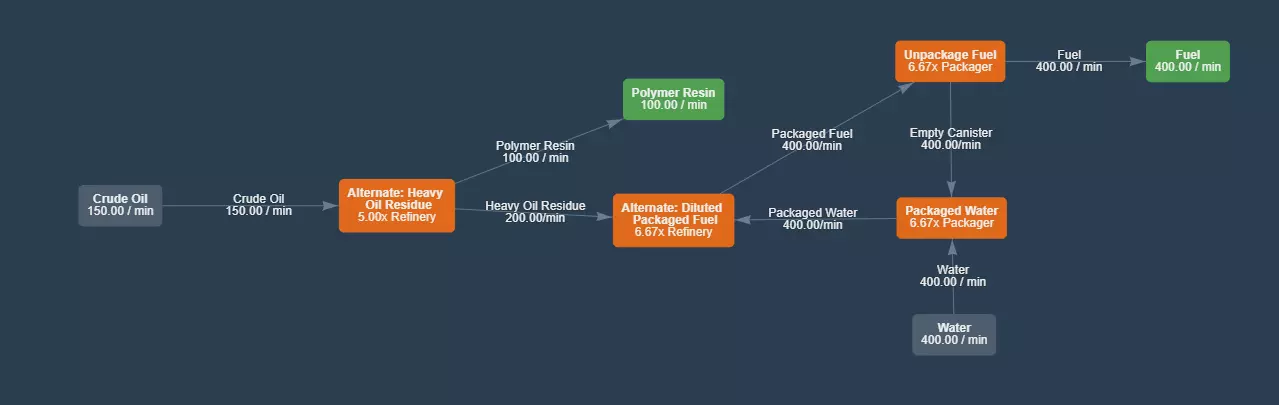
如你所见,与更基础的燃料生产装置相比,此流程的复杂度显著提升。其主要优势在于石油利用率更高——仅需150立方米石油即可生产400立方米燃料。 下面将其分解为可管理的步骤: 1. 搭建重油残渣精炼厂 这应是你要进行的第一步。
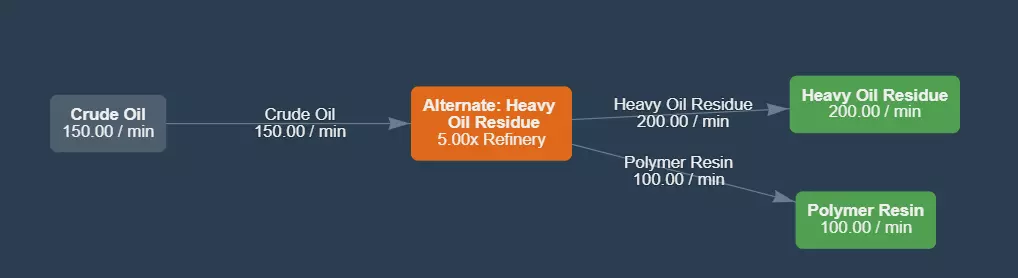
此步骤将生成两种最终产物:重油残渣和聚合物树脂。 聚合物树脂有多种用途。如果你解锁了【聚合物织物替代配方】,可以用该配方制作过滤器所需的织物。你也可以将其用于【残余塑料】或【残余橡胶】配方。如果你不打算对树脂进行任何处理,仍需以某种方式处理掉它。最后的选择是放置【超级回收机】来清除树脂。无论如何,你都必须对树脂进行处理。 2. 设置稀释包装燃料循环 稀释包装燃料顾名思义会生成包装燃料。要启动此流程,你需要包装水。包装水需要空罐和液态水。为获取所需的容器,最好现场制造并放入工业存储容器中。你需要几千个空容器。一旦整个稀释包装燃料流程开始运行,你需要让这些容器循环使用。流程为:容器进入包装水打包机 > 进入稀释包装燃料精炼厂 > 进入拆包燃料打包机,之后空容器会循环回到水打包机。当空容器返回包装水机器时,最好放置一个存储缓冲装置。 3. 输送液体燃料 燃料生产出来并呈液态后,你就可以通过管道将其输送到燃料发电机。 编辑说明 编辑1 - 仅做简单结构调整,无内容变更。编辑2 - 新增未来计划部分 编辑3 - 开始添加煤炭发电信息 编辑4 - 煤炭发电部分完成 编辑5 - 添加了用户在评论区提出的问题 编辑6 - 添加了额外的水图表,其中一个来自Discord社区成员,该成员参与编写官方维基 编辑7 - 开始撰写燃料发电机部分 编辑8 - 清理了部分内容,并修改了一些关于二级管道的描述 编辑9 - 根据更新4的变化编辑了内容 编辑10 - 编辑了指南中的链接 编辑11 - 新增资源部分