
 换一换
换一换 


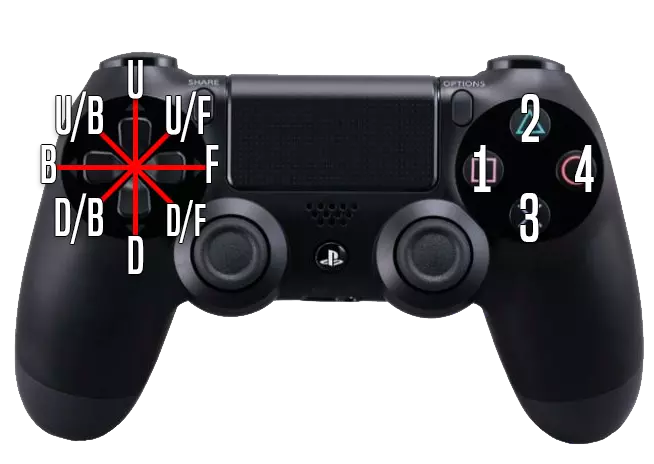
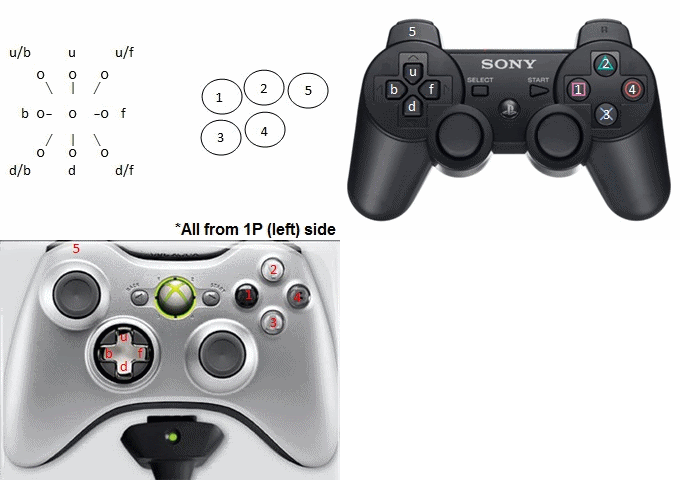
虽然内容有点长,但主要是因为我尽量用简单的语言解释了所有内容。而且这里提到的大部分内容适用于所有格斗游戏,所以基本上你能学到如何在任何一款格斗游戏中变得厉害。 试着学习,而不是为了赢 如果你是《铁拳》新手,你必须明白,有些人已经玩这个系列整整20年了。 还有些人玩了10年、5年、2年,甚至玩了半年的人对新手来说都是很强劲的对手。所以,基本上不要指望刚安装游戏第二天就能赢很多。相反,要专注于比赛中的收获。 你成功格挡了——很好。 你认出了对手的招式并且知道它的作用——很好。你要记住,当对手生命值降至25%时会拥有【rage art】(怒气爆发),这时就不要再胡乱按按钮了——这样做会更好。 这些小的成功会帮助你赢得一局乃至整场比赛。所以在比赛中,专注于做出一些小的操作。无论最终输赢,都要在每一场比赛中尝试学到一些东西。 大胡子男人也这么认为。 顺便说一下,这就是职业玩家的心态——他们不刻意追求胜利,而是寻求游戏知识,胜利只是运用这些知识后的结果。所以,去学习游戏吧,这才是你获得胜利的方法。 角色选择 不要想得太复杂,选你喜欢的角色就好。可能需要几周时间才能从玩法上理解一个角色。所以选一个角色,学习他的招式,然后再考虑你是否喜欢这个角色。 人们经常问角色强度排名。但首先,强度排名只对职业玩家有意义,他们能发挥角色约100%的潜力。新手玩家无法发挥角色100%的潜力,所以强度排名对他们来说不重要。 另一个问题是哪个角色最简单。问题在于,“简单”的角色往往意味着靠反复使用一个特定招式就能击败对手。如果你选择了这种“简单”的角色,很快就会遇到能破解这个特定招式的玩家,到那时你将毫无还手之力,除非你学会该角色的所有招式。 所以,既然你需要了解你所选角色的众多招式,那么这个角色是否有某种新手杀手招式其实并不重要。你要击败的不只是新手玩家,还有经验丰富的老手,对吧? 所以,选择你喜欢的角色,每天投入一些时间(比如至少20分钟),一点点去了解这个角色,他就会成为你最擅长的角色。 不过,如果你只是想找一个能轻松获胜的角色,且不介意其外观或玩法风格,那就选一个不太常用的角色。低中段位的玩家通常记不住一些冷门角色的很多招式,这会给你带来优势。这类角色可能有Youshi、Jack、Gigas、Bob、Kuma、Panda。 但最终选择完全取决于你,这些角色都很厉害。移动 别忘了,这是一款3D格斗游戏,你可以侧移、后移、蹲伏、跳跃。移动能让你躲避即使是非常强力且格挡后无法确反的攻击并进行反击。 游戏中的许多招式可以被侧移躲避,但在招式列表中标记有蓝色图标的招式无法被侧移躲避。如果对手经常侧移,就使用这些招式。 dfbu1234 在每篇《铁拳》攻略中,你都会看到最常用按钮的相同名称: d = 下 f = 前 b = 后 d/f = 下+前 等 qcf = 前半圆(四分之一圆前) qcb = 后半圆(四分之一圆后) hcf/hcb = 前半圆(二分之一圆前)/后半圆(二分之一圆后) 1 = 方块键(PS4手柄) 2 = 三角键 3 = X键 4 = O键 5 = 《铁拳7》中未使用(这是《铁拳TT2》的按键,直接忽略即可)
Attack levels There are 3 of them – high, mid and low. High attacks usually fast, long and/or do lots of damage, but if character stands in a block, he will block a high attack, if he sits, a high attack will miss, so they hard to land. Mid attacks usually a bit slower and shorter than high, but there are a lot of launchers among them, and they penetrate sitting block. Launchers can lead to powerful juggle combos, so the main block in Tekken is standing block, which protects from mid attacks. Low attacks often use as poke – they can deal damage to a standing opponent and make him want to do something besides standing and blocking. Also, check this guide http://web.tekken-net.org/tk7/images_lang/english/common/pdf/torikore.pdf Throws Another way to prevent your opponent from standing and blocking is to throw him. You can find all throws your character have in a move list.Every character has at least 3 of them with 1+3 and 2+4 - they do 35 damage and can have extended range by pressing forward, also they do more damage if you catch enemy from side or back. They may be interrupted by pressing 1 and 2 accordingly. Also, each character has 1+2 (and some direction) throw, it deals 40 damage from a front and more from sides or back, can not be extended and can be interrupted with 1+2. King throw break Attack range It is important to know the exact range of your attacks. Don’t use long range attack when an opponent is close to you. Also think, how opponent moves, if he moves away, he tries to make you whiff your attack. If he comes to you, you may use your attack even if opponent not yet in range, he will come in range by himself. If you don't know your attack range https://www.youtube.com/watch?v=hyGoTLy5qw4 And BTW - top 15 moves to every character https://drunkardshade.com/2017/05/27/tekken-7-top-15-moves-for-all-characters/ Frame data If you don't know what on Earth frame data is, watch this video. https://www.youtube.com/watch?v=45Iqxq9svZQ watch it either way, it's good. and this https://www.youtube.com/watch?v=JwQ8J8iAOLs You can check frame data here http://rbnorway.org/t7-frame-data/ and here http://poorvin.com/t7.txt and here on steam http://steamcommunity.com/sharedfiles/filedetails/?id=938186839 It is important to know how fast or slow each of your attack is. Don’t use slow attack when an enemy can beat it with his fast attack. Also, you must know how much – frames each of your attack is on a block. Don’t spam attack which has a lot if – frames on block or whiff. Also, you may use an attack which + on block more often. Almost any attack have + frames on hit. So if you received damage, no matter, how small, you probably on frame disadvantage and it may be wise not to attack after you receive damage, wait a bit, to block or dodge something and get frame advantage, then it’s your turn to attack. Also, learn your punishers – which attack you can use to punish opponent Your hitbox during attacks Many attacks in Tekken makes your character crouch, jump or deviate back. These attack may allow you to dodge enemy attack (jump vs low attack, crouch vs high, deviate may help vs mid). So attacks which make your character reduce his hitbox somehow definitely good for attacking an opponent. https://www.youtube.com/watch?v=jwzOqBvvgaE Launchers Launchers – attacks which make your opponent fly, or stun him. After that attacks you can do juggle combo. You may find them in frame data http://rbnorway.org/t7-frame-data/ they marked as "Launch" in "Hit frame" section. "Hidden" launchers - some attacks of your character become launchers on counter hit. Which is definitely good since there are more options to do juggle combo for you. You may find them in frame data http://rbnorway.org/t7-frame-data/ they marked as "Launch" in "Counter hit frame" section. Counter hit launchers are often easier to land so make sure you know which attack of your character launches on counter hit and learn, how to follow up it with a combo. The game has screw attacks (marked green in a move list and "Tail spin" in frame data list), they allow you to extend juggle combo by landing another attack after you land a screw attack. Simple juggle combo may look like this: Launcher - screw attack - combo finisher a bit more complicated version launcher - some attack - screw attack - dash forward - combo finisher for example https://www.youtube.com/watch?v=uAYrM2wYp7U&index=1&t=301s&list=LLXz3JIFJwNZSKXvx7WuQmlw Combo finisher may be almost any attack your character have and even Rage Art. Doing Rage Art as combo finisher is a good way to deal huge damage without big risk, so learn, how to do it in a practice mode. Launcher - screw attack - Rage Art example https://gaming.youtube.com/watch?v=VSO8BwNn-P4&feature=share You may invent your own juggle combos or find it in move list or in character guides. Just create some easy sequence which you personally like to do, it may be even just 2 same move strings. If it deals something about 50 damage, it's great for a start. Later you may want to extend this combo when you get familiar with juggle concept. Simple combos ideas are here https://www.youtube.com/playlist?list=PLeEk_GDSnydYwPax0IATKf_x5WXYKTwBc Landing a launcher may be a tricky task because many of them are punishable if blocked (but some not launcher punishable). Usually, you want to make opponent whiff (by back step or side step) to land a launcher. Some launchers are also made your character jump, or crouch, which can be used if you expect a low or high attack from an opponent. Fast launchers can be used as punishers. Doing launchers and juggle combos definitely will help you to win more matches. Learn, how you can land each of your launchers, and follow them with combo each time. Chain attacks Often what you may find in character's move list is not a true combo. Mean opponent may block last attack even if first and second hits. These move sequences are good for tricking your opponent, instead of finishing that chain attack, you may stop and do something else – throw, or some another move. Next time you may finish that attack and surprise your opponent by that. To determine which move is true combo and what is not, in practice mode set opponent on "CPU action 2 guard all". Many of move strings become true combo on counter. You can also check this in practice by choosing "counter" option in settings. https://www.youtube.com/watch?v=KbtwQxNQfxY&t=521s Punishment When you block or dodge (duck, sidestep, backstep e.t.c) opponent's attack you often can punish him with your attack.

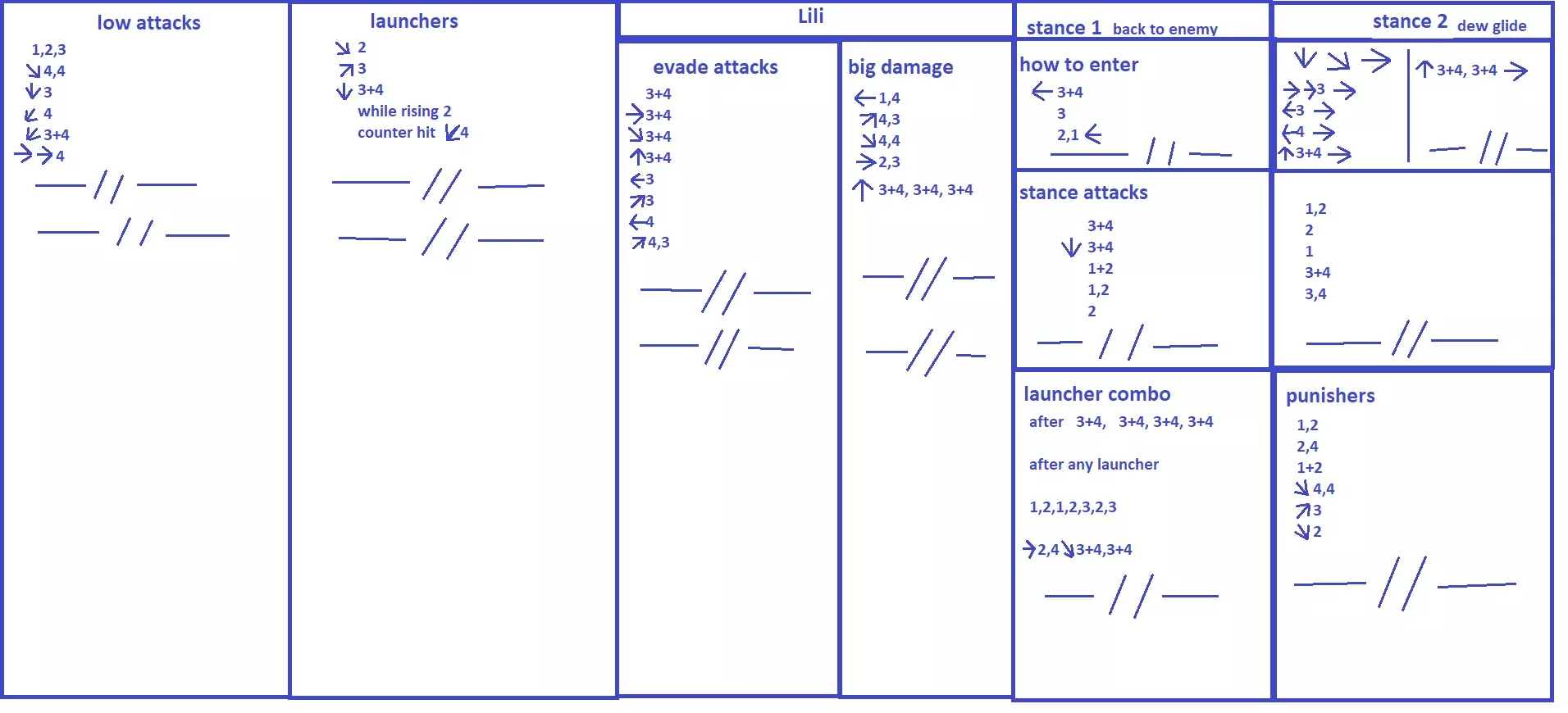
Punishers a reliable source of damage, sometimes you can beat opponents only by doing punishers, so it better understand, how to do it properly. First of all, you must understand which attacks can be used as punishers. They should be fast and they should be true combos or launchers. Just check your move list and find all 10 frames attacks which of 10 frames attacks deals most unblockable damage will be your fastest punisher. Do the same thing for 12 and 14 frame attacks. You may also watch some pro player's gameplay to determine what best punishers in each situation. Learn which fastest launcher your character have. Many characters have 15 frame launchers (for example up/forward+3). A launcher is always a great punisher (if you do juggle combo after it of course). So learn your second fastest punisher, maybe you even can use it. So let's review situation from worst to best 1) Opponent hit you with an attack which is plus frames on block. He can not be punished because he will start acting faster than you. Gladly each character has very few attacks like this. Most Attacks are minus frames on block and give you an opportunity to start acting faster. If you tried to punish opponent with your 10 frames punisher and still got hit - that attack you blocked was + on block. 2) Opponent hit you with an attack which has a small minus (-1 to -9) on block. You still can not punish him even with your fastest 10 frames punisher. But he lost initiative and probably will block. So you may try to throw him. That is not 100% reliable punisher, because your opponent may duck or jumb and beat your throw. So if throw works do it again (but another one) if it not, do something else, maybe some safe attack string. 3) Opponent hit you with an attack which has a big minus (-10 and more) on block. Time to punish him with punisher moves you found earlier. But how to determine which exactly punisher to use 10 frames, 12 or, 14 or, launcher. I recommend you try to use your fastest 10 frames punisher, if it works that mean this attack you blocked has a big minus on block. Next time try your fastest launcher. Remember which attacks can be punished and always punish them. 4) Some attacks can put you in crouch state, even if you block them. Learn your fastest while rising attacks to punish that. 5) Some attacks can push you far away (with Rage Art for example), or your opponent whiff attack far away from you. Learn your fastest long range attack to punish that. 6) Your opponent whiffs something while he was close to you (you sidestepped or ducked for example). It usually best situation for you, try to launch punish. https://www.youtube.com/watch?v=hMo10Enhojw Footsies Footsies is what you probably will do most of the match, so let's discuss them in details. First of all, there is a specific mindset of beginner players who want to run to an opponent and attack him as fast as possible. That is the wrongest thing you can ever do in Tekken. Your opponent can easily start some slow long range attack and you run into it. And even if you came close to an opponent, what next? He can counter every attack you may use just by chance. You decide to use a fast high attack, and opponent just by chance decide to duck, and you will miss. Or you going to use mid attack and opponent randomly may use faster high attach and you loose that clash again. Any your attack can be countered just by pure opponent's luck. Or maybe you get lucky and your attack will win. Good players will not leave everything to luck, so they never attempt to get close to an enemy if only their character is not much stronger that opponent's in close range. Good players will play footsies by staying at some range away from an opponent and try to bait or punish him on skill. Another very common behavior pattern of a beginner (and even some of experienced) players is constant backing up. By doing that, players trying to provoke an opponent to run into them to do that slow long range attack. That simple strategy can work sometimes, but it has its own big weaknesses. First of all, if there are walls in an arena, player, who constantly backing up will soon come to that wall and become a very easy target since he can not even do simple back dash anymore. Other problem if an opponent of that retreating player can walk into attack range and that walk back, the retreating player probably whiff his attack and get punished for that. So in simple terms, footsies is a combination of attacking and retreating strategy, when players not just attack and not just retreat, but switching between attack and retreat very fast many times per round. This strategy is so effective so every pro player in the world use it. And if you can do footsies even on a very simple level, you will be able to defeat much more players, than without that strategy. Watch this video, it about another game, but concept is the same https://www.youtube.com/watch?v=FQQCan5oo90 Let's watch some high-level gameplay https://www.youtube.com/watch?v=ZB0I9E0aFI8 You may see, how opponents are often staying on big distance from each other, they sometimes come closer and then come further way again. You may do footsies to 1) make opponent use some attack and whiff, then punish him. 2) use safe long range mid or low attack to deal some damage from a safe distance (it called "poke"). 3) use some long range launcher (or attack which launches on counter hit) and do a combo if it lands, and block or back dash if it's not (it called "fishing"). 4) attack in an unpredictable moment by suddenly dashing forward or use a move which moves you forward. Even if you love to rush down to opponent's face it will have much better results, if you do that in an unexpected moment after some footsies. There are many things you may do during footsies - bait attacks by going in and out opponent's attack range, throw your long pokes, attack suddenly e.t.c. Your options depend on which character do you playing, so just watch some pro gameplay and try to figure out which good options do you have during footsies. Spammers (Practice mode) People often ask, how to deal with spammers. Most simple way - go in training mode, make CPU do that attack with which you have a problem and find a way how your character can deal with it. First of all, if there is a high attack, just duck and punish. If there is low, also duck and punish or do low counter (down+forward) and punish. Try to sidestep and punish. Also, try to block and punish. Another option - do some long attack to prevent opponent come in close range to do his spam move. Anyway, defensive training looks like this https://www.youtube.com/watch?v=4n9NBQAP6rA https://www.youtube.com/watch?v=5ziXRFVH5w8 https://www.youtube.com/watch?v=-uqly_PGILs Button mapping Tekken have 4 buttons called 1, 2, 3, 4 = square, triangle, X. O on PS4 controller. I recommend to mapp 1+2 and 3+4 combination on R1 and R2. These combinations are very important and can be used in many ways, so they deserve separate buttons. You not only can do 1+2 moves with 1 button but also combination like down 1, 2, forward 3,4 by just down R1, R1, forward R2, R2. Test yourselves which move chains can be done with these mapped buttons, you will find a lot of them. Remember every move of your character So now you may more or less figure out in what situation every attack of your character can be used. Now time to remember all these attacks, so you can use them in battle freely. I recommend you take several pieces of paper and write down all attack your character have, so you can have them before your eyes all time. Divide pieces of paper on several categories like - low attacks, launchers, attacks which make your character jump/crouch/deviate, strong attacks. Also, you may write down all stances, how to enter them and which attacks can be performed from these stances. Write down fast attacks wich can be used as punishers, pokes, juggle combos and any attack you found interesting. In the end, your writing may look like this (that is for ttt2)
起身 当对手处于起身状态时,你仍然可以对其进行攻击。你可以使用一些中/下段攻击,跳过他的下段攻击,后 dash 来让他的起身攻击落空,惩罚他的后滚等。 如果你在地面上,确保你了解你的角色拥有的所有动作。这类动作有很多,你可以在视频网站或论坛上查询,例如相关的系统起身和论坛讨论内容。 另外,也可以观看相关的教学视频。 通用策略 你可能需要观看你所选角色的指南并观看一些回放。寻找通用的策略指南,而不仅仅是连招指南(如果你已经掌握了不错的连招)。即使是《铁拳TT2》和《铁拳6》的旧指南也可以,前提是你找不到《铁拳7》中你所使用角色的策略指南。 首先,如果你的角色不擅长近距离作战,不要太靠近对手,与对手进行立回并等待合适的进攻机会。 找出你的角色拥有的“高伤害攻击”。它可能是一个起手技、某种落地连招或指令投。思考对手需要做出什么动作,你才能使出这个攻击。例如,如果你的高伤害攻击是中段攻击——你需要让对手挥空或蹲防。要让对手挥空,可以使用后跳、侧移、蹲防或跳跃。要让对手蹲防,可以使用下段攻击。或者以低攻击结束的连招,但如果对手蹲下,就不要使用那个低攻击,而是改用你的【中段攻击】。你可以为游戏中的任何攻击设计一些起手方式。 如果你打算先发起攻击,不要直接冲向对手,保持一定距离,让对手无法准确判断你何时会发动攻击。攻击时,使用能让角色蹲下、跳跃或侧移的招式,这将降低你在攻击过程中被击中的几率。或者使用难以被反击的远程攻击。 如果你格挡了对方的攻击,尝试进行反击。 如果对手处于站立格挡状态,使用低攻击或投技。 受到伤害后不要立即攻击,稍等片刻。尝试通过使用难以被反击的快速攻击和【格挡有利攻击】来创造帧数优势。利用未完成的攻击链迷惑敌人。在立回过程中,通过制造破绽或诱骗对手空挥,尝试衔接你的高伤害攻击(起手技、 counter hit 起手技或确反连招)。
Play online and learn, what works and what don’t in different matchups. Learn to read opponent’s habits and strategy. Remember, when you receive damage and try to avoid these situations. Notice when you deal damage you may want to these actions again, but be ready that opponent will adjust his gameplay. Have fun. Some random stuff http://www.tekkenzaibatsu.com/wiki/Tekken_Tag_Tournament_2/System/Forward_Dash_and_Running Forward Dash Forward Dashing, done by doing f~n~F (tap and holding forward, abbreviated as ff), lets you do a quick dash toward your opponent. It covers a pretty large space for its speed, and depending on how long you hold the F, you can go for a short dash, or a forward dash's maximum length. Not only is it quick, it also has a different set of attacks available to each character. Most of them are pretty damaging. However, a problem can arise, especially with new players, that when they discover forward dashing and its attacks, they tend to do them every time, even when they are up-close. Then they usually end up eating jabs or even slower, damaging attacks. Remember that when you are forward dashing, you cannot block, so usually, it's ill-advised to dash if you are too close to your opponent. In forward dashing, it's important to always gauge your range. Remember, it's used to get close to your opponent, so why do it when you're already close? As long as you are using forward dash in the right place at the right time, there should be no problem. Running On the other hand, when you are far away from your opponent (out of forward dash's range), inputting ff will make your character run instead. This is called While Running status (abbreviated as WR). When running, you obviously are approaching your opponent at a fast rate. In the same way, you can't block attacks when your character is running, but holding B will cancel WR quickly, making your character stop and block. But what makes WR essential is the attacks you can use from it, as usually, they are pretty damaging and have special properties with it. Many characters, like Dragunov, and the Kings have special moves coming out of WR, and the moves were so good that they became an essential part of their arsenal. The problem is that you won't always have the right amount of space to go to WR in a ff input. Many times, the distance between you and your opponent is only a forward dash range. For this, the game has allowed us to go to instant while running status (iWR) by triple-tapping foward (f~n~f~n~F, abbreviated as fff). Doing fff will let you do WR moves on a forward dash, even when you're in a small space. For characters such as those mentioned before, being able to do these moves forward dash range will be essential for them. The only problem is you need to quickly input the fff within a relatively small timeframe, or it won't work. So, it's a good idea to train your fingers to execute iWR as consistently as you can. WR Attacks (While Running) There are several attacks every character shares when they are in a WR state, and many of them can only be done after a specific number of steps your character runs. So, the farther you are running, the more options you have available. To summarize, these are the usual options you are presented with when in WR status. --During 3 steps of the run, you will be able to do: WR 3 slash kick (hits mid, KND's, blockstun) and your character specific iWR moves. --After 3 steps of the run, you will be able to do: WR 1+2 cross dive (hits mid, long range, KND's, safe) WR 4 low slide (hits low, KND's, recovers grounded) A takedown tackle for standing and crouching opponents, and a trample stomp when you don't stop running --After 4 steps of the run, instead of the takedown tackle, you will be able to do a unblockable shoulder ram on standing and crouching opponents. http://www.tekkenzaibatsu.com/wiki/Tekken_Tag_Tournament_2/System/Backflips_and_Wall_Jumps Backflips (every character except for Akuma and Elisa) Just like crouchdashes and sways, the Backflip, inputted by ub~b, is a special movement that dodges certain attacks. It makes your character dodge low attacks while moving backward, giving you that needed space. It isn't technically invulnerable to high and mid attacks, but since it goes backwards, many short-ranged attacks will miss. This move can be as valuable as a backdash, 'cause even though you can't block, the evasive properties of this movement and distance it covers makes it worthwhile to do often. You can do backflips especially when your opponent is a bit close to you and pressuring you with pokes, as most of the time, backflips can evade them, and even if you get hit, you won't get floated for a big juggle, making it a low to medium-risk move. Sadly, just like crouchdashes, this isn't available to every single character. Wall Jumps Have you ever been in situations where you're between your opponent and a wall? More often than not, you're gonna be. Having a wall to your back can be disadvantageous to you, since there is no way you can back away from your opponent. In addition to this, everything your opponent can do may be doubly rewarded because walls often allow for more nastier combos. Fortunately, there are ways to turn this from disadvantage to advantage. Depending on your character, there are moves that capitalize on having a wall to your back. One of those moves are wall jumps. Wall Jumps, accessed by doing b~b~UB, makes your character (every character except for Akuma and Elisa) climb quickly to the wall (and evade attacks) then do a specific attack when falling. These attacks depend on which character you're using. Most of the time, the attack can either be a: overhead punch (gives blockstun on block, juggles on hit) leap kick (pushback on block, knockdown on hit) front kick (force crouch on block, knockdowns on hit) backflips (knockdowns on hit and can jump over opponent, putting you on his/her/its back) or some character specific wall jump attack. When climbing, you are immune to attacks, but when falling you are in a vulnerable "jump status", which can get you floated for a juggle if your opponent anticipates this. So there is some sort of risk. But even then, wall jumps can be a nasty surprise move that's worth doing from time to time, especially for players who rely on evasion and trickery, as usually, you can turn the tide of battle with it. https://www.youtube.com/watch?v=WTf7eIwP4wg&feature=youtu.be