
 换一换
换一换 




城市物流核心游戏机制说明 简介 各位新手玩家们,欢迎来到物流速成课程。本指南将探讨城市物流的各个方面,解释相关概念和功能,并提供一些游戏机制的技巧与窍门。请注意,本指南不涉及仓库等设施的具体布局,而是作为理解该系统的通用指导。 物流工人的工作内容 需要重点注意的是,几乎所有物流工人(除了装载站工人)的工作内容都相同:【从其他地方搬运物资到自己的工作地点】。他们不会将物资分配到其他地方。仓库X可以从仓库Y获取资源,但这完全是仓库X工人的职责。这不仅仅关乎存储 你可能会想,当然,我会建造一个全局木材仓库,任何需要木材的工坊或其他设施都可以自行取用。然后对所有其他资源也照此办理,将仓库建在生产资源的建筑附近。我的意思是,如果你再建一个仓库来转移物品,仍然需要有人一路搬运这些东西,那么何必多此一举呢? 这种逻辑的错误在于一个关键原因:非物流工人的携带容量只有4,而搬运工的携带容量则为8到12(取决于种族,当然,我显然没算上唱诗班)。此外,还有一项科技可以提升搬运工的携带容量,这使得两者的差距进一步扩大(最多可再增加10)。因此,让工人直接进行长距离运输的效率至少低2-3倍(在游戏后期科技下,最坏情况下甚至低5倍)。 这一逻辑同样适用于资源分配建筑,市场/食品摊位的工人不算作搬运工。清洁工也是如此。 种族差异 如果你是一名贫穷的克雷托尼亚人,你可能会立刻反驳——但所有种族都是平等的!你不能说有些种族在这方面更差!非常抱歉,但不幸的是,事实并非如此,物流工作并不适合所有人。 不过别担心,因为有个好消息——克雷托尼亚人并不是最差的! 种族 容量 速度 容量*速度 最大科技容量 最大科技容量*速度 阿格诺什 49 36 141 26 坎托 18 4.95 89.1 28 138.6 克雷托尼亚 10 4.5452090 Dondorian 124.5542299 Garithmi 106.36320126 Human 84.5361881 Amevian 84.5361881 Tilapi 86.350.418113.4 你或许应该主要关注【容量*速度】这一列,相信我,研发最高科技在优先级中还非常遥远。不要把它当作唯一的真理来源,无论是规模还是速度也并非总是最重要的,你懂我的意思。任何人都能处理好后勤,只是有些人更具优势。 奴隶制后勤 是的,我知道你在想什么,但先别急,事情并不像听起来那么糟糕,奴隶制只有在被恶意使用时才是邪恶的! 当你生活在一个多种族城市时,意外可能会发生。一位克里托尼亚同胞遭到蒂拉皮人的误解,并遭到毒打!斗殴甚至可能导致可怜市民的死亡。即便你在城市中实行种族隔离,某些类型的工人也不得不穿过一些黑暗的小巷,天知道会发生什么。 还有谁会比负责后勤的人更需要穿过黑暗小巷呢?仓库工人、食品市场和其他服务性建筑必须遍布各处,我们总不能让来自较差社区的人们挨饿吧? 但奴隶们从不参与斗殴!即便是蒂拉皮人,看到这些可怜的被奴役者尽职尽责时,也会心软。所以你看,这是战略性的奴隶制,是为了我们勇敢的后勤部门的福祉!工作量经验法则 如果你的后勤人员占总人口的5%~10%,可以认为是健康的。接近5%是最优状态,10%也在可接受范围内。 系统特点 在深入介绍特定建筑之前,我会先讨论后勤系统的主要特点,因为所有建筑基本都遵循相同的规则。仓库具备所有这些特点,而其他建筑仅使用其中部分功能来完成其职责。
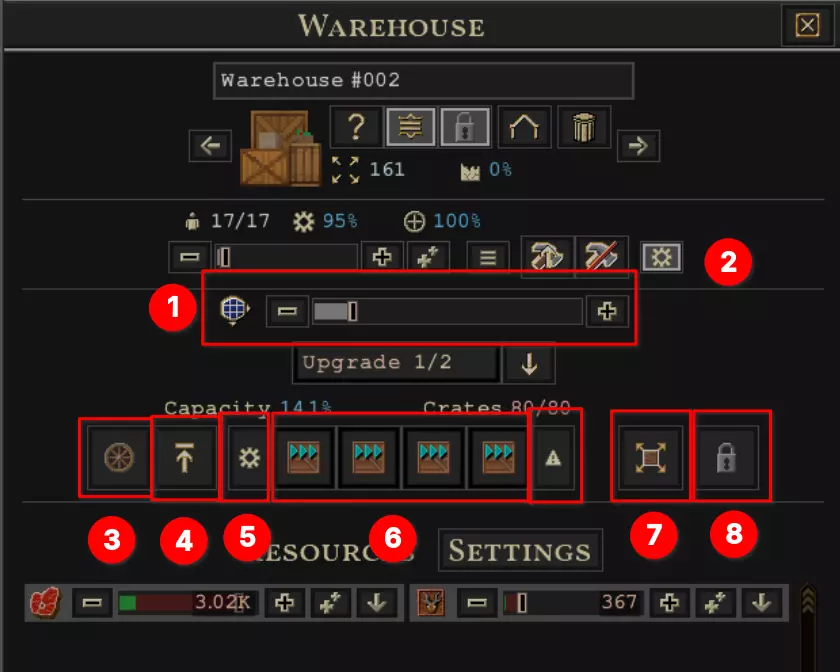
1. RadiusJust limits the range, from where workers are allowed to take resources from. 2. Automate employmentI recommend using it for all warehouses. The game measures current workload and adjusts employment on the fly. It's important to check on busy warehouses from time to time, you might notice that some warehouse automatically employs 50+ workers for example, which indicates a problem. Possibly some farms/workshops producing goods are too far away and fetching these resources is a huge strain. Or perhaps you have two hubs producing food that are far apart with their separate storage. In the first case, you should probably invest in another storage unit for a given resource. Both cases also call for reducing workers radius. Closer storage doesn't guarantee exclusivity, workers might try to fetch far away resources if not limited with radius. Another temporary reason might just be your manual order to cut down half the trees on the map, which will skyrocket wood storage employment, but this is probably what you want when you do it. 3. FetchFetch resources, enabled by default. Allows fetching from several sources: - items on the ground - workshop output storage - import depot - unloading station - hauler You likely want to have it enabled almost always in case of warehouses, unless when you set priority. 4. PrioritizeBy default warehouses are non-prioritized. Setting it to prioritize basically means "this warehouse can take resources from other (non-prioritized) warehouses". You may want it in the following example scenario: 1. You have woodcutters and dedicated wood storage. 2. In another place you have farms and dedicated grain storage. 3. In a third place you want to build a bakery hub, but this is a bit far from the first two. In this case, you build third warehouse, set its resources to wood, grain, possibly bread as an output good of bakeries too. Then you switch it to prioritize and warehouse workers will fetch input goods and collect output goods. Another scenario might be when your city becomes larger and uses wide variety of resources. For example your janitor now needs wood, stone, furniture, iron, tools and so on. Every single part is produced somewhere else. You can throw down a small warehouse with minimal storage for all these resources and set it to prioritize - now they will collect these resources from around the map and nearby janitors will go to them. Note: at some point this role should probably be replaced with loading stations. It can be a good idea to disable fetching when using it - if this is a far away warehouse where you want regular deliveries of wood for example. This will prevent a situation, where hauler goes through the entire map and instead of taking his full capacity of wood from warehouse, he will take just 2 units, because it just so happened, that 2 units were placed at nearby woodcutter output. 5. Auto-set pull sourceThis sets the pull source(6) automatically for up to 4 closest sources. I basically never use it, when I pull stuff I only do it myself. 6. Pull sourceFetch resource from another logistic hub. Normally you'd use it with fetch(3) off, when you want to pull only from a specific target - up to four of those at most per facility. When you click on the icon again after setting a target you can put a % limit for fetch. Setting this to 15% basically means: "fetch from storage X when it is at least 15% filled". You can use it with warehouses, for example when you only want to fetch wood for carpenters warehouse if at least 10% wood is available in main storage. This won't stop carpenters from trying to get it, but it will slow down the rate when supply is short. The main use case is for export depots though. When you sell stuff normally you put them next to a main warehouse for a specific good, set a limit and let it go. 7. Pullers(info-only)Shows the list of facilities that pull from this warehouse. 8. StoringLocks warehouse. Only manual prioritize(4) and pull source(6) from other facilities can take from it, nobody else is allowed to do it. I honestly never had a proper use case for it, but if you want it, it's possible. Warehouse The most basic and essential element in your logistics, used for storage of your resources and probably your default solution to most logistic problems. Use all the features discussed above for: storage, distribution to other parts of the city. Unique: resources in warehouse decay 2 times slower. Export depot Use for trade to sell. Disable fetch(3), disable prioritize(4). Use pull source(6) to set a trade, but remember to set a limit(by default it wants to export everything from target). Normally depots have global % limit for export, but this is problematic. Imagine the following scenario: 1. You have main tools warehouses with 5000 storage. 2. You have 5 distribution centers(for janitors or something) pulling tools from main warehouse, 500 storage each. 3. You set 20% global limit to export depot. What can(and eventually will) happen: since your total storage is 5000 + 5 * 500 = 7500, depot starts exporting at 1500. Three of your distribution centers get 500 tools each, two of them have none and any new production gets sold. In theory you can solve it by setting proper limit. Problem is - whenever you build a new warehouse fetching tools - the ratio shifts and might cause it to reappear. That is why it is important to set it to pull source and disable fetch(so it won't steal from the crafting facility directly). Import depot Use for trade to buy. Set resource, minimum price and it will come. It only accepts shipments that are dropped in its storage. It does not deliver resources anywhere, it has no workers. Other workers are responsible for collecting stuff from its storage and delivering it to their facility. Note: taxes from subjugated cities prioritize going to import depots. Hauler Functionally similar to a warehouse, but limited to a single resource and max 2 pull sources(6). It has 80 storage per empty square tile. Use ONLY for small scale deliveries if you want to save on space and when you don't care about spoilage(it doesn't halve spoil time like warehouse, items just lie on the ground). Examples: - metal and gems delivery directly under jeweler's door - jeweler uses comparatively trivial amount of resources and both of its inputs decay slowly. - paper to school Hauler is entirely optional, any hauler can be replaced with a small warehouse. Only use if you really want to save those few tiles of space. DO NOT build large versions of hauler, you basically get a facility the size of warehouse but without its benefits and with a smaller capacity. Loading/unloading station Functions as a HUGE scale resource delivery. They can use dozens of workers. Loading station acts almost identical to an export depot but it sends a resource within your city, not to the outside world plus it requires some work performed to pack the goods. The core logic is as follows: 1. Collect 400 units of given resource. 2. Send it to closest requesting unloading station, if none is requesting wait for it. 3. Go back to 1. Unloading station is likewise very similar to import depot, but there are some key differences: - it accepts only wagons from loading stations - it can accept more than one resource, even the smallest one accepting up to 8 crates of 400 cargo each - slots to accept goods need to be prepared, so it needs workers - it doesn't accept new packages, until at least one crate reserved for this resource is empty While these stations can sound scary, the logic here is also pretty simple: 1. Prepare delivery slots for resources. 2. Request and wait for delivery. 3. Wait for the resource in the slot to be taken. 4. Go back to 1. There is one crucial detail about both stations - the workers productivity increase with the amount of workers. 5 workers won't be 2 times slower than 10 workers, they will be much slower than that. They will get somewhat exponentially better the larger the scale is. As a result, it is better to make huge unloading stations accepting multiple resources from many loading stations. Consider the following scenario:
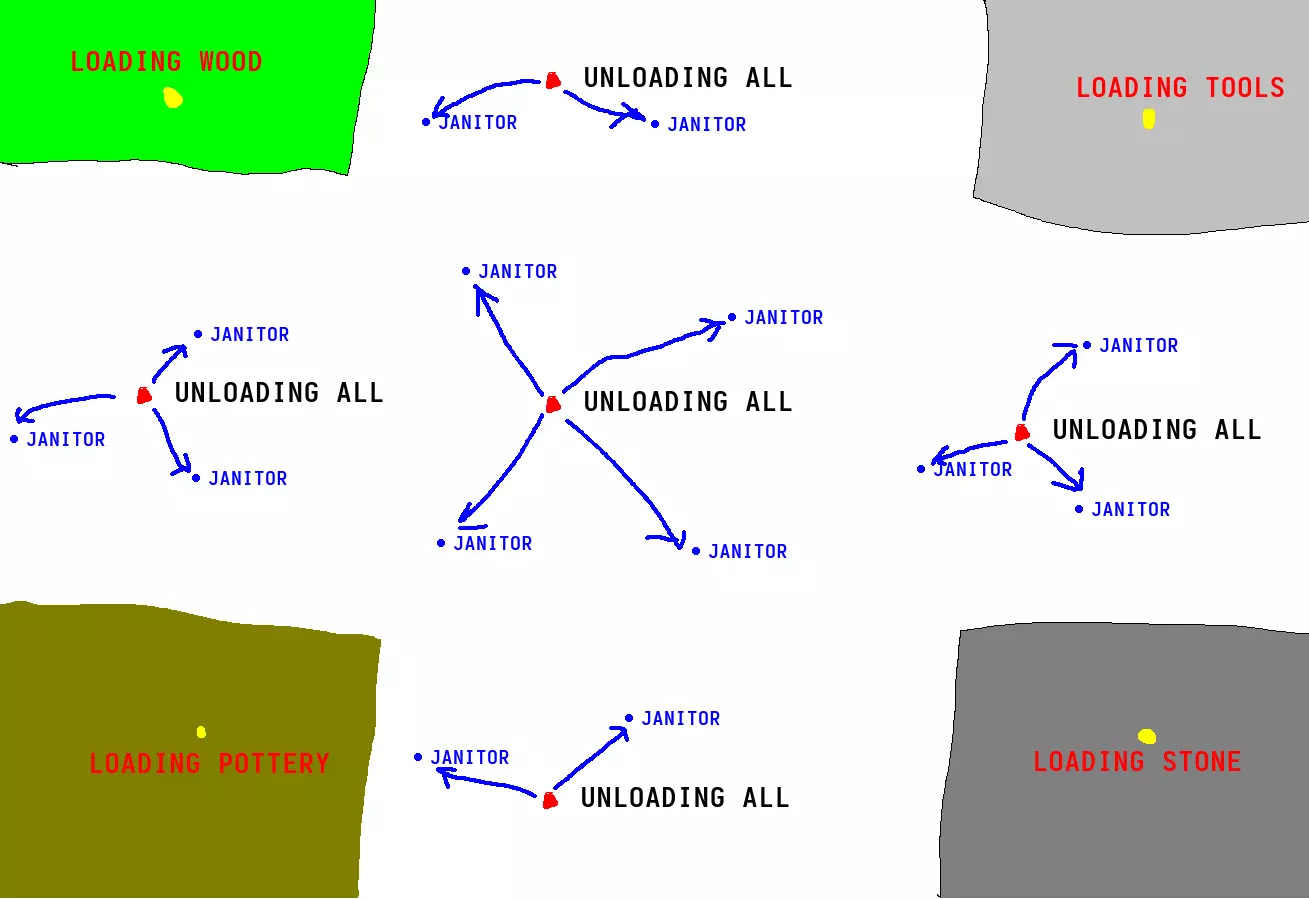
你为不同资源(木材、石材、陶器、工具)的大型生产中心设置了独立的装载站。所有5个卸载站都能接收每种资源(我省略了箭头,因为画出来会很混乱)。这样一来,所有消耗者(清洁工)都可以直接获取所需资源,无需走遍整个地图。 当你将卸载站建得更大,为清洁工集中导入所有物资、所有食物和家具到一个站点时,这种方式效果很好。所有人都可以直接从这里获取物资,不需要仓库,除非你想在这个位置储存更多数量的物资。需要注意的是,卸载站不像仓库那样有减少腐烂的效果,添加仓库并不会减少腐烂。卸货站会一直尝试被填满,并且上面总会有正在衰减的资源,所以只有在确实需要缓冲的情况下才添加一个。另一种情况可能是,当你需要将大量资源运输到很远的地方,达到每天数百甚至数千单位时——比如你需要将大量煤炭运输到冶炼和锻造区域。在游戏早期效率很低,但在人口达到约3000人后(如果操作得当,可能更早)会成为物流上的缓解。重要提示:使用车站时,确保它们从中获取资源的仓库是有范围限制的,否则可能会形成循环,即装载站从仓库获取资源,将其发送到卸货站,然后仓库派遣工人穿越半个地图去从卸货站获取资源。军队补给站 这是一种略有不同的后勤建筑,在游戏界面中属于不同类别,但运作规则与其他后勤建筑相同。其功能与仓库完全一致,但对所有玩家锁定,且会定期向全球地图上的己方军队输送资源。 如果需要运输食物、衣物、 armor、武器,这些资源可能存放在不同的仓库中——在这种情况下,最好建造多个专门用于一到两种资源的补给站,而非从整个地图调用资源。 零工 零工和没有可用工作量的受雇市民也会自动分配搬运任务。虽然不应依赖这一点,但如果发现无人值守的仓库被“神奇地”填满了,那就是他们的功劳。它们也会遵守仓库关于取货、范围等方面的规则。 常规工坊/市场 每个物流网络的最后一环都是消费者,而且现实情况是,消费者比较死板,不会听从安排。你无法缩小他们的活动范围,无法强制他们从特定仓库取货,也无法根据当前库存量来设置使用限制。 他们只会直接过来取货。如果距离很远,他们会浪费时间跑去取。如果村里最后一点谷物是用来开垦新田地的,他们也可能会拿去烤面包。你必须通过自己的物流系统来应对他们的这种“任性”行为。 幸运的是,对此还是有一些控制方法的。食品摊位和市场都可以设置为只获取特定资源:
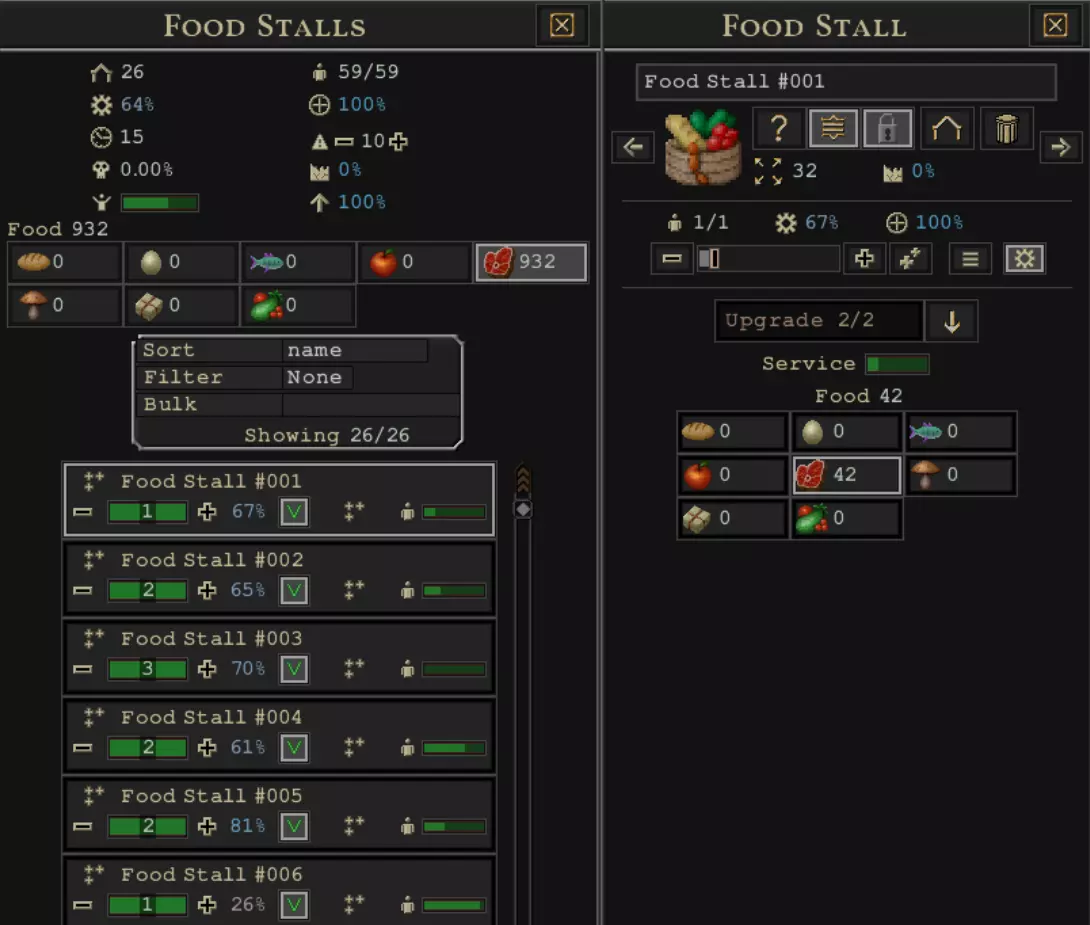
右侧用于设置当前选中市场的配置,左侧则是全局所有市场的通用设置。记得在游戏初期就进行设置,因为默认情况下市场会获取所有资源。在游戏早期,你可能只想向市民分配基础家具,而默认状态下市场会收集各种资源并摆上货架,即便这些资源不允许分发给任何人。 最后,希望这能帮助你理解这款游戏中物流系统的基本原理。这些知识都是我在游戏过程中不断摸索,并向他人请教后总结出来的。如果你发现任何错误,请告诉我,我会进行修正。