
 换一换
换一换 


本指南包含关于雇佣兵和任务的各种详细信息: - 雇佣兵概述 - 任务概述 - 经验值与升级 - 任务奖励计算 - 雇佣兵死亡系统 - 雇佣兵有限生命周期 - 雇佣兵复活的决定因素 1. 注意事项! 首先,建议阅读常见问题解答,其中包含游戏的基本问题解答(包括雇佣兵相关内容),本指南不再赘述。 其次,本指南提供的信息适用于未采取任何外部措施防止雇佣兵死亡的玩家,即假设为正常游戏流程,不包含任何可被视为作弊的行为。 雇佣兵招募 获取雇佣兵有四种方式: 加载0.版本的存档时,可获得一名免费雇佣兵。首次达到23级(或更高等级)时。 如果你的最后一名佣兵已阵亡,8小时后你将获得一名新佣兵。 成功完成招募任务可额外获得一名佣兵。 你可以花费40红宝石立即购买一名新佣兵。 只有当你拥有4名或更少的佣兵(包括正在进行的任务中可能获得的佣兵)时,选项3和4才可用。 佣兵加成类型 每名佣兵拥有以下加成类型之一: +任务红宝石获取量(百分比) +任务英雄之魂获取量(百分比) +任务金币获取量(百分比) +任务技能激活概率(百分比) +招募任务速度(百分比) +额外生命(免费复活次数) 与遗物类似,佣兵有不同的稀有度等级。稀有度决定了加成的幅度。 佣兵分配 加成类型和稀有度均为随机。以下是稀有度等级的奖励幅度和概率分布表: 稀有度 奖励幅度(b) 额外生命 概率 概率(分数) 普通 5%-6 - 72.4% 2500/4117 uncommon 7.5%(显示为8%) - 24.29% 1000/4117 rare 10% 1 9.716% 400/4117 epic 20% 2 3.643% 150/4417 fabled 50% 3 1.214% 50/4417 mythical 200% 4 0.304% 25/8234 legendary 500% 5 0.097% 4/4117 transcendent 2000% 6 0.012% 1/8234 2. 开始任务! 按任务时间(t)分类,共有10种不同的任务类型。 下表总结了这些类型。系数f用于计算任务奖励。较短任务的每秒奖励更高。 t t(天) t(天) f EXP 5分钟 0.003 1/288 3.2 0.35% 15分钟 0.01 1/96 2.75 1.04% 30分钟 0.021 1/48 2.5 2.08% 60分钟 0.042 1/24 2 4.17% 2小时 0.083 1/12 1.75 8.33% 4小时 0.167 1/6 1.5 16.67% 8小时 0.333 1/3 1.25 33%按奖励类型划分,共有6种可能的任务类型: 英雄之魂 红宝石 遗物 随机技能激活 金币 额外佣兵 圣诞礼物(2016年圣诞节季节性任务,礼物随机包含红宝石或遗物,以及一些其他无用物品,如布鲁普币。也可能有糖果手杖,它们非常有价值,因为你可以用它们复活佣兵,而不是使用红宝石。) 总共有46种不同的常规任务。 3. 升级! 获取经验值 佣兵完成任务后会升级。等级进度与任务时间成正比,与其他因素无关。累计24小时的任务时间等于升一级。 假设任务中的每一秒产生1点经验值。每次升级需要86400点经验值。

Technically, a Level Up happens at 99%. If you finish quests with a level 1 mercenary for 23h and 50 min (or 23h and 55 min), he will level up to level 2 with "-1% of the way to Lvl. 3". That still applies for version 0.25 onwards, but is now displayed as "0% of the way to Lvl. 3". Level benefitsThe level of the mercenary is a factor for calculating quest rewards. For example, a level 1 mercenary (Noob) will receive one Ruby from a 1-day-ruby-quest. That same mercenary will receive 7 rubies for the same quest at level 7. So quest rewards are growing linear with the level. 4. Quest reward calculation a) Ruby rewardsRuby gains through quests can be calculated using the following formula: r = (1+b) × m × t × f with r ... reward (rubies) b ... mercenary ruby bonus (example: b = 0.05 for a common mercenary with +5% rubies from quests) m ... mercenary level t ... quest time in days f ... quest factor (as in the table; chapter 2) So the quest reward for a 1-day-quest using a level 1 mercenary ("Noob") without a ruby bonus is 1 ruby. b) Relic rewardsRelic rewards basically follow the same formula as rubies. No mercenary bonus factor is required, as there are no mercenaries with such a bonus at the moment: r = m × t × f with r ... reward (relics) m ... mercenary level t ... quest time in days f ... quest factor (as in the table; chapter 2) c) Hero soul rewardsHero soul rewards can be calculated using the following formula: h = 0.1q × (1+b) × m × t × f h* = 0.1 × (1+b) × m × t × f h = h* × q with h ... reward (hero souls) h*... reward as a percentage of Quick Ascension souls q q ... Quick Ascension souls b ... mercenary hero soul bonus (example: b = 0.05 for a common mercenary with +5% hero souls from quests) m ... mercenary level t ... quest time in days f ... quest factor (as in the table; chapter 2) That reward is directly linked to the souls gained from a Quick Ascension. Thus, the reward is also linked to your HZE (Highest Zone Ever), the levels of the ancients Atman and Solomon, some relic bonuses as well as Phandoryss and Borb and Ponyboy. That becomes even more obvious with version 1.0: Instead of the number of hero souls, the reward now is displayed as a percentage of q. The amount of hero souls you'll receive is the same, though. d) Random skill activation rewardsSkill rewards follow the ruby reward formula as well: r = (1+b) × m × t × f with r ... reward (random skill activations) b ... mercenary skill activation bonus (example: b = 0.50 for a fabled mercenary with +50% skills activated by quests) m ... mercenary level t ... quest time in days f ... quest factor (as in the table; chapter 2) All nine skills are possible, even Energize and/or Reload. Furthermore, different skills are activated: Two random skill activations will never result in Golden Clicks activated twice. Therefore, skill activation rewards are capped at r = 9.0, displayed as "All skills activated". e) Gold rewardsGold rewards are based on the gold you gain from buying a timelapse (L) for 20 rubies. The following formula applies: g = 3L × (1+b) × m × t × f with g ... reward (gold) L ... Timelapse gold b ... mercenary gold bonus (example: b = 0.10 for a rare mercenary with +10% Gold from Quests) m ... mercenary level t ... quest time in days f ... quest factor (as in the table; chapter 2) f) Mercenary rewardsr = 1 with r ... reward (number of new mercenaries) Yeah, that was a tough one... g) Christmas presentsr = m with r ... reward (number of new mercenaries) m ... mercenary level Another complex formula. There's only a 4-hour version available for christmas quests. Non-integer resultsWhile calculating ruby-, relic- or skill activation rewards, you may get values like r = 0.53 or r = 4.60. In the game, these results will be displayed and applied like in the following examples: r = 0.53 → 53% chance of a ruby r = 4.60 → +4 rubies and 60% chance of another respectively r = 0.53 → 53% chance of a relic r = 4.60 → +4 relics and 60% chance of another respectively r = 0.53 → 53% chance of a random skill activation r = 4.60 → +4 skill activations and 60% chance of anotherThat same pattern actually applies for hero souls, too. However, usually the chance of an additional hero soul will not be displayed. For higher ruby- or relic rewards the "chance of another" will not be displayed: r = 11.20 → 11-12 rubies 5. Failed. Encountered an Immortal. Rules for deathUnfortunately, mercenaries are not invincible... 引用自 Asminthe (Developer):Each mercenary will die after spending x seconds on quests. It is unaffected by which quests they were doing. x is different for every mercenary and a new value of x is selected when a mercenary is revived.That time x is determined as follows: 引用自 Asminthe (Developer):Some random rolls that attempt to keep the average lifespan of mercenaries roughly what it was before the change. It basically repeatedly rolls as though the mercenary were doing 1-day quests in the previous system until one fails, then picks a random time on that day that the mercenary will die.Using the old system (version 0.23 and 0.24), the chance of death for a 1-day quest was 20%. So the number of days a mercenary will suvive follows a geometric distribution[en.wikipedia.org]. Assuming a uniform distribution for the "random time on that day" is added, the average x is 4.5 days. Not only that, but the expected remaining lifetime is 4.5 days, too. No matter how long the mercenary already survived. See this for an explanation. That way I simulated x (in days) for 10'000'000 mercenaries, leading to the following histogramm:
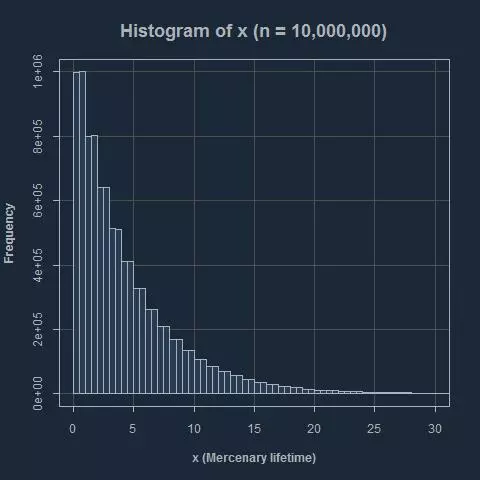
理论上,每个x值(从1秒到无限大)都是可能的。不过,较大的x值出现的概率极低。甚至有0.014%的概率,佣兵会在开始任务后的第一分钟内死亡。(由于游戏使用的随机数生成器,实际的存活时间x会受到一定限制。) 复活费用:如果佣兵死亡,你可以选择将其埋葬(即从佣兵列表中移除),或者花费一定数量的红宝石将其复活。复活费用会随着佣兵等级呈指数增长,计算公式如下:R = ⌈10 + 1.5^m⌉,其中R表示复活所需的红宝石数量,m表示佣兵等级。由此可见,m是唯一的决定因素。复活费用不受佣兵稀有度或其他任何因素的影响。若你拥有合适的雇佣兵,你可以使用额外生命来替代红宝石。 以下表格显示了相关雇佣兵等级(m)的等级名称和复活成本: 等级 等级名称 复活成本 1 新手 12红宝石 2 新手 13红宝石 3 学徒 14红宝石 4 专家 16红宝石 5 大师 18红宝石 6 宗师 22红宝石 7 传奇 28红宝石 8 半神 36红宝石 9 半神+1 49红宝石 10 半神+2 68红宝石 11 半神+3 97红宝石 12 半神+4 140红宝石 13 半神+5 205红宝石 14 半神+6 302红宝石 15 半神+7 448红宝石 16 半神+8 667红宝石 17 半神+9 996红宝石 18 半神+10 1488红宝石 19 半神+11 2227红宝石 20 半神+12 3336红宝石 ......... 如果你复活雇佣兵且无需面临再次死亡的风险,他将完成任务!这是因为剩余的任务时间会被添加到他的生命值x中。 6. 我正在变老……如你可能已经注意到的,复活成本呈指数级增长,而任务奖励仅呈线性增长。这会影响雇佣兵的效率(定义为产出投入比)。计算不同等级下的任务奖励与复活成本比率(c),结果如下列图表所示:
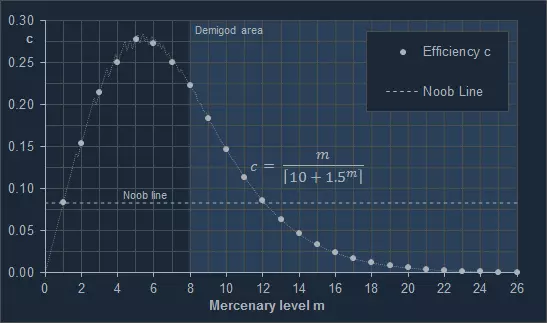
如你所见,提升新招募的1级雇佣兵等级会让他们更有效率。但关键信息是,每个雇佣兵最终都会因关节炎和关节病而变得效率低下,此时最好不要复活他们,使用新招募的新手雇佣兵反而更好。愿他们安息。 这个【退役等级】取决于多种因素,例如奖励类型(红宝石、英雄之魂等)、任务类别、雇佣兵加成和稀有度。 无论如何,雇佣兵的寿命是有限的。不要期望能永远使用同一个雇佣兵!你无法接受这一点?复活的红宝石成本对你来说是种侮辱?请阅读以下内容。 模拟方法:有趣的问题是,为死去的雇佣兵花费红宝石是否值得。一般来说,如果复活一名雇佣兵的成本低于其在下一次死亡前的预期收益,那么复活是个不错的选择。换句话说,预期收益与复活成本之间的差额(即“净利润”)必须大于0。 了解了生命值x的计算方式后,我将通过模拟来判断在特定等级复活雇佣兵是否划算。每次模拟的步骤如下: 1. 定义基本参数(雇佣兵等级、任务等,详见第7章)。 2. 生成100万次随机的雇佣兵生命值x,其中X=Y+Z+t: - Y是服从几何分布的随机变量,Y~geo(0.2) - Z服从均匀分布:Z~uni(0,1) - t是任务时间,反映雇佣兵死亡时所在的任务。 3. 使用梅森旋转算法。我将org作为用于该目的的随机数生成器。为便于分析,我假设Y和Z是独立同分布的,且Y与Z相互独立。 我计算了每个雇佣兵在各等级可完成的任务数量及相应奖励。 我累加了所有奖励直至其死亡(不包含雇佣兵最后一个任务的奖励)。 我计算了这100万次奖励的平均值与起始等级复活成本之间的差值,以得出“平均净利润”。 平均而言,若净利润大于0,则值得复活雇佣兵。我将最后一个净利润为正的等级定义为退役等级。我的模型假设雇佣兵始终执行相同的任务(例如仅为期两天的红宝石任务),他们也在这样的任务中失败了。有关限制条件,请参见第9章。 7. 退役决定因素 由于复活成本对于特定等级是固定的,佣兵“退役等级”的重要决定因素可以在任务奖励公式中找到: a) 任务类别 退役等级取决于任务类别,更具体地说,取决于任务时间t和相应的奖励系数f。坚持执行短时间任务更有可能赚回用于复活的红宝石,因为这些任务的f值更高。因此,只要你在玩游戏,专注于5分钟任务是个不错的主意。 下图说明了这一点。你可以看到,对于执行5分钟任务的佣兵,平均净利润是佣兵等级m的函数。为期两天的红宝石任务,均无奖励(b=0)
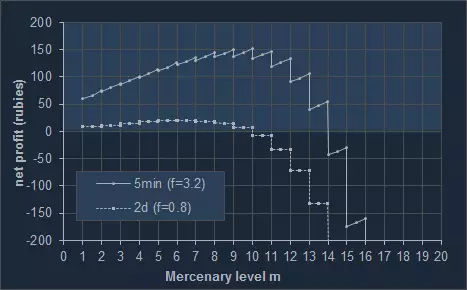
虽然在没有红宝石任务奖励加成的情况下复活雇佣兵,对于2天时长的任务来说几乎无利可图,但对于5分钟时长的任务而言则完全可行,至少在13级之前是如此。 雇佣兵加成:雇佣兵加成b是另一种提升奖励的方式。稀有度越高,加成越高,相应任务类型的奖励也越高。 下图对比了由无红宝石加成(b=0)的雇佣兵和拥有红宝石加成(b=5=500%)的传说级雇佣兵完成的1天红宝石任务。
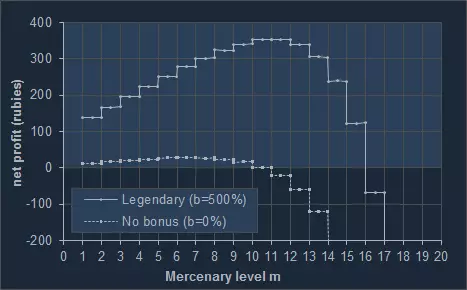
c) 任务类型与奖励评估 对于红宝石任务,可以计算复活成本与预期任务奖励之间的差值。但如果是英雄之魂任务或其他类型的任务,就如同将不同种类的事物进行比较,需要将非红宝石任务的奖励“换算”成红宝石。 对于英雄之魂,一种直观的换算方式是快速飞升。通过消耗红宝石购买英雄之魂,我们可以得出一个“价格”:每次快速飞升(q)需要50红宝石。 红宝石任务的基础奖励为1颗红宝石(1天任务,1级佣兵,无加成)。对于英雄之魂任务,其奖励为快速飞升的10%,即0.1q×50/q=5红宝石。由此可见,英雄之魂任务的收益是红宝石任务的五倍。因此,如果专注于英雄之魂任务,佣兵的退役等级应设置得更高。此外: 如果你始终坚持完成英雄之魂任务并保持正净利润,那么平均而言,你每红宝石获得的英雄之魂数量将多于购买快速飞升! 下图比较了英雄之魂任务和红宝石任务的平均净利润,两种情况均无加成(b=0),且执行的是1天任务。
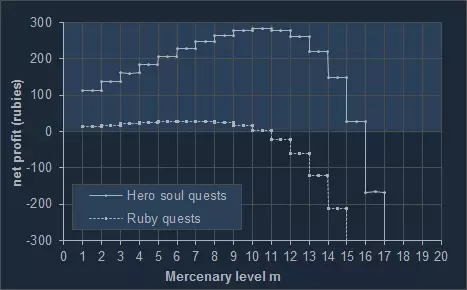
要确定遗物或技能激活的价值会稍微困难一些。理论上,我们可以参考商店中花费40红宝石购买3个随机遗物的选项,这样算下来一个遗物价值40/3≈13.33红宝石。但这个选项会严重高估遗物的价值,因此首先不建议购买遗物。 任务奖励计算表明,一个遗物或一次随机技能激活相当于1个红宝石。基于此,我们可以将这些任务视为红宝石任务。 d) 经验值 这一点不太重要,但实际上复活那些即将升级的佣兵会更好。假设有两个6级的死亡佣兵,一个经验值为0%(6.00级),另一个经验值为99%(6.99级)。两者的复活成本相同,但6.00级的佣兵需要完成一整天的任务才能任务等级的系数m=6。6.99级的佣兵在完成下一个任务后,即可开始系数m=7的任务。同等级中更有经验的佣兵可以将更高比例的新生命值x用于执行奖励更高的任务。 我在下图中对此进行了说明。图中展示了佣兵持续执行5分钟红宝石任务时,不同等级的【净利润】(无红宝石加成,b=0)。
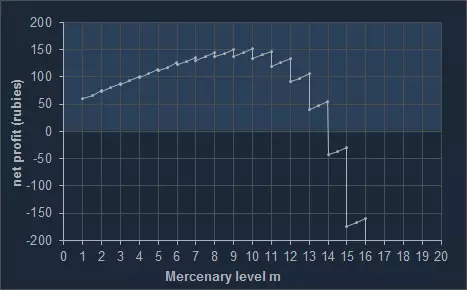
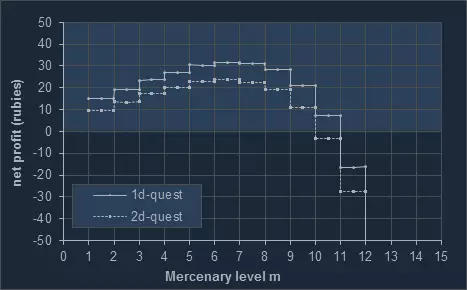
该效果适用于时长小于24小时的任务。对于1天和2天的任务,由于任务时长是升级间隔(1天)的整数倍,所以不会出现这种效果。下图展示了稀有雇佣兵(b=7.5%)仅执行1天和2天红宝石任务的净利润情况。
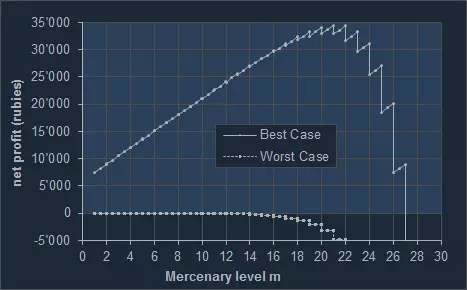
e) 最佳情况与最差情况 所有这些因素共同作用,决定是否值得复活雇佣兵。下图对比了两种极端情况: 没有适当加成、执行2天红宝石任务的雇佣兵 与 拥有2000%加成、执行5分钟英雄之魂任务的超越级雇佣兵
8. Retirement level simulation Sample sizeIn this chapter I will provide specific retirement levels as a result of multiple simulations. Each cells value was determined by simulating 1'000'000 lifestimes per datapoint with a specific vector of start levels. That's vector I used: m = (1.00, 1.50, 1.99, 2.00, 2.50, 2.99, 3.00, ... , 30.00), a total of 88 start levels. That leads to 1'000'000 × 88 = 88'000'000 mercenary lifetimes per cell. Hence the total number of both tables is 2 tables × 88'000'000 × 9 bonuses × 10 quest classes = 15'840'000'000 lifetimes. From a statistic viewpoint that should be more than sufficient. (My poor laptop, crunching all these numbers...) InterpretationDisplayed are average values which should be treated the appropriate way: It's ok to base decisions on average values/expected values if you have to make that decision very often and if you're somewhat neutral towards risk. While that's a reasonable assumption for mercenaries at lower levels with low revive cost, it doesn't hold for high level mercenaries: People are usually not risk neutral when it comes to high values like a few hundreds of rubies, and high level mercenaries are rare, so you won't have to decide about their fate that often. The realisation of a single lifetime x and a couple of lifetimes still are random. So if you're unlucky, your merc can die in the very next quest and you will have lost rubies for almost nothing. In the long run, it will average out and you will have more rubies (or other resources worth rubies) as long as you refrain from reviving mercenaries at too high levels. See chapter 9 (Limitations) for further notable points. Retirement levels for ruby quests: (Can be used for relic- and skill activation quests, too.) f3.202.752.502.001.751.501.251.000.80t5 min15 min30 min60 min2 h4 h8 h24 h2 d(No bonus) (0%)13131212111110109Common (5%)13131312121110109Uncommon (8%)13131312121111109Rare (10%)13131312121111109Epic (20%)141313121211111010Fabled (50%)141414131312121111Mythical (200%)161616151514141313Legendary (500%)181818171716161515Transcendent (2000%)222121202020191918 Retirement levels for hero soul quests:f3.202.752.502.001.751.501.251.000.80t5 min15 min30 min60 min2 h4 h8 h24 h2 d(No bonus) (0%)181717161616151514Common (5%)181817171616151514Uncommon (8%)181817171616151514Rare (10%)181817171616151515Epic (20%)181818171716161515Fabled (50%)191818181717161615Mythical (200%)212020201919181817Legendary (500%)232222212121202019Transcendent (2000%)262625252424242323 9. Limitations The information provided in this guide is not enough to develop an overall mercenary strategy. There are some things to note regarding my assumptions, and a few additional factors that can influence the retirement level: I've not accounted for opportunity costs: Reviving a mercenary prevents you from earning rewards with a new Lvl. 1 Noob mercenary, what should be considered. A new mercenary isn't free either: You can instantly buy a new one for 40 rubies, but that's only a good option if all your other mercenaries can receive more than 40 rubies for a 8-hour ruby quest. That's highly unlikely, so it's usually better to do recruitment quests. On the other hand, that costs you the rewards of a 8-hour quest. That reward depends heavily depends on your other mercenaries (levels, bonuses etc.). For that reason I decided to omit opportunity costs from my analysis. Actual retirement levels may be slightly lower as a result. With a few assumptions, dukC2's approach contains these opportunity costs. I assumed that you do only quests from a particular quest class (e. g. only 4-hour quests) for the entire lifetime. That's usually not possible of course. But that isn't that much of a problem as you can simply use your "average quest length". Alternatively you can look at the next (longer) quest class or even always rely on the 2-day columns if you want to be on the safe side. Furthermore, I assumed that you do only quests from a particular quest type (e. g. only Hero Soul quests) for calculating specific retirement levels. That's extremely unlikely as well, as you're not able to influence the selection of quests you get. The best way to handle that on the one hand highly depends on your overall quest-/mercenary strategy, and on the other hand depends on your valuation of the different rewards. It is generally not a bad idea (if you don't like too much risk) to lower given retirement levels by one, because the average net profit at the retirement level is similar to a Lvl. 1 mercenary or even lower in many cases. The tables contain the highest levels with a positive net profit. But in some rare cases, it can happen that there are levels with a negativ net profit even before. The reason is the EXP-effect. Look at that graph for an illustration. Displayed are the results of a common mercenary with a ruby bonus (b = 5%), doing 30-minute ruby quests:
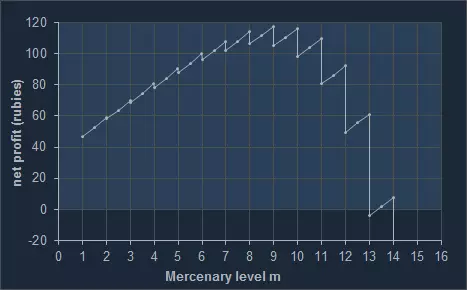
第8章的第一个表格中提到退休等级为13级,但即便在该等级,净利润也会在短期内变为负数。不过这种现象属于例外情况,因此并无问题。 关于红宝石的流动性,理论上复活16级佣兵是个不错的主意,但根据你其他的红宝石开销,你可能没有667颗红宝石剩余…… 这确实有些吹毛求疵,但与我用于模拟的随机数生成器相比,游戏本身使用的随机数生成器复杂程度较低,导致佣兵可能的生命周期数量相当少。因此,平均生命周期略高于4.5天: 引用自Nemonical-Yves:今天早些时候,我暴力破解了游戏所用随机数生成器的全部2147483646个可能种子。随机数生成器本身呈现线性分布。但计算部分天数的机制并非完全线性,原因有二:其一,由于最大种子值不能被一天的秒数整除,取模运算存在轻微不平衡;其二,只有20%的种子(即那些前一天导致死亡的种子后续生成的种子)能够参与计算,而这些种子的分布并非完全均衡。 确切的平均生存时间为:4天12小时0分10.758318秒。 总体而言,其随机性略优于完全线性的随机分布。 另外,由于种子值的量化特性,实际的日生存概率并非80%,而是79.999999962747%,不过已经非常接近了。不管是有意还是无意,我们最慷慨的开发者为我们额外提供了将近11秒的时间,太棒了! 参考资料 感谢以下人员: - Reddit用户“svayam--bhagavan”发布的代码片段 - Reddit用户“Qnopsik”提供的复活成本公式 - Nemonical-Yves在不同情况下对随机数生成器的测试 - 我的《点击英雄》 clan提供的用于测试奖励计算公式的额外数据 - 开发者Asminthe对0.25版本死亡系统的解释 - Reddit用户“Xeno234”提供的相关代码 - 评论区的每一位用户 - Microsoft Excel和R