
 换一换
换一换 


神经可塑性与瞄准训练中的突触发生 摘要 神经可塑性是大脑根据经验进行结构和功能重组的能力,是学习新运动技能的核心。本文探讨了第一人称射击(FPS)游戏中重复的瞄准训练如何通过突触发生、感觉运动整合和睡眠依赖的记忆巩固等机制诱导神经结构的持久变化。重点关注学习背后的生物学过程,包括突触效能、神经营养调节以及神经增强生活方式和营养因素的作用。 核心概要 核心概要的核心? 聪明练习。好好睡觉。保持一致。你的大脑就是你的瞄准能力。
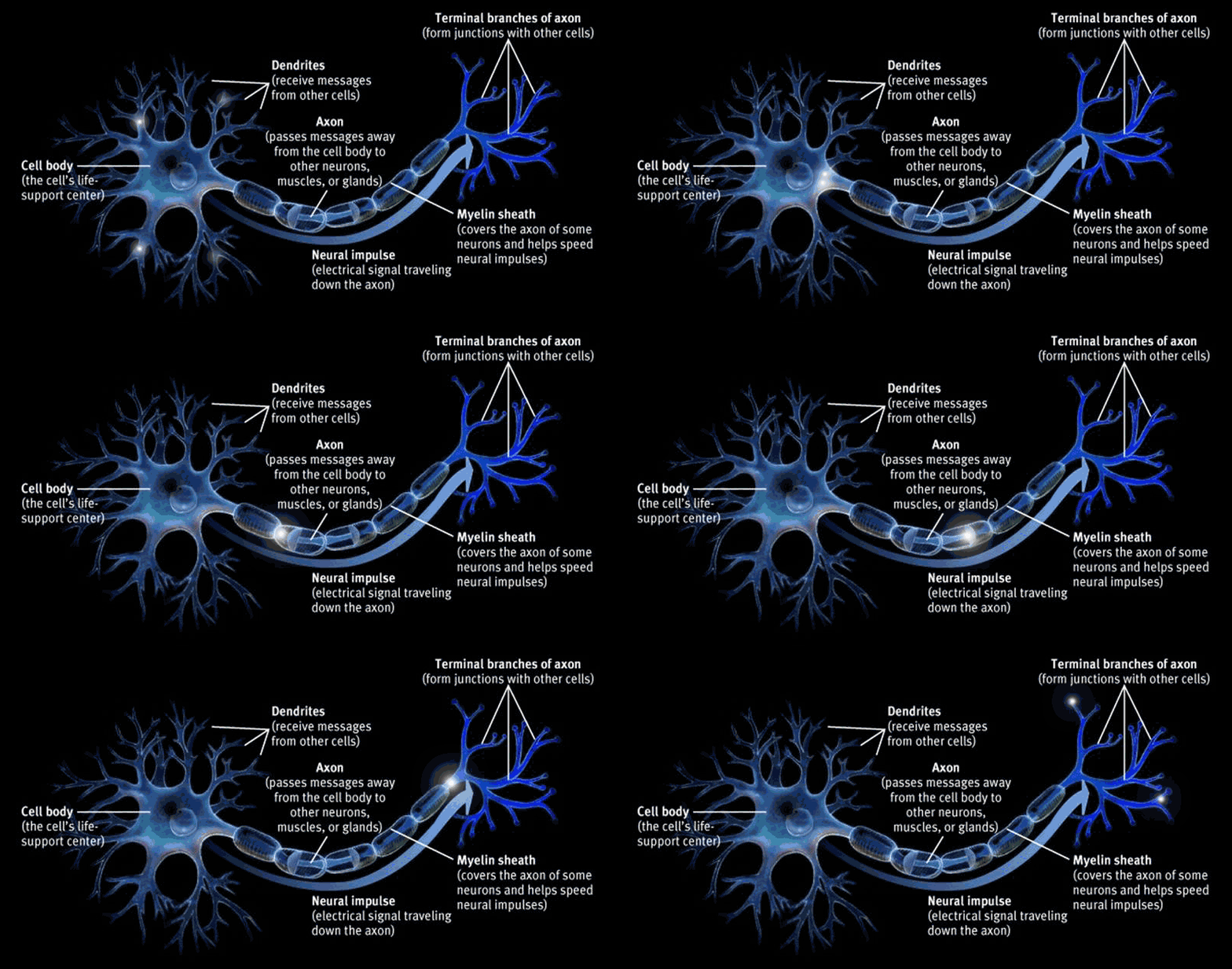
🧠 Your brain isn’t fixed — it changes based on what you do. Every time you train your aim (like flicking or tracking in FPS games), your brain physically rewires itself. The connections between brain cells (neurons) get stronger or weaker depending on how often and how correctly you repeat something. 🔗 This process is called synaptogenesis. It’s how new "brain pathways" are formed. At first, movements feel awkward — like walking through a forest with no path. But if you repeat them the right way, that path becomes a road, then a highway. Eventually, those actions become automatic. 💡 But your brain can also learn the wrong things. If you keep repeating bad habits (like flicking too far), your brain memorizes those too. It doesn’t know the difference between “good” or “bad” — it just learns what you do the most. 😴 Sleep is where the real magic happens. Your brain takes what you practiced during the day and decides what’s important to keep. This happens mostly during deep sleep. If you don’t sleep enough, your brain may not store what you learned — it’s like not saving your game. 🥦 Supplements can help — but only if you’re already training and sleeping well. Things like Omega-3, Lion’s Mane, blueberries, creatine, and even caffeine with L-theanine can support brain performance, focus, and reaction time. But they won’t work if your basics (like sleep and consistent practice) are missing. Bottom line? If you want better aim, don’t just grind. ✅ Practice with intention ✅ Sleep 7–9 hours ✅ Use the right routines ✅ Avoid repeating mistakes ✅ And maybe support your brain with good food or safe supplements Your brain literally builds itself around what you do. So train it wisely. 🎯 Want to get better at aim? Then train like you’re training your brain, not just your hands. It’s not just about how many hours you put in — it’s how you use those hours. If you’re just mindlessly playing, rushing through your shots, or tilting after every mistake, you’re actually building bad habits into your brain. Every error, if repeated enough, becomes a permanent part of your muscle memory. That’s why so many players plateau — they keep practicing their mistakes without realizing it. ✅ What actually helps your brain learn faster and better? Deliberate practice. Slow down and focus on form, not speed. Start with accuracy — speed comes later naturally. Correct repetitions. Don’t just grind. Stop when you start doing it wrong. Quality > quantity. Consistency. 20 minutes a day > 2 hours once a week. Brains like regular schedules. Sleep right after training. A short session before bed can have a big impact — your brain gives it special priority during sleep. Track your progress. Seeing improvement (even small ones) reinforces motivation and helps your brain lock in good patterns. 🧠 Bonus brain boosters (if your basics are solid): SupplementWhat it helps withPro tip Omega-3 (DHA+EPA)Better focus, faster reaction timeTake with food to absorb better Lion’s ManeMemory, clarity, recovery after tiltLook for real extract (not powder) Blueberry extractReduces brain inflammation, boosts memoryOr eat real blueberries! CreatineMental endurance, better memoryWorks best when taken daily Citrulline MalateBrain blood flow, longer focus sessionsEmpty stomach works best Caffeine + L-theanineFocus + calm — no jitterGreat combo before ranked matches ⚠️ Final warning: Your brain is powerful, but it doesn’t care what you’re learning — it just learns what you repeat. If you repeat aim mistakes, poor posture, bad timing, low effort — guess what? Your brain makes those easier for you next time. That’s why some players get worse the more they play. But if you respect your practice, protect your sleep, and support your brain… you’ll build skill faster than 90% of players. Introduction 1. Introduction The human brain contains approximately 86 billion neurons, each forming thousands of synaptic connections (Azevedo et al., 2009). These synapses serve as conduits for electrochemical signaling, enabling complex behaviors such as voluntary movement, decision-making, and motor coordination. One of the most compelling illustrations of this system is visuomotor skill acquisition—especially in high-performance contexts like FPS gaming—where precise control and rapid sensorimotor integration are critical. This paper examines how practice, repetition, and lifestyle influence the brain’s capacity to adapt, focusing on the principles of neuroplasticity and synaptogenesis in the context of aim training. Synaptic Communication and Behavioral Output 2. Synaptic Communication and Behavioral Output At the foundation of every motor action lies synaptic transmission. Synapses facilitate communication between neurons via neurotransmitters or electrical impulses, allowing information to propagate through neural circuits. These circuits govern muscular coordination and fine-tuned movements, such as mouse control during aim-intensive tasks. Crucially, synapses are not fixed structures; their strength and number can be modified through repeated activation—a principle known as activity-dependent plasticity (Citri & Malenka, 2008). Synaptogenesis and Skill Acquisition 3. Synaptogenesis and Skill Acquisition Repeated execution of a motor behavior enhances the likelihood of coincident neuronal firing. According to Hebbian theory, "neurons that fire together, wire together" (Hebb, 1949). Over time, repeated activations lead to the formation of new synapses—a process termed synaptogenesis. This phenomenon supports the consolidation of motor skills. Initially weak and uncoordinated pathways—analogous to a narrow forest trail—gradually evolve into efficient, high-speed routes with continued use. This transformation underlies the improvement in performance during tasks requiring precision, such as flicking or target switching in FPS games. Neuroplasticity: Reshaping the Brain Through Experience 4. Neuroplasticity: Reshaping the Brain Through Experience Neuroplasticity encompasses synaptogenesis but also extends to structural changes in cortical areas. For example: Motor Cortex Adaptation: The primary motor cortex (M1), responsible for voluntary movement control, exhibits increased gray matter density in individuals who engage in fine motor training (Draganski et al., 2004). Sensorimotor Integration: The synchronization between visual input and motor output—essential in aim training—depends on strengthened connectivity between visual and motor cortices (Seitz & Dinse, 2007). Neuroplasticity ensures that these regions become more functionally efficient over time, enabling faster reaction times, reduced cognitive load, and enhanced precision. The Role of Sleep in Memory Consolidation 5. The Role of Sleep in Memory Consolidation Motor learning is not confined to periods of active practice. A significant portion of neural consolidation occurs during sleep. Deep sleep (slow-wave sleep) facilitates synaptic consolidation, selectively strengthening neural patterns that were most consistently activated during wakefulness (Walker & Stickgold, 2005). Failure to achieve adequate sleep impairs this process, effectively nullifying gains achieved during training. Experimental studies demonstrate that subjects who sleep after learning a new motor sequence perform significantly better than those who do not (Fischer et al., 2002). Key findings: Optimal sleep duration for synaptic consolidation: 7.5–9 hours. Practicing a skill just before sleep enhances retention, possibly due to memory tagging mechanisms (Rasch & Born, 2013). Neuroplasticity: A Double-Edged Sword 6. Neuroplasticity: A Double-Edged Sword While plasticity facilitates learning, it is indifferent to correctness. Repeatedly performing a movement incorrectly can lead to the reinforcement of suboptimal patterns. This underscores the importance of error-aware training and deliberate practice. Hence, the brain acts like a 3D printer—molding itself based on the input it receives. The implication is profound: quality trumps quantity in neural imprinting. Enhancing Plasticity Through Nutrition and Supplementation 7. Enhancing Plasticity Through Nutrition and Supplementation While neuroplasticity is intrinsically supported by training and sleep, several natural compounds have been studied for their potential to enhance cognitive and neural function: 7.1 Omega-3 Fatty Acids (DHA + EPA) Mechanism: DHA is a key structural component of neuronal membranes; enhances synaptic function. Benefits: Improved attention, memory, and reaction time (Yehuda et al., 2005). Dosage: 1000–2000 mg/day (combined EPA+DHA) 7.2 Lion’s Mane Mushroom (Hericium erinaceus) Mechanism: Stimulates NGF (Nerve Growth Factor), supporting neuronal growth and plasticity. Benefits: Improved memory and cognitive flexibility (Mori et al., 2009). Dosage: 500–1000 mg/day of standardized extract 7.3 Blueberry Extract (Anthocyanin-rich) Mechanism: Anti-inflammatory and neuroprotective; enhances hippocampal function. Benefits: Faster reaction time, improved working memory (Krikorian et al., 2010). Dosage: 300–600 mg/day or consumed fresh 7.4 Creatine Monohydrate Mechanism: Increases ATP availability in neurons. Benefits: Enhanced working memory, attention, and cognitive stamina (Avgerinos et al., 2018). Dosage: 3–5 g/day 7.5 Citrulline Malate Mechanism: Boosts nitric oxide, improving cerebral blood flow. Benefits: Improved mental endurance under stress. Dosage: 6–8 g/day on an empty stomach 7.6 Caffeine + L-Theanine Mechanism: Synergistic combination improves focus while reducing jitter. Benefits: Increased sustained attention, ideal for high-pressure gaming. Dosage: 100 mg caffeine + 200 mg L-theanine (2:1 ratio) These supplements, when used in conjunction with sleep and training, may improve outcomes by marginal gains, which can be decisive in competitive environments. References References Azevedo, F. A. C. et al. (2009). Equal numbers of neuronal and nonneuronal cells make the human brain an isometrically scaled-up primate brain. Journal of Comparative Neurology. Hebb, D. O. (1949). The Organization of Behavior. Wiley. Citri, A. & Malenka, R. C. (2008). Synaptic plasticity: multiple forms, functions, and mechanisms. Neuropsychopharmacology. Draganski, B. et al. (2004). Changes in grey matter induced by training. Nature. Fischer, S. et al. (2002). Sleep forms memory for finger skills. PNAS. Walker, M. P., & Stickgold, R. (2005). It’s practice, with sleep, that makes perfect. Behavioral and Brain Sciences. Mori, K. et al. (2009). Improvement of cognitive functions by oral intake of Hericium erinaceus. Biomedical Research. Krikorian, R. et al. (2010). Blueberry supplementation improves memory in older adults. Journal of Agricultural and Food Chemistry. Avgerinos, K. I. et al. (2018). Effects of creatine supplementation on cognitive function of healthy individuals: A systematic review and meta-analysis. Experimental Gerontology. Rasch, B. & Born, J. (2013). About sleep’s role in memory. Physiological Reviews. Yehuda, S. et al. (2005). Essential fatty acids and the brain: From infancy to aging. Neurobiology of Aging.