
 换一换
换一换 




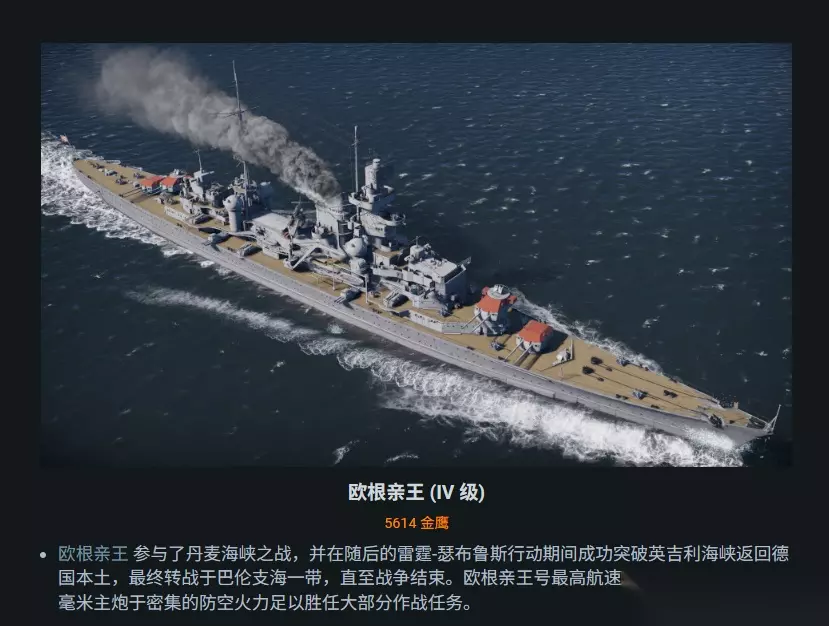
欧根亲王号历史 欧根亲王号是希佩尔海军上将级重巡洋舰,为该级五艘舰艇中的第三艘。它在二战期间服役于纳粹德国海军。该舰于1936年4月铺设龙骨,1938年8月下水,并在战争爆发后的1940年8月正式服役。其舰名源自18世纪奥地利籍将领——萨伏依的欧根亲王。该舰装备有八门20.3厘米主炮,尽管名义上符合《英德海军协定》设定的10,000长吨吨位限制,但实际排水量超过16,000长吨。 欧根亲王号曾参与1941年5月的“莱茵演习”行动,当时它与俾斯麦号战列舰一同尝试突入大西洋。在丹麦海峡海战中,两艘舰船击沉了英国战列巡洋舰胡德号,并使战列舰威尔士亲王号遭受中度损伤。欧根亲王号在行动中与俾斯麦号分离,执行袭击盟军商船的任务,但因引擎故障而提前结束。该舰驶入被占领的法国进行维修后,参与了“地狱犬行动”——一次大胆的日间穿越英吉利海峡返回德国的行动。1942年2月,欧根亲王号被部署至挪威,然而在抵达挪威水域数天后,便遭英国潜艇三叉戟号鱼雷袭击,其驻留时间因此缩短。鱼雷严重损坏了舰尾,迫使该舰返回德国进行维修。该舰重新服役后,在波罗的海用了数月时间训练军官学员,随后在东线为撤退的德国陆军提供炮火支援。1945年5月德国战败后,该舰向英国皇家海军投降,之后作为战争战利品移交给美国海军。在美国对该舰进行检查后,美国海军将这艘巡洋舰指派参加在比基尼环礁进行的十字路口行动核试验。在原子弹爆炸中幸存下来的欧根亲王号被拖至夸贾林环礁,最终于1946年12月倾覆沉没。如今,残骸的部分结构仍在水面以上可见,位置大约在布科茨陆军机场西北方向两英里处,位于埃努布吉岛的边缘。她的一个螺旋桨被打捞上来,现陈列于德国拉伯海军纪念馆。
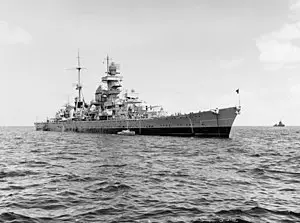
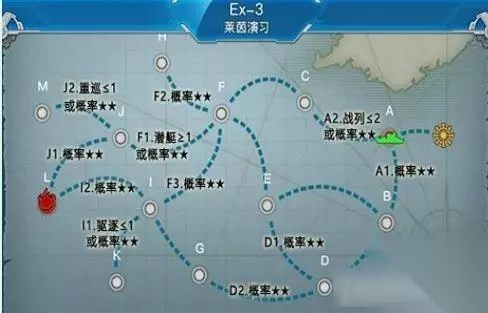
莱茵演习行动 截至1941年5月11日,“欧根亲王”号的维修工作已完成。在海军上校赫尔穆特·布林克曼的指挥下,该舰驶往格丁尼亚港,船员们在那里为其大西洋出击任务做好了准备。5月18日,“欧根亲王”号在阿尔科纳角附近与“俾斯麦”号会合。这两艘舰由三艘驱逐舰——“汉斯·洛迪”号、Z16“弗里德里希·埃科尔特”号和Z23号——以及一支扫雷艇舰队护航。德国空军在舰队驶离德国水域期间提供空中掩护。5月20日13:00左右,德国舰队遭遇瑞典巡洋舰“哥特兰”号;该巡洋舰在卡特加特海峡对德军舰队进行了两小时的跟踪。哥得兰岛向海军总部发送报告称:“两艘大型舰船、三艘驱逐舰、五艘护航舰以及10-12架飞机经过马斯特兰德,航向205°/20'。” 德国海军总司令部(OKM)并不担心哥得兰岛带来的安全风险,但吕特晏斯认为行动安全已无法保障。这份报告最终被送到英国驻瑞典海军武官亨利·德纳姆上尉手中,他随即将该信息转发给了英国海军部。
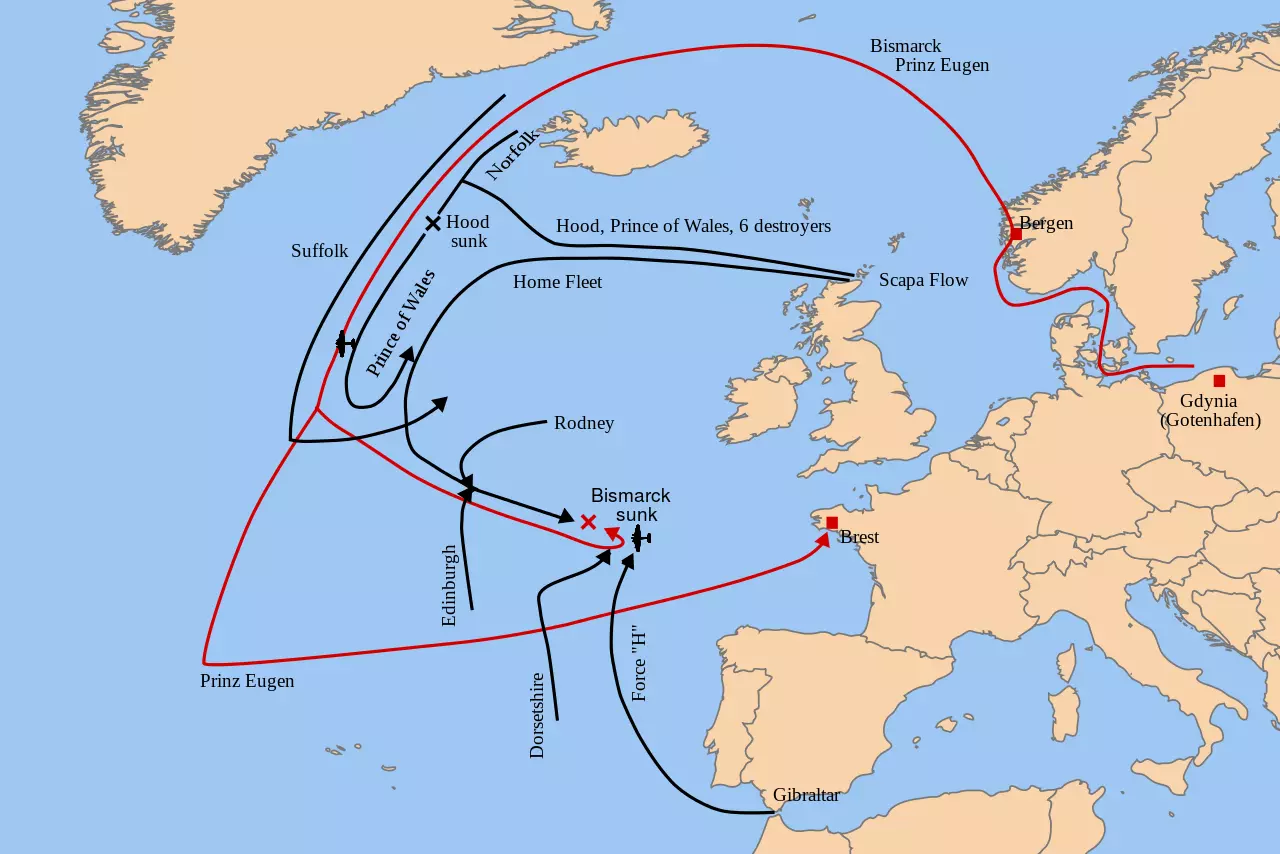
The code-breakers at Bletchley Park confirmed that an Atlantic raid was imminent, as they had decrypted reports that Bismarck and Prinz Eugen had taken on prize crews and requested additional navigational charts from headquarters. A pair of Supermarine Spitfires were ordered to search the Norwegian coast for the German flotilla. On the evening of 20 May, Prinz Eugen and the rest of the flotilla reached the Norwegian coast; the minesweepers were detached and the two raiders and their destroyer escorts continued north. The following morning, radio-intercept officers on board Prinz Eugen picked up a signal ordering British reconnaissance aircraft to search for two battleships and three destroyers northbound off the Norwegian coast. At 7:00 on the 21st, the Germans spotted four unidentified aircraft that quickly departed. Shortly after 12:00, the flotilla reached Bergen and anchored at Grimstadfjord. While there, the ships' crews painted over the Baltic camouflage with the standard "outboard gray" worn by German warships operating in the Atlantic. While in Bergen, Prinz Eugen took on 764 t of fuel; Bismarck inexplicably failed to similarly refuel. At 19:30 on 21 May, Prinz Eugen, Bismarck, and the three escorting destroyers left port.[23] By midnight, the force was in the open sea and headed toward the Arctic Ocean. At this time, Admiral Raeder finally informed Hitler of the operation, who reluctantly allowed it to continue as planned. The three escorting destroyers were detached at 04:14 on 22 May, while the force steamed off Trondheim. At around 12:00, Lütjens ordered his two ships to turn toward the Denmark Strait to attempt the breakout into the open waters of the Atlantic. By 04:00 on 23 May, Lütjens ordered Prinz Eugen and Bismarck to increase speed to 27 knots (50 km/h; 31 mph) to make the dash through the Denmark Strait. Upon entering the Strait, both ships activated their FuMO radar detection equipment sets. Bismarck led Prinz Eugen by about 700 m; mist reduced visibility to 3,000 to 4,000 m. The Germans encountered some ice at around 10:00, which necessitated a reduction in speed to 24 knots (44 km/h; 28 mph). Two hours later, the pair had reached a point north of Iceland. The ships were forced to zigzag to avoid ice floes. At 19:22, hydrophone and radar operators aboard the German warships detected the cruiser HMS Suffolk at a range of approximately 12,500 m (41,000 ft). Prinz Eugen's radio-intercept team decrypted the radio signals being sent by Suffolk and learned that their location had indeed been reported. Admiral Lütjens gave permission for Prinz Eugen to engage Suffolk, though the captain of the German cruiser could not clearly make out his target and so held fire. Suffolk quickly retreated to a safe distance and shadowed the German ships. At 20:30, the heavy cruiser HMS Norfolk joined Suffolk, but approached the German raiders too closely. Lütjens ordered his ships to engage the British cruiser; Bismarck fired five salvoes, three of which straddled Norfolk and rained shell splinters on her decks. The cruiser laid a smoke screen and fled into a fog bank, ending the brief engagement. The concussion from the 38 cm guns disabled Bismarck's FuMo 23 radar set; this prompted Lütjens to order Prinz Eugen to take station ahead so she could use her functioning radar to scout for the formation. The British cruisers tracked Prinz Eugen and Bismarck through the night, continually relaying the location and bearing of the German ships. Battle of the Denmark Strait The harsh weather broke on the morning of 24 May, revealing a clear sky. At 05:07 that morning, hydrophone operators aboard Prinz Eugen detected a pair of unidentified vessels approaching the German formation at a range of 20 nmi (37 km; 23 mi), reporting "Noise of two fast-moving turbine ships at 280° relative bearing!". At 05:45, lookouts on the German ships spotted smoke on the horizon; these turned out to be from Hood and Prince of Wales, under the command of Vice Admiral Lancelot Holland. Lütjens ordered his ships' crews to battle stations. By 05:52, the range had fallen to 26,000 m and Hood opened fire, followed by Prince of Wales a minute later. Hood engaged Prinz Eugen, which the British thought to be Bismarck, while Prince of Wales fired on Bismarck.
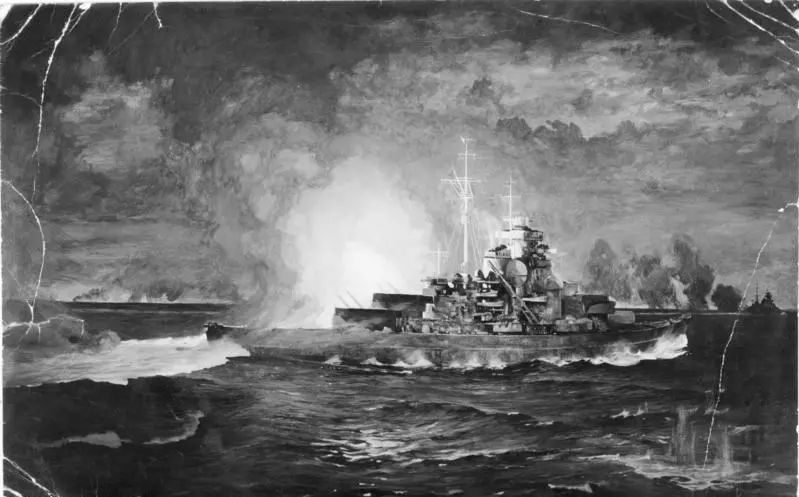
The British ships approached the Germans head on, which permitted them to use only their forward guns, while Bismarck and Prinz Eugen could fire full broadsides. Several minutes after opening fire, Holland ordered a 20° turn to port, which would allow his ships to engage with their rear gun turrets. Both German ships concentrated their fire on Hood. About a minute after opening fire, Prinz Eugen scored a hit with a high-explosive 20.3 cm shell, detonating unrotated projectile ammunition and starting a large fire on Hood, which was quickly extinguished. Holland then ordered a second 20° turn to port, to bring his ships on a parallel course with Bismarck and Prinz Eugen. By this time, Bismarck had found the range to Hood, so Lütjens ordered Prinz Eugen to shift fire and target Prince of Wales to keep both of his opponents under fire. Within a few minutes, Prinz Eugen scored a pair of hits on the battleship and reported that a small fire had been started. Lütjens then ordered Prinz Eugen to drop behind Bismarck, so she could continue to monitor the location of Norfolk and Suffolk, which were still some 10 to 12 nmi (19 to 22 km; 12 to 14 mi) to the east. At 06:00, Hood was completing her second turn to port when Bismarck's fifth salvo hit. Two of the shells landed short, striking the water close to the ship, but at least one of the 38 cm armor-piercing shells struck Hood and penetrated her thin upper belt armor. The shell reached Hood's rear ammunition magazine and detonated 112 t of cordite propellant. The massive explosion broke the back of the ship between the main mast and the rear funnel; the forward section continued to move forward briefly before the in-rushing water caused the bow to rise into the air at a steep angle. The stern similarly rose upward as water rushed into the ripped-open compartments. After only eight minutes of firing, Hood had disappeared, taking all but three of her crew of 1,419 men with her. After a few more minutes, during which Prince of Wales scored three hits on Bismarck, the damaged British battleship withdrew. The Germans ceased fire as the range widened, though Captain Ernst Lindemann, Bismarck's commander, strongly advocated chasing Prince of Wales and destroying her. Lütjens firmly rejected the request, and instead ordered Bismarck and Prinz Eugen to head for the open waters of the North Atlantic. After the end of the engagement, Lütjens reported that a "Battlecruiser, probably Hood, sunk. Another battleship, King George V or Renown, turned away damaged. Two heavy cruisers maintain contact." At 08:01, he transmitted a damage report and his intentions to OKM, which were to detach Prinz Eugen for commerce raiding and to make for St. Nazaire for repairs. Shortly after 10:00, Lütjens ordered Prinz Eugen to fall behind Bismarck to discern the severity of the oil leakage from the bow hit. After confirming "broad streams of oil on both sides of [Bismarck's] wake", Prinz Eugen returned to the forward position. Separation and return to France With the weather worsening, Lütjens attempted to detach Prinz Eugen at 16:40. The squall was not heavy enough to cover her withdrawal from Wake-Walker's cruisers, which continued to maintain radar contact. Prinz Eugen was therefore recalled temporarily. The cruiser was successfully detached at 18:14. Bismarck turned around to face Wake-Walker's formation, forcing Suffolk to turn away at high speed. Prince of Wales fired twelve salvos at Bismarck, which responded with nine salvos, none of which hit. The action diverted British attention and permitted Prinz Eugen to slip away. On 26 May, Prinz Eugen rendezvoused with the supply ship Spichern to refill her nearly empty fuel tanks. She had by then only 160 tons fuel left, enough for a day. Afterwards the ship continued further south on a mission against shipping lines. Before any merchant ship was found, defects in her engines showed and on 27 May, the day Bismarck was sunk, she was ordered to give up her mission and make for a port in occupied France. On 28 May Prinz Eugen refuelled from the tanker Esso Hamburg. The same day more engine problems showed up, including trouble with the port engine turbine, the cooling of the middle engine and problems with the starboard screw, reducing her maximum speed to 28 knots. The screw problems could only be checked and repaired in a dock and thus Brest, with its large docks and repair facilities, was chosen as destination. Despite the many British warships and several convoys in the area, at least 104 units were identified on the 29th by the ship's radio crew, Prinz Eugen reached the Bay of Biscay undiscovered, and on 1 June the ship was joined by German destroyers and aircraft off the coast of France south of Brest; and escorted to Brest, which she reached late on 1 June where she immediately entered dock. Operation Cerberus and Norwegian operations Brest is not far from bases in southern England and during their stay in Brest Prinz Eugen and the battleships Scharnhorst and Gneisenau were repeatedly attacked by Allied bombers. The Royal Air Force jokingly referred to the three ships as the Brest Bomb Target Flotilla, and between 1 August and 31 December 1941 it dropped some 1200 tons of bombs on the port. On the night of 1 July 1941, Prinz Eugen was struck by an armor-piercing bomb that destroyed the control center deep down under the bridge. The attack killed 60 men and wounded more than 40 others. The loss of the control center also made the main guns useless and repairs lasted until the end of 1941.
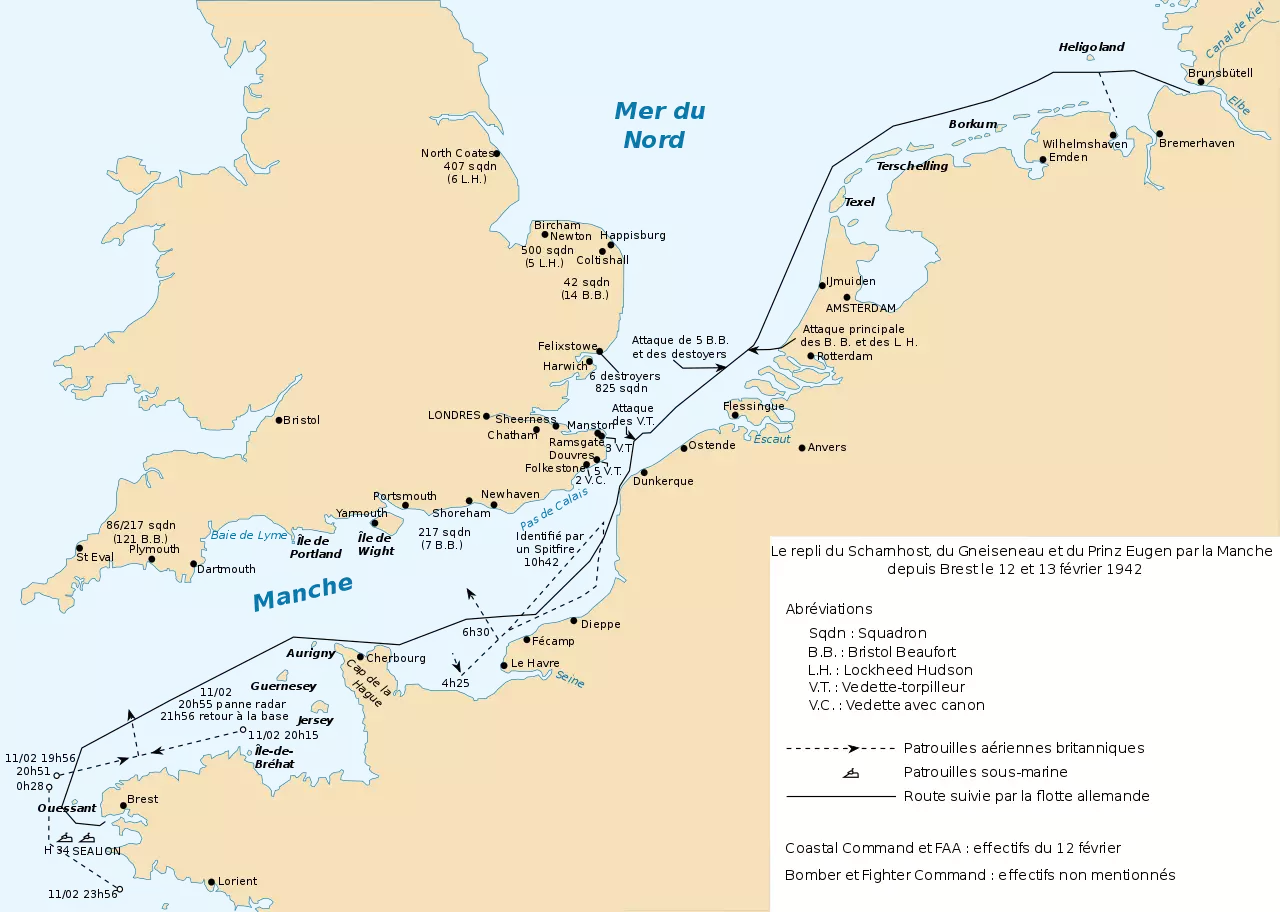
持续的空中打击使德国指挥部决定,在“欧根亲王”号、“沙恩霍斯特”号和“格奈森瑙”号修复就绪后,必须立即转移至更安全的基地。同时,“俾斯麦”号行动已证明,在没有空中掩护的情况下在大西洋行动存在风险。此外,希特勒将挪威战区视为“命运之地”,因此他于1942年初下令这三艘舰船返回德国,以便部署到那里。其意图是利用这些舰船拦截前往苏联的盟军护航队,并加强挪威的防御。尽管雷德尔抗议此举风险过大,希特勒仍坚持它们应取道英吉利海峡返航。奥托·西里亚克斯海军中将被任命为此次行动的指挥官。2月初,扫雷舰在英吉利海峡清扫出一条航道,不过英军未能察觉这一行动。 2月11日23时,沙恩霍斯特号、格奈森瑙号与欧根亲王号驶离布雷斯特。一小时后,它们进入英吉利海峡;三艘舰船以27节(50公里/小时;31英里/小时)的速度疾驰,航行中紧贴法国海岸。到06:30时,它们已驶过瑟堡,此时一支鱼雷艇 flotilla 加入了它们。这支鱼雷艇由海军上校埃里希·贝指挥,他坐镇驱逐舰Z29。战斗机部队司令阿道夫·加兰德在“地狱犬”行动期间指挥德国空军的战斗机和轰炸机部队(“雷霆”行动)。战斗机贴近桅顶飞行,以避开英军雷达网的探测。所有三艘舰船上都配备了联络官。德国飞机随后抵达,用箔条干扰英国雷达。到13:00时,舰队已驶过多佛尔海峡,但半小时后,一个由六架费尔雷剑鱼式鱼雷轰炸机组成的编队在喷火战斗机护航下对德军发动攻击。英军未能突破德国空军的战斗机屏障,六架剑鱼式轰炸机全部被摧毁。 在多佛尔附近,欧根亲王号遭到英国海岸炮兵连的炮击,但未被命中。随后数艘摩托鱼雷艇对该舰发起攻击,但欧根亲王号的驱逐舰护航舰在它们发射鱼雷前将其驱离。16:43,欧根亲王号遭遇五艘英国驱逐舰:坎贝尔号、活泼号、麦凯号、惠特谢德号和伍斯特号。她用主炮向他们开火,命中伍斯特号数次,但为躲避鱼雷不得不进行不规则机动。尽管如此,欧根亲王号仍于2月13日清晨抵达布伦斯比特尔,船体完好无损,不过在三艘主力舰中只有它出现了伤亡——一人被航空机炮击毙。 1942年2月21日,欧根亲王号、重巡洋舰舍尔海军上将号以及驱逐舰理查德·拜岑号、保罗·雅科比号、Z25号、赫尔曼·舍曼号和弗里德里希·伊恩号前往挪威。在格里姆斯塔峡湾短暂停留后,舰队继续驶向特隆赫姆。两天后,当在特隆赫姆峡湾外巡逻时,英国潜艇三叉戟号向欧根亲王号发射了鱼雷。鱼雷击中了船尾,造成五十人死亡、船体严重受损,船只也因此失去了操控能力。不过,该船依靠自身动力抵达了特隆赫姆,随后被拖往洛夫峡湾。在接下来的几个月里,船上进行了紧急维修:整个船尾被切除并进行了钢板覆盖,同时安装了两个临时舵,由绞盘手动操作。
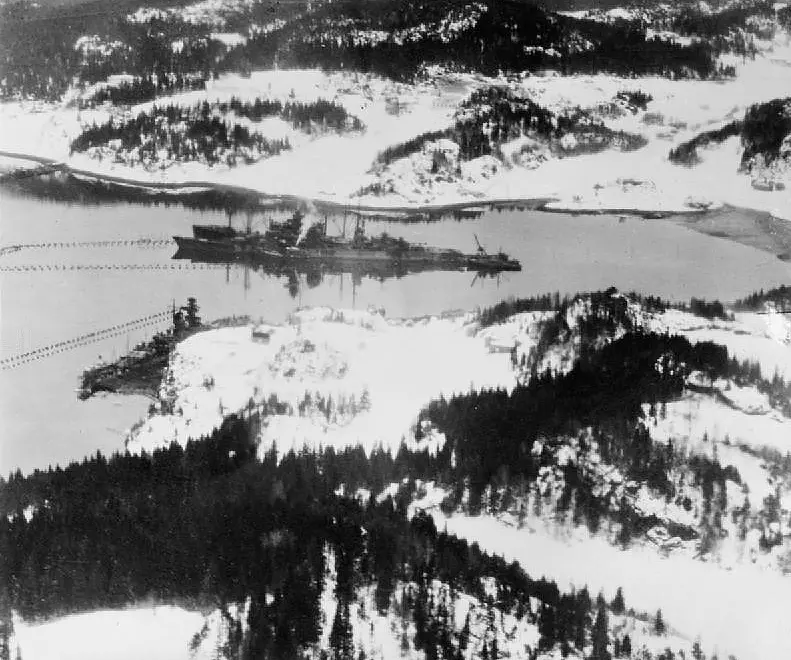
5月16日,“欧根亲王”号依靠自身动力启程返航德国。在前往基尔港的途中,该舰遭到由默文·威廉姆斯中校指挥的英国部队攻击,对方出动了19架布里斯托尔“布伦海姆”轰炸机和27架布里斯托尔“ Beaufort”鱼雷轰炸机,但未能命中目标。“欧根亲王”号随后进入维修状态直至10月,并于10月27日开始海试。汉斯-埃里希·沃斯在该舰重新服役时被任命为舰长,他后来成为希特勒的海军联络官。11月22日,意大利海军少将德·安杰利斯赠送了原奥地利战列舰“特格霍夫”号的舰钟,这与“欧根亲王”号最初计划使用的舰名有关。在11月和12月期间,这艘船在波罗的海进行了长时间的试航。1943年1月初,德国海军命令该舰返回挪威,以增援驻扎在那里的军舰。1月,欧根亲王号曾两次试图与沙恩霍斯特号一同驶往挪威,但两次尝试都因被英国侦察机发现而中断。当转移至挪威已无可能时,欧根亲王号被编入舰队训练中队。在接下来的九个月里,它在波罗的海巡航,用于训练海军学员。波罗的海的服役 随着苏联红军在东线将德国国防军击退,重新启用欧根亲王号作为炮火支援舰变得十分必要;1943年10月1日,该舰被重新分配至战斗任务。1944年6月,欧根亲王号、吕佐夫号重巡洋舰以及第六驱逐舰 flotilla 组成第二特遣舰队,后以其指挥官奥古斯特·蒂勒海军中将的名字更名为蒂勒特遣舰队。此时欧根亲王号由汉斯-于尔根·赖尼克海军上校指挥;整个6月,该舰在波罗的海东部、乌托岛西北海域航行,在德军从芬兰撤退期间展示武力。8月19-20日,该舰驶入里加湾并炮击图库姆斯。四艘驱逐舰和两艘鱼雷艇为此次行动提供了支援,同时还有欧根亲王号的Ar 196水上飞机;该巡洋舰主炮共发射了265发炮弹。欧根亲王号的炮击对成功击退苏联进攻起到了关键作用。 9月初,欧根亲王号支援了夺取霍格兰德要塞岛的失败尝试。随后该舰返回格丁尼亚,之后护送一支从芬兰撤离德国士兵的船队。这支由六艘货船组成的船队于9月15日从波的尼亚湾启航,整个第二特遣舰队负责护航。瑞典飞机和驱逐舰对船队进行了跟踪,但未进行干预。次月,欧根亲王号重新承担起炮火支援任务。10月11日和12日,她为梅梅尔的德军部队提供炮火支援。在最初两天里,该舰主炮发射了约700发弹药。14日和15日,在补充主炮弹药后,她再次返回并发射了370发弹药。
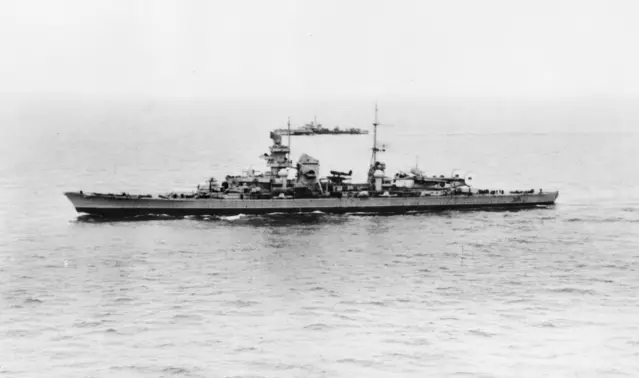
While on the return voyage to Gotenhafen on 15 October, Prinz Eugen inadvertently rammed the light cruiser Leipzig amidships north of Hela. The cause of the collision was heavy fog. The light cruiser was nearly cut in half, and the two ships remained wedged together for fourteen hours. Prinz Eugen was taken to Gotenhafen, where repairs were effected within a month. Sea trials commenced on 14 November. On 20–21 November, the ship supported German troops on the Sworbe Peninsula by firing around 500 rounds of main battery ammunition. Four torpedo boats—T13, T16, T19, and T21—joined the operation. Prinz Eugen then returned to Gotenhafen to resupply and have her worn-out gun barrels re-bored. The cruiser was ready for action by mid-January 1945, when she was sent to bombard Soviet forces in Samland. The ship fired 871 rounds of ammunition at the Soviets advancing on the German bridgehead at Cranz held by the XXVIII Corps, which was protecting Königsberg. She was supported in this operation by the destroyer Z25 and torpedo boat T33. At that point, Prinz Eugen had expended her main battery ammunition, and critical munition shortages forced the ship to remain in port until 10 March, when she bombarded Soviet forces around Gotenhafen, Danzig, and Hela. During these operations, she fired a total of 2,025 shells from her 20.3 cm guns and another 2,446 rounds from her 10.5 cm guns. The old battleship Schlesien also provided gunfire support, as did Lützow after 25 March. The ships were commanded by Vizeadmiral Bernhard Rogge. The following month, on 8 April, Prinz Eugen and Lützow steamed to Swinemünde. On 13 April, 34 Lancaster bombers attacked the two ships while in port. Thick cloud cover forced the British to abort the mission and return two days later. On the second attack, they succeeded in sinking Lützow with a single Tallboy bomb hit. Prinz Eugen then departed Swinemünde for Copenhagen, arriving on 20 April. Once there, she was decommissioned on 7 May and turned over to Royal Navy control the following day. For his leadership of Prinz Eugen in the final year of the war, Reinicke was awarded the Knight's Cross of the Iron Cross on 21 April 1945. During her operational career with the Kriegsmarine, Prinz Eugen lost 115 crew members; 79 men were killed in action, 33 were killed in accidents and three died of other causes. Of these 115 crew members, four were officers, seven were cadets or ensigns, two were petty officers, 22 were junior petty officers, 78 were sailors and two were civilians. Service with the United States Navy On 27 May 1945, Prinz Eugen and the light cruiser Nürnberg—the only major German naval vessels to survive the war in serviceable condition—were escorted by the British cruisers Dido and Devonshire to Wilhelmshaven. On 13 December, Prinz Eugen was awarded as a war prize to the United States, which sent the ship to Wesermünde. The United States did not particularly want the cruiser, but it did want to prevent the Soviet Union from acquiring it. Her US commander, Captain Arthur H. Graubart, recounted later how the British, Soviet and US representatives in the Control Commission all claimed the ship and how in the end the various large prizes were divided in three lots, Prinz Eugen being one of them. The three lots were then drawn lottery style from his hat with the British and Soviet representatives drawing the lots for other ships and Graubart being left with the lot for Prinz Eugen. The cruiser was commissioned into the US Navy as the unclassified miscellaneous vessel USS Prinz Eugen with the hull number IX-300. A composite American-German crew consisting of 574 German officers and sailors, supervised by eight American officers and eighty-five enlisted men under the command of Graubart, then took the ship to Boston, departing on 13 January 1946 and arriving on 22 January. After arriving in Boston, the ship was extensively examined by the US Navy. Her very large GHG passive sonar array was removed and installed on the submarine USS Flying Fish for testing. American interest in magnetic amplifier technology increased again after findings in investigations of the fire control system of Prinz Eugen. The guns from turret Anton were removed while in Philadelphia in February. On 1 May the German crewmen left the ship and returned to Germany. Thereafter, the American crew had significant difficulties in keeping the ship's propulsion system operational—eleven of her twelve boilers failed after the Germans departed. The ship was then allocated to the fleet of target ships for Operation Crossroads in Bikini Atoll. Operation Crossroads was a major test of the effects of nuclear weapons on warships of various types. The trouble with Prinz Eugen's propulsion system may have influenced the decision to dispose of her in the nuclear tests.
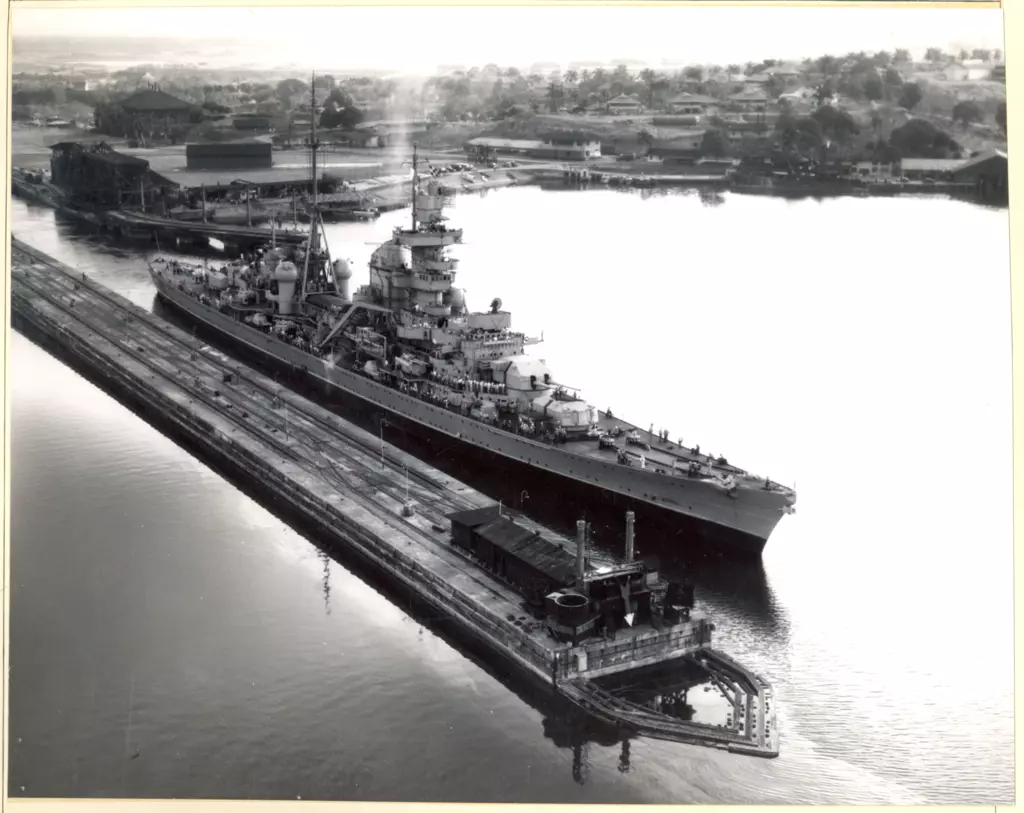
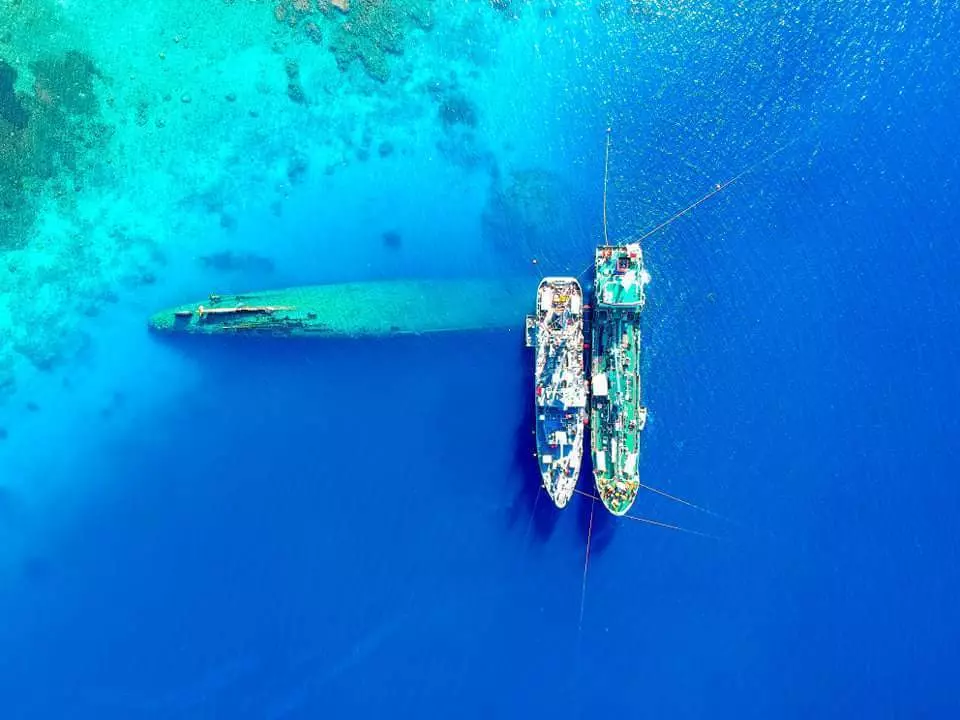
她经费城和巴拿马运河被拖往太平洋,于3月3日启航。这艘船在两次原子弹爆炸中幸存下来:1946年7月1日的“ Able”试验(空中爆炸)和7月25日的“ Baker”试验(水下爆炸)。“欧根亲王”号停泊在两次爆炸震中约1200码(1100米)处,仅受到轻微损坏;“ Able”爆炸只弯曲了她的前桅并折断了主桅顶部。爆炸未对其造成重大结构损坏,但船体受到了严重的放射性沉降物污染。该舰被拖至中太平洋的夸贾林环礁,由于辐射危险,一处小泄漏未得到修复。1946年8月29日,美国海军将“欧根亲王”号退役。到1946年12月底,该舰状况已极为糟糕;12月21日,它开始严重倾斜。由于打捞队未能及时抵达夸贾林环礁,美国海军试图将其冲滩以防止沉没,但在12月22日,欧根亲王号倾覆并沉没。当舰体翻转时,其主炮塔从炮座中脱落。该舰的船尾,包括螺旋桨组件,仍有部分露出水面。美国政府以不希望受污染的钢材进入市场为由,拒绝了打捞权。1979年8月,该舰的一个螺旋桨被打捞上来,并被安置在德国的拉伯海军纪念馆。该船的船钟目前保存在美国海军国家博物馆,而特格特霍夫号的船钟则保存在奥地利格拉茨。 自1974年起,美国政府开始就该船满载的燃料舱可能发生漏油的危险发出警告。政府担心强台风可能损坏沉船并导致漏油。从2018年2月开始,美国海军(包括海军第一机动潜水与打捞部队)、美国陆军以及密克罗尼西亚联邦联合开展了一项原油清除行动,动用了打捞船USNS Salvor。该打捞船在沉船的燃料舱上凿孔,将原油直接泵入油轮Humber。美国海军宣布,相关工作已于2018年10月15日完成;该项目共提取了约25万美制加仑(95万升)燃油,占沉船剩余燃油量的97%。负责打捞行动的蒂姆·恩格中校表示:“目前已无活跃泄漏点……剩余燃油被封闭在少数内部油箱中,无泄漏且受到多层保护。”