
 换一换
换一换 


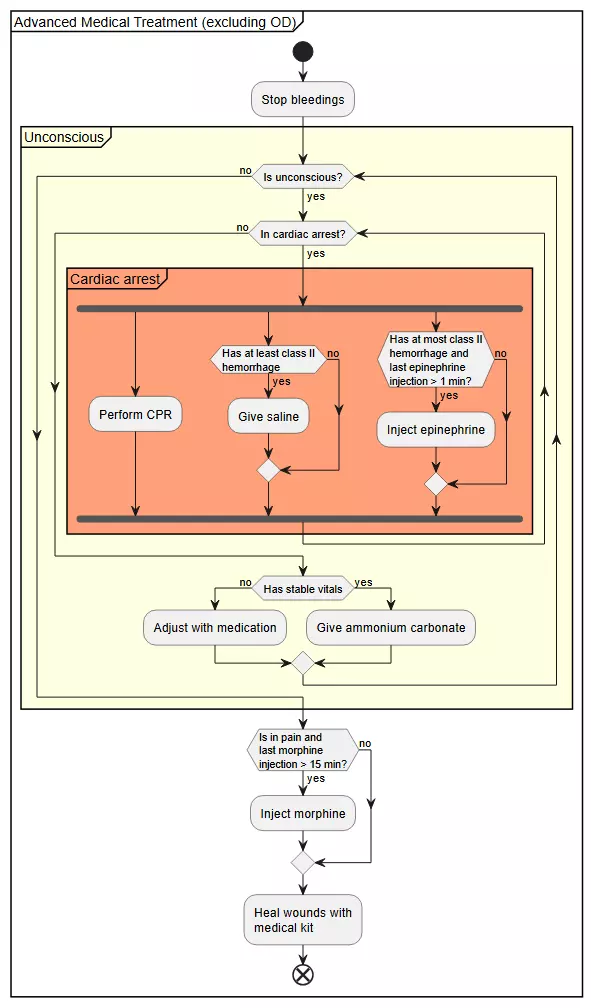
Ace Medical Prototype模组稳定和救治队友深度指南 简介与基本概述 你想要拯救生命,但却不理解这个新型模组医疗系统的工作原理。 美托洛尔到底是什么?应该在什么时候使用? 为什么肾上腺素不像原版游戏那样能让人苏醒? 本指南将详细解答所有这些问题以及更多疑问。 在我们详细分解之前,以下是我推荐你携带到战场上的物品,按我认为的重要性排序,并简要说明其基本作用: 绷带 - 止血。所有玩家都必须携带。 生理盐水 - 补充流失的血容量。 碳酸铵 - 唤醒病情稳定的患者。肾上腺素 - 辅助心肺复苏,提升生命体征。 吗啡 - 缓解疼痛,降低生命体征。避免给失去意识的患者使用。 止血带 - 止住四肢的严重出血。 以上是无论你是谁或扮演什么角色,我都建议携带的物品。以下是医护兵应携带的更专业药物,其他人可能不常需要。 医疗包 - 当你有补给时可治疗他人伤势,与基础游戏相同,还能补充药物、绷带和生理盐水。治疗轻伤需要野战医院或救护车。 去氧肾上腺素 - 减缓出血。 纳洛酮 - 治疗吗啡过量。 美托洛尔 - 降低生命体征。 以下是帮助他人应采取的步骤概要:
现在,来进行更详细的说明。 检伤分类 检伤分类是对患者的初步评估,目的是确定其接受治疗的紧急程度以及所需的治疗措施。你可以通过检伤分类来确定多名患者的优先顺序,或者单纯弄清楚你正在处理的那名患者需要什么。 在本模组中,检伤分类相对简单。 首先,开始前要确保你和患者都处于安全状态。如果你在治疗患者的过程中头部中弹,那你对患者就毫无用处了。同样,如果你在治疗过程中因失血过多而昏迷,作为医护人员你也是无用的,所以在救治他人之前,先处理好你自己的危及生命的伤势。

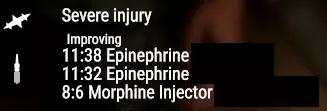
Once you're in relative safety, make note of is the patient's state of consciousness, and if they are unconscious, check for a pulse via interacting with their neck, chest, or limbs. You can then gather additional information about their current status using Check Injuries to get a summary of what's wrong with them. Make note of if the patient is bleeding and to what extent, if they have a hemorrhage and of what class, and if they have a pulse. We'll concern ourselves with high or low heart rate and blood pressure later. Patients with the most severe vitals should be handled first, and you should re-assess the status of your patients as you work. However, there may be situations in which a patient's injuries are so numerous and/or severe that treatment may not be possible under the circumstances you're in, such as lack of resources or assistance, enemy presence, time and difficulty in stabilizing patient before they die of their injuries, and other such complications. In such cases, other patients may need to be prioritized, and/or the patient in question may need to be considered too far gone to help. It's a judgement call, but generally speaking you should handle the worse off people that you're capable of assisting first, and if circumstances allow. Vitals Heart Rate (HR), Blood Pressure (BP), and Hemorrhage class are your patient's vitals. These three values will determine your patient's current status, be it stable, unstable, critical, cardiac arrest, or dead. A patient for whom any of their vitals have entered the critical state will fall unconscious. A patient who remains in cardiac arrest too long or who's hemorrhage becomes too excessive will die. Heart Rate is measured in beats per minute (BPM) The stable range for heart rate is between 40 and 220 BPM A heart rate above 220 will lead to cardiac arrest. A heartrate below 40 is considered unstable. Below 30 is critical. Below 20 will lead to cardiac arrest.A HR outside of stable can be addressed with medications, which will be covered later, or CPR. For now, just worry about it not being 0. Blood Pressure is measured in two values put together. The stable range for BP is between 69/46 and 284/189 A BP higher than 284/189 will lead to cardiac arrest. < 69/46 is unstable < 51/34 is critical.If your patients HR and BP both enter critical ranges, it will lead to cardiac arrest. A BP outside of stable can be addressed with medications. Hemorrhage classes summarize the amount of blood your patient has lost. Hemorrhage Class I means your patient has lost < 30% of their blood volume, and is considered stable, as is no blood loss at all, of course. Class II is >30% lost, and is considered unstable. Class III is > 60% lost, and is considered critical Class IV is >80% lost, and will lead to cardiac arrest. Your patient will exsanguinate, which is fatal, at 100% blood loss. Bleeding and CPR The most important step in medical treatment is ensuring the patient stops getting worse. Your first priority is to stop any and all bleeding as soon as possible using bandages, and in severe cases, tourniquets. Note: if using a tourniquet, it's good practice to then apply bandages to the effected limb, and once wounds have been sufficiently bandaged, to remove the tourniquet. If, while attending to heavy bleeding, you suspect or confirm a severe hemorrhage, provide saline to prevent the patient exsanguinating. Once bleeding has been stopped, confirm that the patient is unconscious, and if they have no pulse. Patients without a pulse are in Cardiac Arrest, immediately perform CPR. If you're alone, you will have to do your best to take other life saving measures in-between sets of chest compressions. Approximately every 30 seconds, pause chest compressions and check the patient's pulse. If it returns to 0, immediately restart CPR. If you have help, direct someone to do CPR while you take other life saving measures. Have them stop approximately every 30 seconds and check the patient's pulse. If it returns to 0, immediately restart chest compressions. If you check a patient's pulse while CPR is underway, they will show as having a pulse, you must stop CPR to confirm if the patient's heart is beating. In addition to CPR, you may need to address a patient's hemorrhage. If the patient has a class II hemorrhage or greater, this will decrease your chances of successfully restoring a pulse while performing CPR. If it's Class IV, the patient's heart will not restart. Provide saline and continue CPR, and continue providing saline if necessary. Finally, epinephrine improves your chances of successfully restoring a pulse. Administer it whilst continuing CPR, however, wait at least 60 seconds between doses. Continue CPR until patient's pulse is restored. Medication Now that the patient's heart is beating, lets get them stable and wake them back up. We discussed the various vitals and where we want them to have the patient be considered stable, so lets look at how we manipulate them: Medications. There are a variety of medications that all do different things, which I will summarize here. Glossary: T Max: Time to maximum effect T 1/2: Time to half effect LD-50: How many doses will cause cardiac arrest in 50% of patients. TD 50: How many doses will render 50% of patients unconscious. Ammonium Carbonate ("Smelling Salts") Used to wakes up stable, unconscious patients. Will have no effect if the patient is not stable. T Max: 2.3 seconds T 1/2: 3-4 seconds Epinephrine ("Epi") Used to increase HR and BP, and assists when performing CPR. Increases Revive Chance Increases HR Increases BP T Max: 23 s T 1/2: 1 minute 3 seconds LD 50: 4.4 Metoprolol Used to decreases excessive HR and BP. Decreases HR Decreases BP T Max: 25 s T 1/2: 1 min 9 s TD 50: 3.1 LD 50: 3.8 Morphine Suppresses pain Generally should not be administered to unconscious patients. Decreases HR Decreases BP T Max: 1 min 57 s T 1/2: 15 min 20 s TD 50: 3.1 LD 50: 3.8 Naloxone ("NARCAN") Used to counteract over-usage of narcotics. Treats morphine overdose. T Max: 1 min 35 s T 1/2: 7 min 26 s Phenylephrine Slows down bleeding and transfusion Increases BP T Max: 29 s T 1/2: 1 min 18 s LD 50: 2.9 Using the above medications, you can improve your patient's Heart Rate and Blood Pressure if they are not stable, or otherwise improve their condition. Often, a patient who's heart has been restarted with CPR and Epi and who's hemorrhage has been treated will usually be stable on their own, unless drugs have been administered to them excessively. Use caution when administering Morphine to yourself or others, as multiple doses can stop someone's heart. If you come upon a patient with no apparent injuries, a dangerously low heart rate or in cardiac arrest, and their recent medication includes multiple doses of Morphine, administer Naloxone and monitor their vitals for improvement. As always, if a patient has no pulse, begin CPR immediately. You can see the history of a patient's recent medications by using Check Injuries. Note: The times displayed are in-game time, however the duration of medication's effectiveness are in real-time.
总结与回顾 现在你的患者已经苏醒,使用检查伤势确认他们是否还有其他需要处理的情况,例如轻微出血或需要用医疗包治疗的肢体损伤,与基础游戏中的操作相同。如果患者感到疼痛且距离上次注射吗啡已超过15分钟,你也可以为其注射吗啡。 恭喜,你拯救了一条生命! 简要回顾步骤如下: 1. 止住患者的所有出血。 2. 如果患者没有脉搏,通过心肺复苏、肾上腺素和生理盐水(根据需要)恢复其脉搏。 3. 使用药物稳定患者的生命体征。 4. 给生命体征稳定的患者使用碳酸铵使其苏醒。 5. 根据需要给予任何额外的药物或生理盐水。致谢与来源 本指南大部分信息来源于Ace GitHub,包括流程图、药物数据及详情等具体内容。 请注意,部分具体数值可能会被服务器管理员修改。如果本指南中的某些内容看起来有问题,这可能是原因之一。 若你发现任何错误或有补充信息,欢迎在评论区告知。