
 换一换
换一换 


An incredibly flexible civ, Brazil can perform well at cultural, domination, religious and scientific victories alike, and has a particular focus on Great People. Here, I detail Brazilian strategies and counter-strategies. Introduction Following this guide requires the Gathering Storm expansion. It also assumes you have all other Civ 6 content, listed below, though it is not necessary to have these to utilise the key strategies of each civ. Pre-Rise and Fall content packs Vikings, Poland, Australia, Persia/Macedon, Nubia, Khmer/Indonesia Rise and Fall Expansion New Frontier content packs Maya/Grand Colombia, Ethiopia, Byzantium/Gauls, Babylon, Vietnam/Kublai Khan, Portugal I remain not minister nor President, but still an Emperor in an age of ascendant republics. Positioned from birth to rule, but my heart belongs to God and humanity, and my mind to culture and the sciences. Let my legacy not be a conquering empire, towering statues nor lavish events, but only this: peace and prosperity for Brazil. How to use this guide This guide is divided into multiple sections explaining how best to use and play against this specific civ. The Outline details the mechanics of how the civilization's unique features work and what their start bias is if they have one. The Victory Skew section describes to what extent the civ (and its individual leaders where applicable) is inclined towards particular victory routes. This is not a rating of its power, but an indicator of the most appropriate route to victory. Multiple sections for Uniques explain in detail how to use each special bonus of the civilization. Administration describes some of the most synergistic governments, government buildings, policy cards, age bonuses, pantheons, religious beliefs, wonders, city-states and Great People for the civ. Only the ones with the most synergy with the civ's uniques are mentioned - these are not necessarily the "best" choices when playing as the civ for a given victory route. Finally, the Counter-Strategies discusses how best to play against the civ, including a consideration of leader agendas if the civ is controlled by a computer. Note that all costs (production, science, etc.) mentioned within the guide assume a game played on the normal speed settings. To modify these values for other game speeds: Online: Divide by 2 Quick: Divide by 1.5 Epic: Multiply by 1.5 Marathon: Multiply by 3 Glossary Terminology used in this guide and not in-game is explained here. AoE (Area of Effect) - Bonuses or penalties that affect multiple tiles in a set radius. Positive examples include Factories (which offer production to cities within a 6 tile radius unless they're within range of another building of the same type) and a negative example is nuclear weapons, which cause devastation over a wide radius. Beelining - Obtaining a technology or civic quickly by only researching it and its prerequisites. Some deviation is allowed in the event that taking a technology or civic off the main track provides some kind of advantage that makes up for that (either a source of extra science/culture or access to something necessary for a eureka or inspiration boost) CA (Civ Ability) - The unique ability of a civilization, shared by all its leaders. Compact empires - Civs with cities close together (typically 3-4 tile gaps between city centres). This is useful if you want to make use of districts that gain adjacency bonuses from other districts, or to maximise the potential of area-of-effect bonuses later in the game. Dispersed empires - Civs with cities that are spread out (typically 5-6 tile gaps between city centres). Civs with unique tile improvements generally favour a more dispersed empire in order to make use of them, as do civs focused on wonder construction. GPP - Short for Great Person Points. Districts, buildings and wonders generate these points and with enough you can claim a Great Person of the corresponding type. GWAM - Collective name for Great Writers, Artists and Musicians. All of them can produce Great Works that offer tourism and culture, making them important to anyone seeking a cultural victory. LA (Leader Ability) - The unique ability of a specific leader. Usually but not always, they tend to be more specific in scope than civ abilities. Some leader abilities come with an associated unique unit or infrastucture. Prebuilding - Training a unit with the intention of upgrading it to a desired unit later. An example is building Slingers and upgrading them once Archery is unlocked. Sniping - Targeting a specific city for capture directly, ignoring other enemy cities along the way. Typically used in the context of "capital sniping" - taking a civ's original capital as quickly as possible to contribute towards domination victory without leading to a drawn-out war. Start bias - The kind of terrain, terrain feature or resource a civilization is more likely to start near. This is typically used for civilizations that have early bonuses dependent on a particular terrain type. There are five tiers of start bias; civs with a tier 1 start bias are placed before civs of tier 2 and so on, increasing their odds of receiving a favourable starting location. Super-uniques - Unique units that do not replace any others. Examples include India's Varu and Mongolia's Keshigs. Tall empires - Empires that emphasise city development over expansion, usually resulting in fewer, but bigger, cities. Uniques - Collective name for civ abilities, leader abilities, unique units, unique buildings, unique districts and unique improvements. UA (Unique Ability) - A collective name for leader abilities and civ abilities. UB (Unique Building) - A special building which may only be constructed in the cities of a single civilization, which replaces a normal building and offers a special advantage on top. UD (Unique District) - A special district which may only be constructed in the cities of a single civilization, which replaces a normal district, costs half as much to build and offers some unique advantages on top. UI (Unique Improvement) - A special improvement that can only be built by the Builders of a single civilization. "UI" always refers to unique improvements in my guides and not to "user interface" or "unique infrastructure". UU (Unique Unit) - A special unit that may only be trained by a single civilization, and in some cases only when that civilization is led by a specific leader. Wide empires - Empires that emphasise expansion over city development, usually resulting in more, but smaller, cities. Outline (Part 1/2) Start Bias

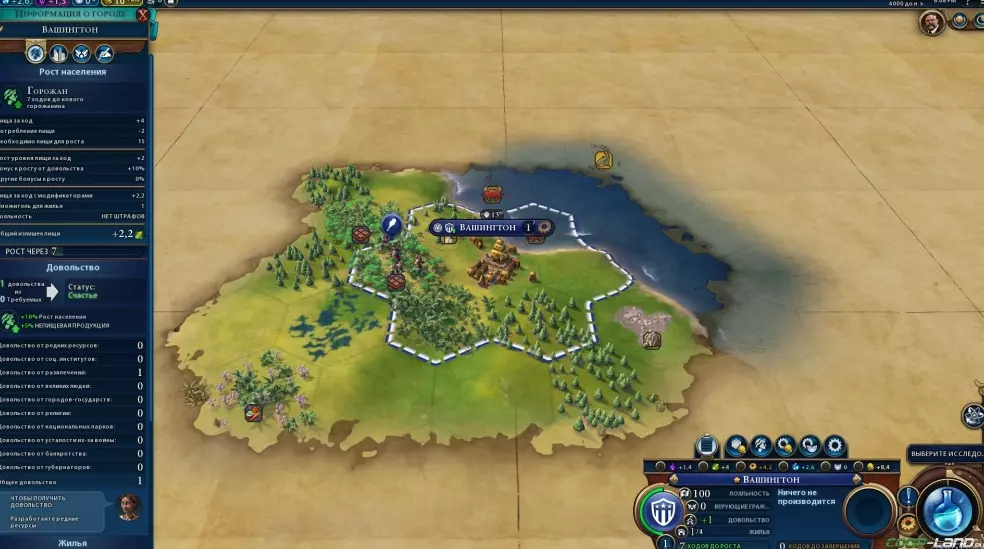
巴西有二级雨林地块的出生倾向。这对于利用文明能力至关重要。雨林丘陵作为未改良地块也有不错的产出,有助于让你的开局更强一些,并且在文艺复兴时期的重商主义市政下,你可以用锯木厂改良它们以获得更好的产出。 文明能力:亚马逊 雨林地块为学院、商业中心、圣地和剧院广场区域提供+1相邻加成。 这不会与学院每两个相邻雨林地块提供+1科技的常规加成叠加。巴西拥有的雨林对相邻地块提供+1吸引力,而非-1。 佩德罗二世的领袖能力:宽宏大量

通过招募或赞助获得伟人后,将返还其伟人点数花费的20%。这是上一位伟人全部花费的20%,无论你是否使用了赞助(例如,若上一位伟人花费660点,你将以132点开始下一位伟人的积累)。特色单位:米纳斯吉拉斯级战列舰
工业时代海军远程单位,替代战列舰 研究 淘汰 升级自 升级至 成本 资源 维护费用

民族主义 公民 工业时代

激光* 科技 信息时代

护卫舰(310

无法识别或无法翻译,已删除。

)

导弹巡洋舰
无法翻译的内容已删除

无法识别内容,已删除。

无法识别或无法翻译,已删除。
无法识别内容,已删除。
6
无法识别内容,已删除。
如果无法获取石油,即使研究了激光技术,你仍可以继续建造米纳斯吉拉斯级单位。 战斗力:70 远程战斗力 移动力 射程 视野 负面属性 正面属性

95

80

5

3
2

无法占领城市 对城市防御造成全额伤害。 间接火力 - 可越过障碍物攻击目标。 组建舰队或舰队群仅增加7点防空强度,而非预期的10点或17点。 变量变更 现在需要工业时代的【民族主义】市政,而非现代的【炼油】科技。 这意味着该单位在【强制征兵】政策卡(文艺复兴时代,需【探索】市政)下建造速度更快,而非【国际水域】政策卡(原子时代,需【冷战】市政)。 这也使得现代时代的【伟大海军上将】对其无效,但文艺复兴时代的【伟大海军上将】将提升其速度和强度。正面改动: 70力量(原为60) 95对空力量(原为90) 80远程力量(原为70) 概述(第2/2部分) 独特区域:街头狂欢节

古典时代特色区域,替代娱乐中心 研究需求 地形要求 建造条件 基础生产力消耗 维护费用 掠夺产出

游戏与娱乐 市政 古典时代 您领土内任何可通行的陆地地块。 该城市不能已拥有科帕卡巴纳区。

竞技场

动物园

体育场 27
无法识别或无法翻译,已删除。
无法识别内容,已删除。

无法识别内容,已删除。
掠夺者恢复25点生命值。所有区域的成本会根据你的科技和市政进度增加。如果你拥有的特色区域数量大于或等于已解锁的特色区域类型数量,且前者除以后者的结果大于你拥有的该区域的数量,你将获得40%的折扣。 用金币购买区域需要城市中派驻拥有“承包商”晋升的总督蕾娜(金融家)。用信仰购买区域需要城市中派驻拥有“神圣建筑师”晋升的总督莫克沙(红衣主教)。 相邻加成:无 其他产出:2 伟人点数:无 其他效果:无

启用“面包与马戏”城市项目 启用“狂欢节”城市项目 通往该城市的国内贸易路线提供+1

通往这座城市的国际贸易路线提供+1
相邻地格吸引力+1 正面改良的建造费用-50% 提供的宜居度从1提升至2 解锁城市项目【狂欢节】 城市项目【狂欢节】在进行时提供1点宜居度,完成后提供伟人点数(工程师、商人、作家、艺术家和音乐家) 提供的伟人点数等同于【剧院广场】的【庆典】项目,外加【商业中心】【投资】项目的一半和【工业区】【物流】项目的一半 特色区域:科帕卡巴纳

工业时代特色区域,替代水上乐园 研究要求 地形要求 建造要求 基础生产力消耗 维护费用 掠夺产出

自然历史 市政 工业时代

你领土内任何无特征且邻接陆地的海岸或湖泊地格。该城市不能已拥有街道狂欢节区域。

摩天轮

水族馆

水上运动中心 27
无法识别或无法翻译,已删除。
无法识别内容,已删除。
无法识别内容,已删除。
掠夺者恢复25点生命值。所有区域的成本会根据你的科技和市政进度增加。如果你拥有的特色区域数量大于或等于已解锁的特色区域类型数量,且前者除以后者的结果大于你拥有的该区域的数量,你将获得40%的折扣。 使用金币购买区域需要城市中派驻拥有【承包商】晋升的总督蕾娜(财务官)。使用信仰购买区域需要城市中派驻拥有【神圣建筑师】晋升的总督莫克夏(红衣主教)。 相邻加成:无 其他产出:2 伟人点数:无 其他效果:无
启用【面包与马戏】城市项目 启用【狂欢节】城市项目 通往该城市的国内贸易路线提供+1
通往这座城市的国际贸易路线提供+1
相邻地格获得+1魅力 正面改良项的建造费用-50% 提供的宜居度从1提升至2 解锁【狂欢节】城市项目 【狂欢节】城市项目在进行时提供1点宜居度,完成后提供伟人点数(工程师、商人、作家、艺术家和音乐家) 提供的伟人点数相当于【剧院广场】的【节庆】项目,加上【商业中心】【投资】项目的一半和【工业区】【物流】项目的一半 胜利倾向 在本节中,将根据文明对特定胜利类型的倾向程度进行主观评分——而非其强度。评分3分或以上意味着该文明在该胜利路线上至少具有轻微优势 领袖

ćĺ

ĺ¤äş¤

控制模式

ĺŽć

科学 佩德罗二世 8/10 (良好) 5/10 (尚可) 7/10 (良好) 7/10 (良好) 7/10 (良好) 对于巴西来说,文化胜利比其他胜利方式略占优势,这主要得益于其两个独特区域的特性。狂欢节项目所能产出的所有伟人都有助于文化胜利,同时这两个区域造价低廉,能让你更快建造需要它们的旅游加成建筑。此外,雨林相邻加成意味着巴西的剧院广场能获得特别高的文化产出,而雨林吸引力加成对国家公园和海滨度假胜地也十分有利。一旦摇滚乐队出现,雨林相邻带来的额外信仰值将尤其有用。外交是巴西最薄弱的路线,但这并不意味着它不可行。雨林提供的额外商业中心相邻加成是援助紧急情况的良好黄金来源,米纳斯吉拉斯级战列舰非常适合用于军事紧急情况,能够招募更多伟人尤其有助于获得提供使者的伟人,而文明的整体多功能性有助于完成城邦任务。 统治胜利是一个可行的选择,在水域极多的地图上可能是最佳选择。米纳斯吉拉斯级战列舰是一个强大的特色单位——组建一支舰队,它能在三个时代之前就拥有与导弹巡洋舰相当的远程强度!你也可以将邻近雨林的圣地与“神圣道路”万神殿搭配使用,以产出大量信仰值,然后结合“大主教堂”用信仰值购买陆地单位。得益于巴西独特的区域,战争疲劳应该不成问题。 圣地从邻近的雨林获得额外信仰值,将这一点与“神圣道路”万神殿相结合,你就能在游戏早期获得巨大的信仰产出。如果宗教胜利不可行,你可以将所有这些信仰值用于伟人赞助。 最后,科技胜利也能获得一定优势。尽管学院每片雨林仅提供+1科研值(并非你可能期望的+1.5),但这仍然是一个相当可观的加成。对雨林地块的高度重视也能帮助你从动物园建筑中获得更多科技值——而动物园恰好可以建造在独特的街道狂欢区中。最后,佩德罗的领袖能力有助于你获得更多的大科学家和大工程师。 文明能力:亚马逊
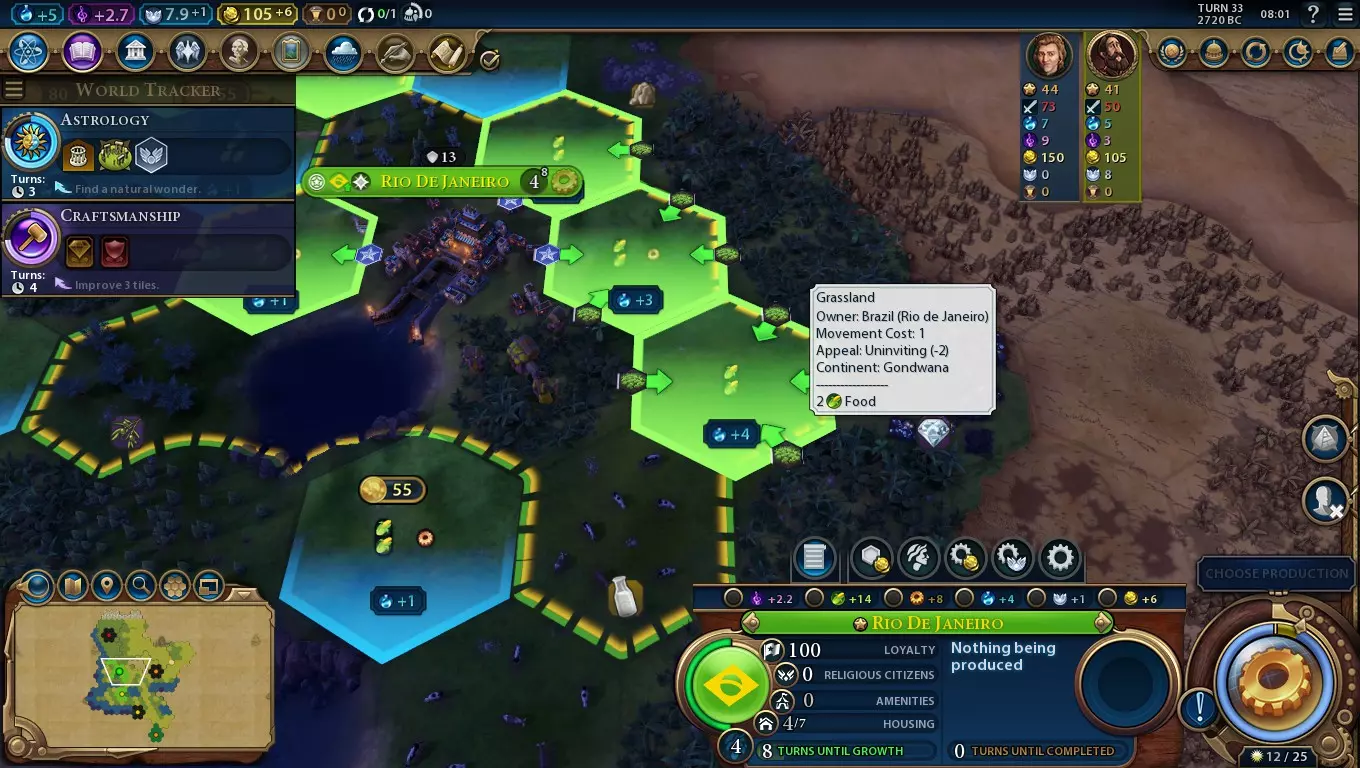
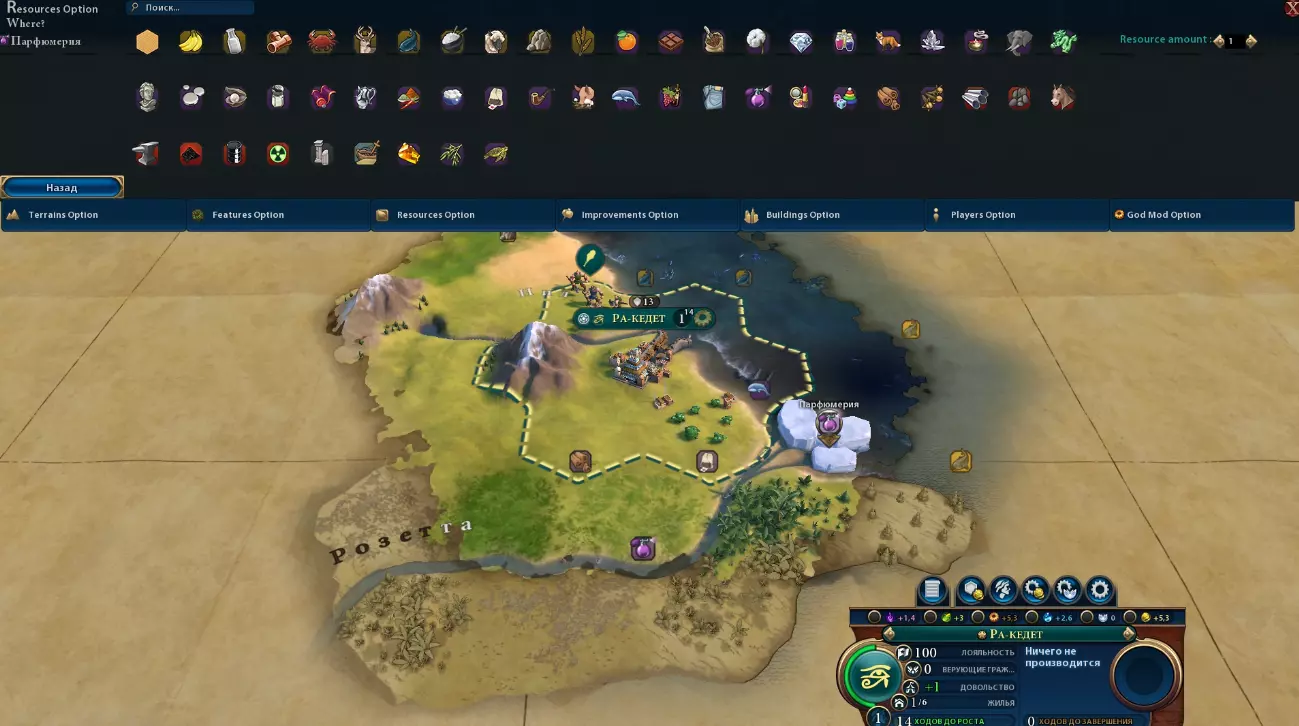
Brazil's civ ability offers a strong advantage to any victory route - so long as you can settle near rainforests and don't cut them all down. Your start bias will usually place you near a few rainforests, and with rainforest hills yielding 2 food and 2 production, you can get off to a reasonable start. Extra yields from rainforest adjacency Brazilian Campus, Holy Site, Commercial Hub and Theatre Square districts gain extra adjacency bonuses from rainforest tiles. To make the most of this ability, try to settle as many cities around rainforest as you can. It's a bad idea to settle a city right in the middle of a dense rainforest region as you won't have many free tiles to improve, but instead, if you encounter such an area, surround it with cities instead. Settling lots of cities will help maximise your number of possible districts, and it'll also be useful for maximising your output of Great Person Points, which you'll need in turn to make good use of Pedro's ability. Problems you might have regarding amenities can be sorted out later with the Street Carnival or Copacabana UDs. Let's look more closely at the four affected districts: Campus - Although these districts gain the least (adjacent rainforests simply contribute twice as much rather than three times as you might expect), more science is still a very good bonus to have. Unless you're after a religious victory, you'll usually want these first. Holy Site - Take the Sacred Path pantheon and rainforests offer +2 faith each to the adjacent Holy Site - as much as a natural wonder! A Holy Site surrounded by rainforests gets 12 faith in that situation. That's excellent for religious and cultural games alike, but even otherwise you can use faith for Great Person patronage. Add the Work Ethic follower belief on top and Holy Sites can produce a huge amount of production. Commercial Hub - Getting decent adjacency bonuses out of this district isn't hard anyway, but Brazil can make them incredible. Gold is a less useful yield than science or culture, and you can't bump up the yields substantially like you can with Holy Sites and the Sacred Path pantheon, so you should look for the optimum placement of the other districts before you work out where to place Commercial Hubs. Theatre Square - Theatre Square adjacency bonuses are fairly hard to get, and Brazil's unique ability lets you get particularly good ones. Having a high culture output means you can get your incredibly powerful UU out sooner. The other speciality districts don't gain from Brazil's unique ability. Positioning Industrial Zones carefully so they're within six tiles of as many cities as possible will mean you won't need to build so many for a large production boost. If you desperately need production, consider building Commercial Hubs instead so you can use the trade routes for domestic trading. Obviously you'll want to build your unique districts in plenty of cities later on, so restrain your use of Aerodromes and Encampments to make room for them. Having some is still helpful; having Encampments in every city is not. Rainforest appeal Rainforests offer positive instead of negative tile appeal adjacency in Brazilian lands. This is useful for Neighbourhoods, and can boost the tourism of National Parks and Seaside Resorts alike. Ski Resorts are unaffected as appeal adjacency does not affect mountain tiles. While Rainforests don't offer as much appeal as old-growth woods do (unless you have the Biosphère wonder, available at the atomic-era Synthetic Materials technology, in which case they provide more appeal), the positive appeal nonetheless removes a key downside of focusing an empire on rainforest terrain. Side-effects Brazil's heavy rainforest focus has a few helpful side-effects. Having a lot of rainforest around should help you resist the risk of drought events, and also acts as a natural barrier to would-be attackers. Don't simply neglect your defences, however - civs like Kongo can easily slip through rainforest, and rough terrain can make retreating enemies harder to kill. Furthermore, rainforest is susceptible to forest fires; that will boost the tiles' yields at the cost of pillaging improvements. With the renaissance-era Mercantilism civic, you can build lumber mills on rainforests for extra production. Rainforest lumber mills tiles offer a minimum of +3 production and +2 food, allowing you to get a handy production boost while still having enough food to cover the citizen working the tile. This becomes really effective once you have the industrial-era Natural History civic and are able to build Zoos in your Street Carnival districts. They make all rainforest and marsh tiles in their city offer +1 science - including rainforests with lumber mills. Finally, keeping rainforest around can help you in the space race. Any civ can use Builders to rush space projects via the Royal Society building, but it's limited to one use per turn per project. A science-oriented Brazil can do one better. Keeping a lot of rainforests around until late in the game means you're free to chop them down for extra production, letting you get space projects finished in much less time. Just be sure you don't hurt your science or production yields too much in the process. Summary Settle extensively so you can maximise the bonus. Settle around rainforests, not in the middle of them so more cities can benefit. Build lumber mills and Zoos to maximise rainforest yields. The Sacred Path pantheon combined with the Work Ethic follower belief makes Holy Sites an immense source of production. Cultural players can make use of the extra appeal of rainforests for National Park and Seaside Resort tourism. Domination players should push for high Theatre Square adjacency bonuses to get to Nationalism sooner. Religious players can enjoy Sacred Path's boost to Holy Site yields. Scientific players should build lots of Campus districts, and can chop down the rainforests at the end of the game to rush space race projects. Pedro II's Leader Ability: Magnanimous
无法识别或无法翻译,已删除。
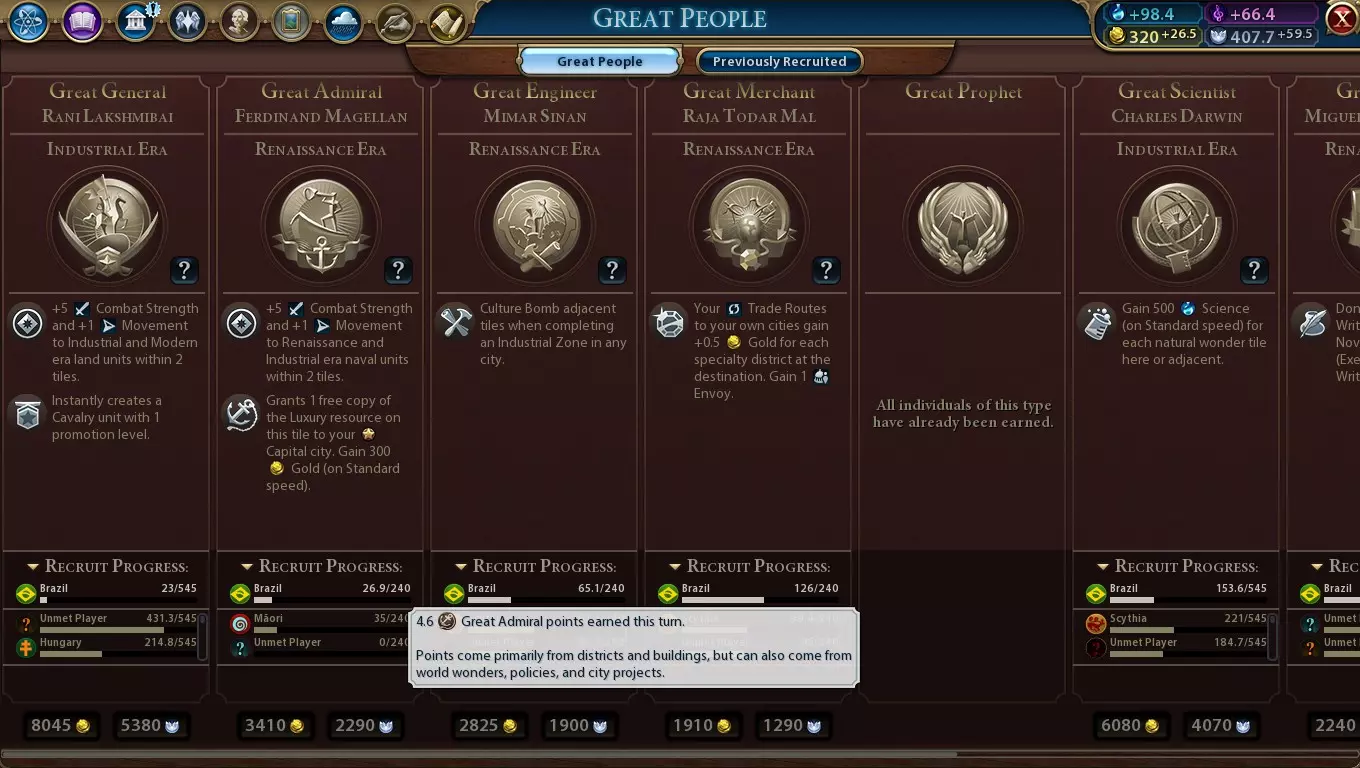
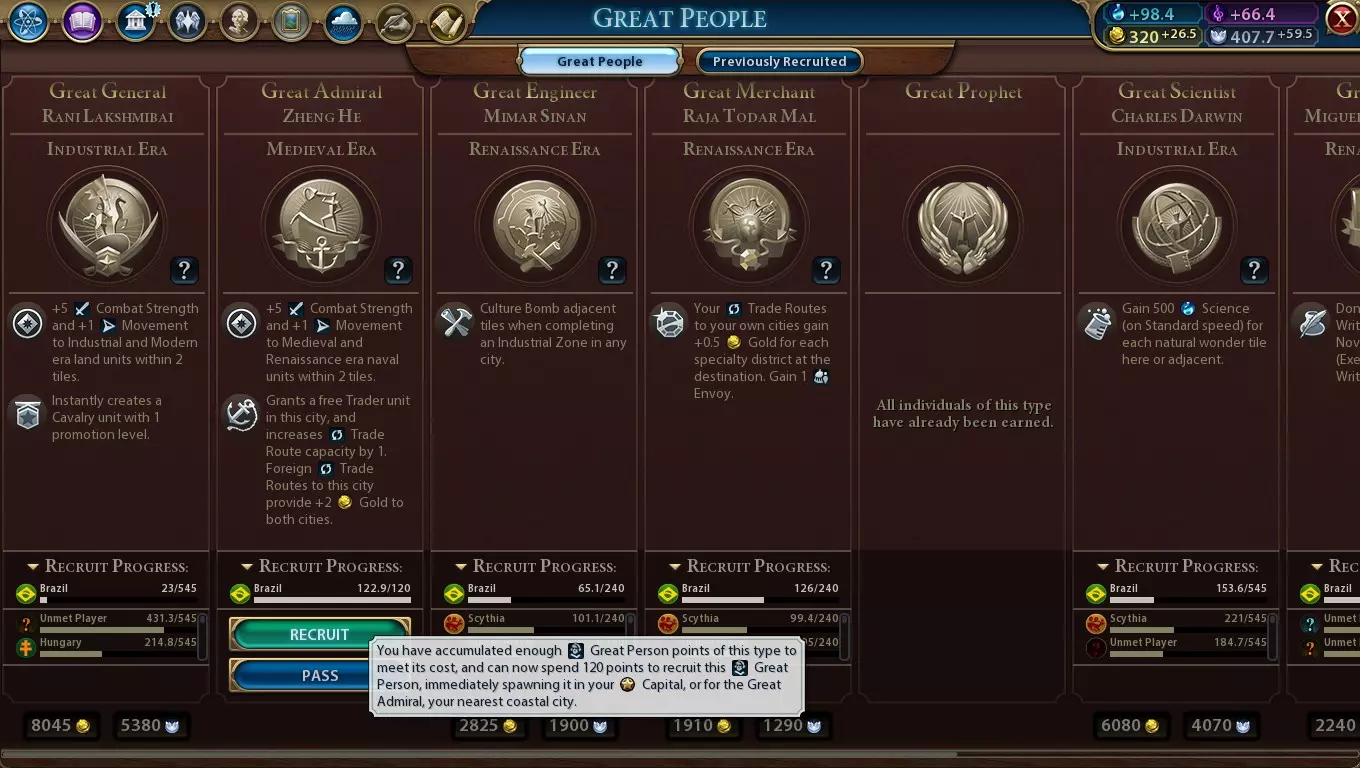
### 通用用法 佩德罗二世的领袖能力能帮助你获得更多你想要的伟人类型,每次生成一位伟人时,都会返还大量点数。如果你通过亚马逊文明能力获得了大量城市以最大化产出,你也会生成大量伟人点数来辅助这个能力。 记住,你生成的伟人越多,这个能力就越强大。如果你从不生成伟人,就永远不会获得这里的加成。记得在你的区域中建造大量建筑,以最大化生成伟人的几率! 不要忘记赞助——你需要大量金币或信仰来进行赞助,但这能显著加快伟人的生成速度。就这一用途而言,信仰比黄金更有用,但商业中心能提供大商人点数,而佩德罗的领袖能力对圣地和大预言家毫无用处,因为你最多只能生成一个大预言家。 佩德罗领袖能力最大的问题在于范围太广,你不可能追逐所有不同类型的伟人。值得庆幸的是,有个东西能帮上大忙——狂欢节项目,在拥有任意一种独特区域的城市中即可启用。该项目能产出大工程师、大商人、大作家、大艺术家和大音乐家点数。再加上亚马逊能力所强化的区域,你将特别擅长生成大作家、大艺术家、大音乐家、大商人和大工程师——这种组合尤其适合文化胜利。在游戏后期,尽可能囤积大量金币和/或信仰值可能是值得的,这样你就能负担得起关键后期伟人的赞助费用。例如,一些最后的大商人能提供可观的旅游业绩加成。 特殊用途 获得伟人时能返还伟人点数,这使得巴西在同一时代获取多个伟人方面具有独特优势。如果你在玩一个战争密集型的游戏(例如多人游戏),可以尝试获取某个时代所有的大将军或大 admiral,以阻止其他文明获得速度和力量加成。这通常不是巴西的最佳玩法,但存在这种选择。 特色单位:米纳斯吉拉斯级战列舰
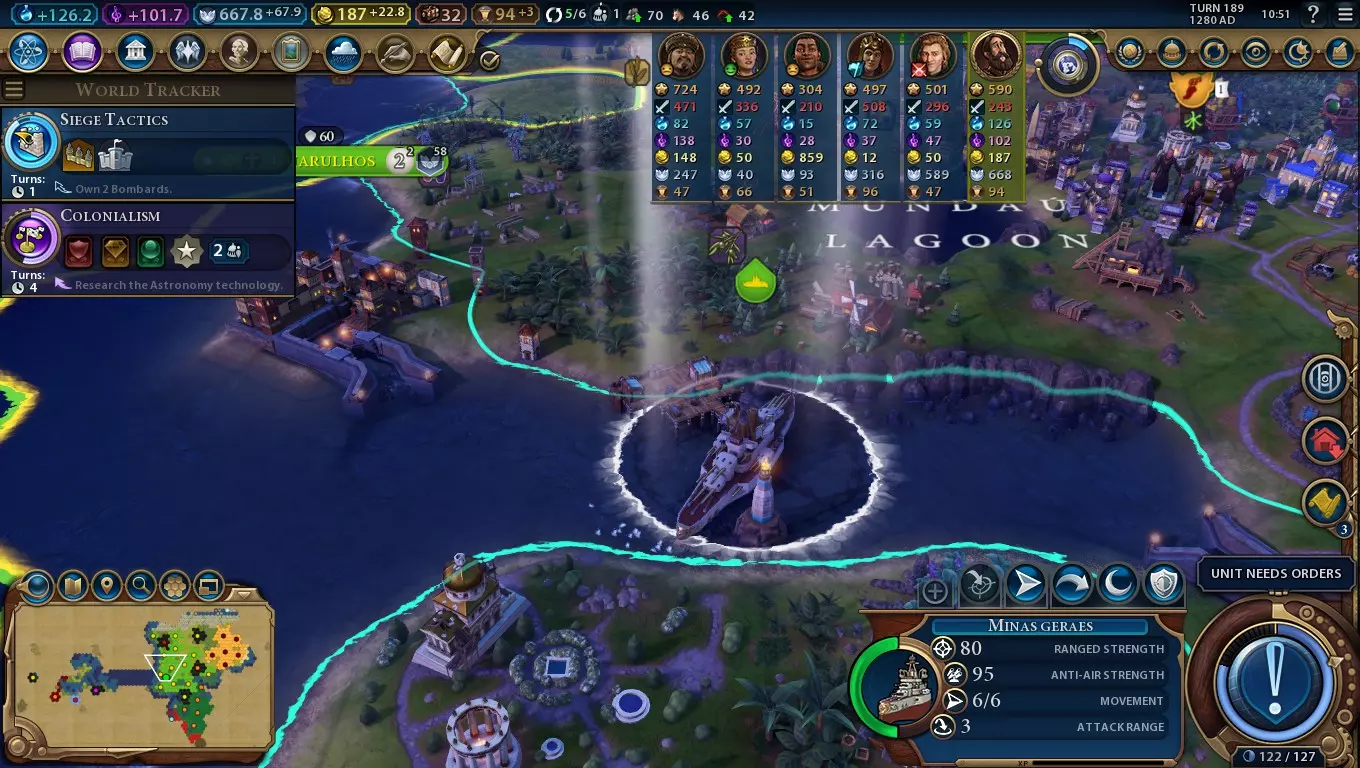
The Minas Geraes is basically an atomic-era unit that got lost and ended up in the industrial era. This thing is almost as powerful as a Missile Cruiser at attacking, defends just as well against melee attacks (albeit a fair bit weaker against air units), while arrivng at a time when most civs will still be using Caravels and Frigates. On water-heavy maps, it'll help you significantly on the road to domination victory. Preparation Minas Geraes units require the industrial-era Nationalism civic, but you'll also need the industrial-era Industrialisation technology to provide coal. Due to the sheer power of this unit, you'll want it as fast as you can, so make sure you have plenty of Theatre Squares and Campuses surrounded by rainforests. Don't forget to build Monuments as well! Assuming you have the Games and Recreation, Political Philosophy and Drama and Poetry civics, here's all the ones you need for Nationalism: Defensive Tactics - Boost: Be the target of a declaration of war (Out of your control) Recorded History - Boost: Have two Campus districts (You should do this anyway thanks to all the science you can get) Feudalism - Boost: Have six farms (Not too hard unless your cities are in very hilly regions) Civil Service - Boost: Get a city to size 10 (Usually better to get this after Feudalism to increase your odds of getting the boost) Medieval Faires - Boost: Have four trade routes active simultaneously (Can be tricky depending on how quickly you can develop districts.) Guilds - Boost: Build two Markets (If you have enough Commercial Hubs for Medieval Faires, this isn't too much of a stretch) Humanism - Boost: Earn a Great Artist (Tricky! If you've been using your Carnival project a lot you've got a chance, but otherwise you'll most likely have to hard-research this.) Diplomatic Service - Boost: Have an alliance with another civ (Any civ you've befriended can usually be allied easily) The Enlightenment - Boost: Earn three Great People (Easy enough for Brazil.) Nationalism - Boost: Declare war using a casus belli (Just hard-research this one) You'll probably want to make a detour to Exploration at some point. That'll offer you a decent government, pass through the Mercenaries civic (which offers the Professional Army policy card, havling the cost of upgrading Frigates to Minas Geraes units) and the Press Gangs civic card, offering a 100% production boost to renaissance and industrial-era naval units. Normal Battleships don't get a production boost civic card until the atomic-era International Waters card, so you've got yet another advantage over other civs! As for the technology tree, Square Rigging (which unlocks Frigates) is neatly on the way to Industrialisation, allowing you to build Frigates ready for upgrading to Minas Geraes units immediately once Nationalism is researched. Frigates require nitre, but if you lack access to it you can build Quadriremes instead to upgrade to Minas Geraes units later (albeit at a higher price). It's helpful to also research Steam Power so you can bring along some Ironclads to get the last hit on cities, as Minas Geraes can't capture them themselves, though Caravels will still perform reasonably well at the job if you can't spare the coal. It may be helpful to have a few Harbours to help you get a Great Admiral, but the strength advantage of the unit is already so high that the +5 strength boost is often redundant. Building Commercial Hubs instead has more synergy with Brazil's other unique advantages. Because Minas Geraes arrive at Nationalism, you can form them into a fleet immediately, making them even stronger than a Missile Cruiser. In most cases it's redundant to give a unit that strong any more strength, so you generally should hold off from forming a fleet until your enemies have Battleships and Submarines of their own. A curious side-effect of obtaining your first Minas Geraes is that your cities will suddenly jump in strength. The defensive strength of your cities is based on the highest melee strength of any unit you own, and the ranged strength is based on the highest ranged strength of any unit you own. Having a unit that's so ridiculously strong for its era means you'll have very hard cities to take over for quite some time. If you have more oil than you can use, consider putting off researching the Lasers technology. That will allow you to carry on building Minas Geraes units at a fast pace. Although they're a bit weaker than Missile Cruisers, they're significantly more cost-effective. Combat In combat, an 80-strength behemoth up against units like Frigates and Caravels absolutely splatters them - Minas Geraes units will typically destroy the latter in just 1 hit. Land units similarly can be crushed, and city defences fall fast as Battleships have no penalty against them. You will need other units to support them, though - whether to provide a line of sight so they can make use of their huge attack range, or to capture cities.
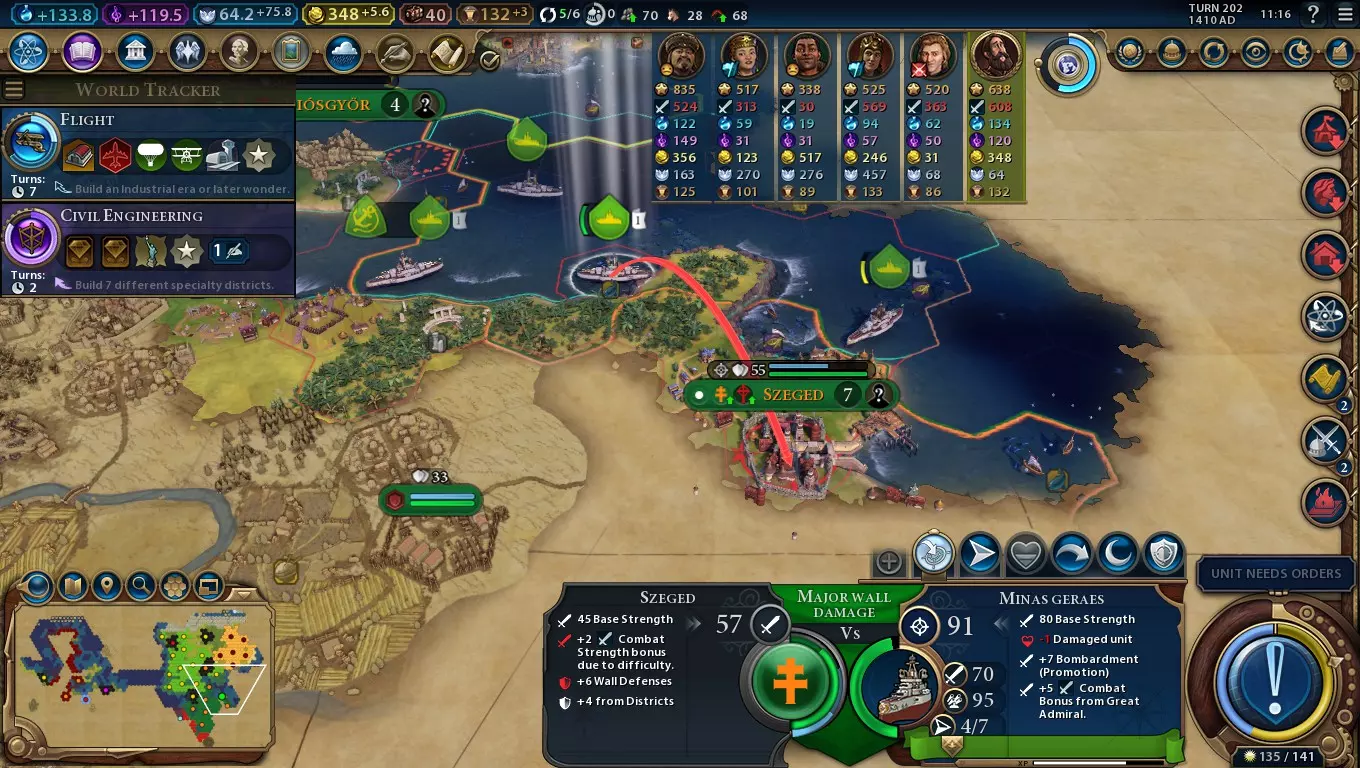
有其他单位为这座城市提供视野,我就能安全摧毁其防御。 一旦潜艇开始出现,没问题——只需将你的卡拉维尔帆船或铁甲舰升级为驱逐舰,它们就会在构成太大威胁前被发现。 早期空中单位通常也不会造成太大麻烦,除非它们拥有扫射晋升(适用于战斗机类飞行器)或鱼雷轰炸机晋升(适用于轰炸机类飞行器),因为米纳斯吉拉斯级单位的对空强度比它们所替代的单位更高。不过,一旦后期飞行器登场,你就需要更强大的对空手段。一艘搭载满战斗机类飞行器的航空母舰应该足够了。结论 就其创造的实力优势而言,米纳斯吉拉斯级战列舰是游戏中最强的独特单位之一。它有两个主要缺点:登场时间较晚,其他文明有时间提前应对;以及在内陆战斗中毫无用处。但在海洋或近海地区,它能在整整两个时代中占据主导地位。 独特区域:街头狂欢节
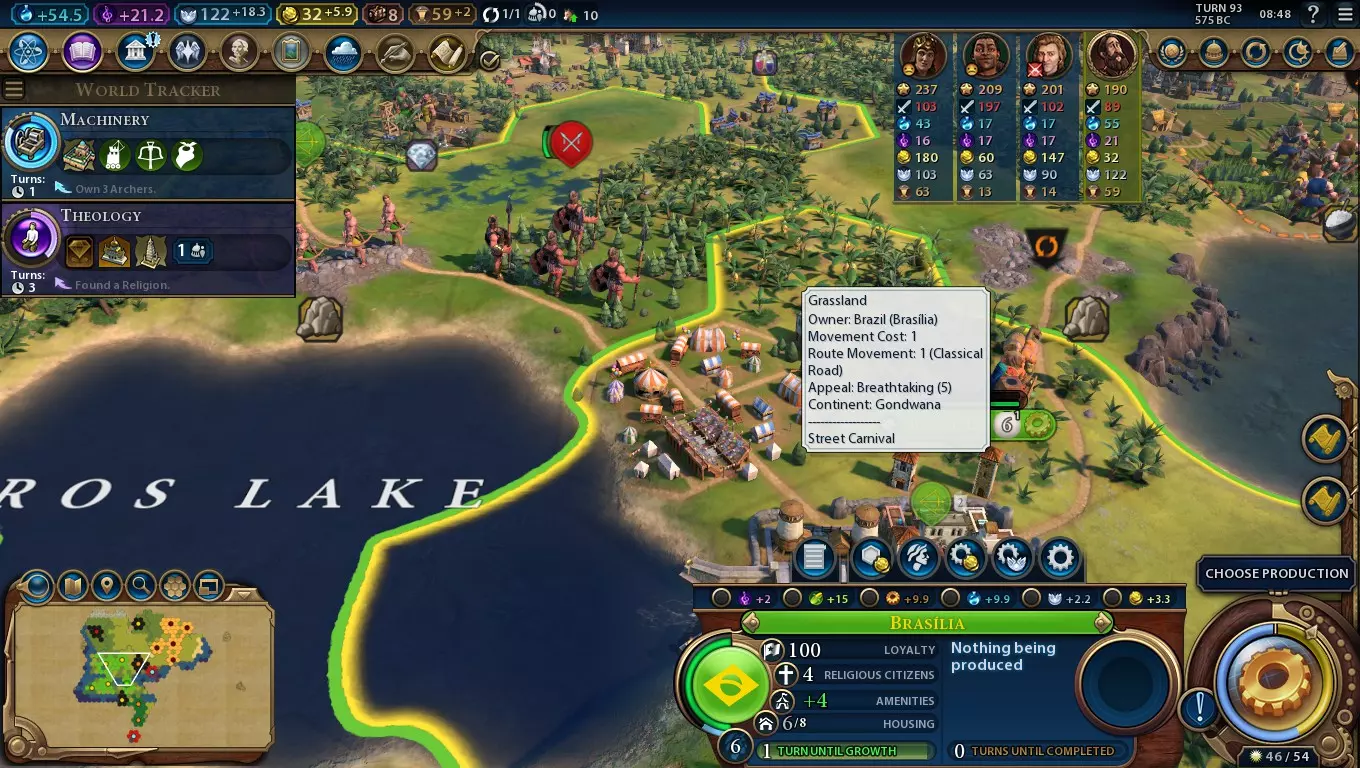
Brazil is unique among civs for having two unique districts: The Street Carnival and the Copacabana. Both have the same unique bonus, though there are differences between the two that affect how they're used. The general mechanics of the unique bonus will be covered here, while a comparison of the two districts will be in the Copacabana section. The Street Carnival may at first appear to be a weak unique district. It doesn't directly produce Great Person Points and lacks adjacency bonuses, so it appears to have poor synergy with other uniques. It also replaces a district which doesn't tend to be built in large quantities. However, via its special project, it's one of the best sources of Great Person Points in the game. Because of the district's dependence on its unique project, you don't need to build any until you have decent production in a city or really need amenities. Unlike most unique districts, rushing Street Carnivals doesn't work so well due to the need to commit production to them once they're done to achieve their full potential. Don't feel too bad about delaying them, but don't delay them too much - generating lots of Great People is still important! Amenities While working on a Carnival project, the city will receive +1 amenity. Often, this will mean one amenity from a luxury resource will be moved from a city working on a Carnival to a different city for its duration. Having lots of amenities provides nice boosts to growth and all yield types, so working plenty of Carnival projects might be more useful than it looks at first glance. At this point, it's worth bringing up amenity mechanics. First things first, cities need 1 amenity per 2 points of population they have. A size 2 or 3 city will require one, a size 4 or 5 city will require two, and so on. A city with a deficit of 7 or more amenities is in revolt. It stops growing, has a -40% penalty to all non-food yields, has -6 loyalty per turn and will cause Barbarians to spawn based on the civ's current military technology every few turns. A city with a deficit of 5 or 6 amenities is in unrest. It stops growing, has a -30% penalty to all non-food yields, has -6 loyalty per turn and will cause Barbarians to spawn based on the civ's current military technology every few turns, albeit in smaller numbers than if it's in revolt. A city with a deficit of 3 or 4 amenities is unhappy. It has a -30% growth rate, a -20% penalty to all non-food yields. and -6 loyalty per turn. A city with a deficit of 1 or 2 amenities is displeased. It has a -15% growth rate, a -10% penalty to all non-food yields and -3 loyalty per turn. A city with between 0 and +2 amenities is content has no yield bonuses or penalties. A city with a surplus of 3 or 4 amenities is happy. It has a 10% bonus to growth, a 10% bonus to all non-food yields and +3 loyalty per turn. A city with a surplus of 5 amenities or more is ecstatic. It has a 20% bonus to growth, a 20% bonus to all non-food yields and +6 loyalty per turn. So, even though Carnivals might not directly offer gold, science, faith or culture, by providing an amenity they can indirectly offer all of these - and even production! Carnivals and Great Person Points When a Carnival is complete, you'll get as many GWAM points as you would have had for completing the Theatre Square Festival project, in addition to half the Great Merchant Points you would have got from the Commercial Hub Investments project, and half the Great Engineer Points you would have got from Industrial Zone Logistics. The exact number scales through the game; the later a project is completed, the more points it grants. Because the Great Person Points output of Carnivals completely eclipses that of Theatre Square Festivals, the only uses of Festivals are if you are either really desperate for culture or do not have a Street Carnival in the city yet. As extra amenities can boost your culture output, that slight advantage will rarely ever be worthwhile. In the last few eras of the game, it's not a bad idea to keep spamming Carnival projects in cities that can manage it. Don't neglect the provision of housing capacity, relevant specialist slots (if you need to boost certain yields in particular), Great Work Slots or your UU, but otherwise you can just keep spamming them. If you've got plenty of amenities and most Great People are completely depleted, switch to regular district projects so you can get better outputs. Unique District: Copacabana
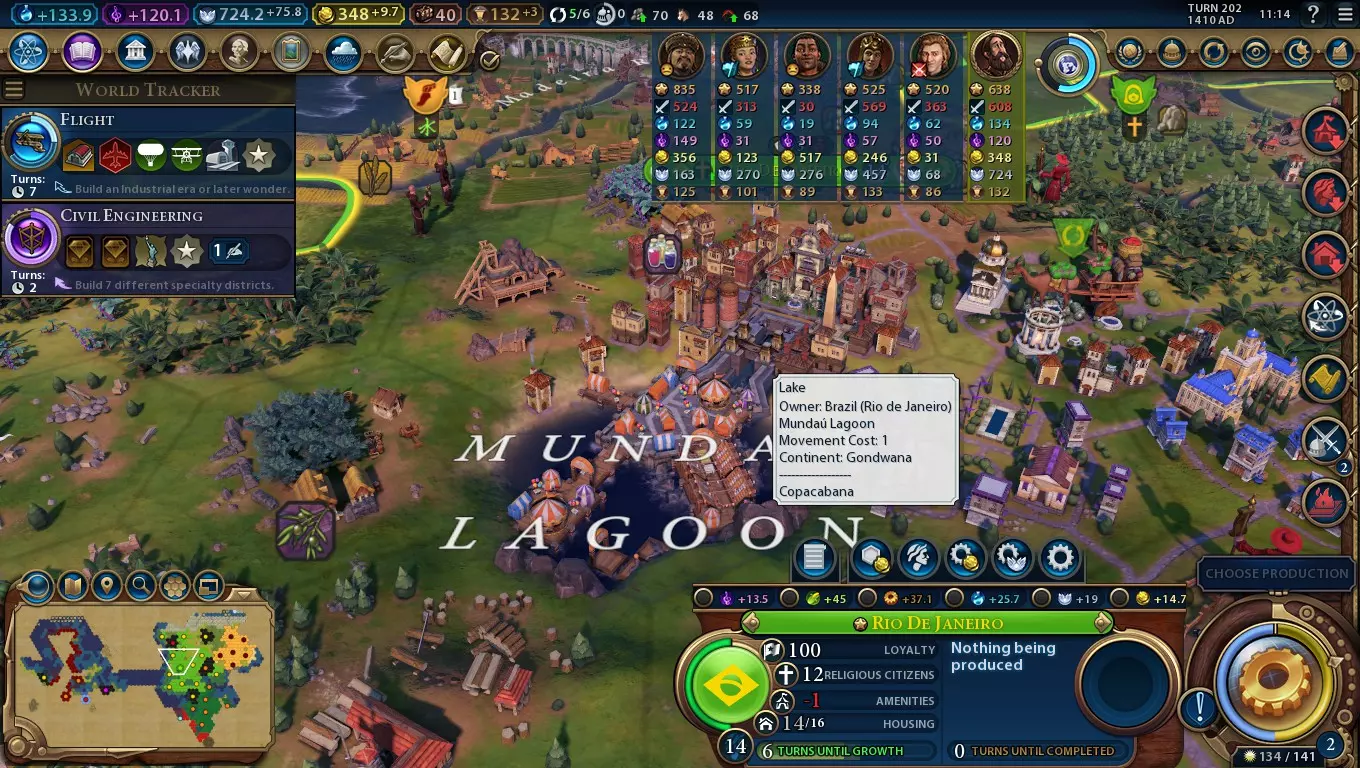
巴西不仅拥有独特的娱乐中心,还有独特的水上乐园,确保你在建造时有选择的余地。这两个区域的独特加成相同,但它们拥有略微不同的附属建筑组合,这可能会决定你将哪个区域放置在何处。 解锁科帕卡巴纳区域: 科帕卡巴纳区域需要工业时代的【博物学】市政,对于文化型文明而言,这无论如何都是一个关键市政。话虽如此,你不应该直奔这个市政——任何拥有足够水域使科帕卡巴纳区域变得特别强大的地图,其水域也足以让你不想太晚获得【民族主义】(以及由此带来的独特单位)。 街头狂欢与科帕卡巴纳区域 通常来说,混合建造街头狂欢节区域和科帕卡巴纳区域会有所帮助,因为两者最终都会提供具有范围性宜居度加成的建筑,但同类建筑的效果不会叠加。选择哪些城市建造哪种区域,取决于哪些完全发展的区域拥有最合适的加成。 以下是这两种区域的一些关键差异对比: 区域:街头狂欢节、科帕卡巴纳 (区域及首个建筑的)市政要求:游戏与娱乐(古典时代)、自然历史(工业时代) 建造要求:城市领土内任何可通行的陆地 tiles。城市不能已拥有科帕卡巴纳区域。您领土内任何无特征且与陆地相邻的海岸或湖泊地格。 城市不能已拥有街道狂欢节区域。 需要区域的奇观:罗马斗兽场(需要竞技场)、马拉卡纳体育场(需要体育场) 无 一级建筑成本:150
ć600
无法识别内容,已删除。
无法识别或无法翻译,已删除。
一级建筑效果 1
无法翻译,已删除。

无法识别或无法翻译,已删除。

with Conservation 1
3
无法识别或无法翻译,已删除。
二级建筑成本 445
ć1780
无法识别内容,已删除。
ć1780
二级建筑效果 1
到六格范围内城市(不可叠加自身效果)

该城市所开发的雨林和沼泽地格生效。
对九格范围内的城市生效(不可叠加自身效果)
该城市开发的沿海资源、沉船残骸和礁石地块。三级建筑成本 660
ć 2640
无法识别内容,已删除。
ć 2640
三级建筑效果 1
对六格范围内的城市生效(不可叠加)。提升至3
若已供电(电力负载为2)。2
如果这座城市规模达到10级及以上
如果这座城市规模达到20以上 1
对九格范围内的城市生效(不可叠加自身效果),提升至3
若已供电(电力负载为2)。2
to every wonder on or adjacent to coastal tiles in this city. The bonuses of the two sets of buildings are similar, but Street Carnivals largely favour more land-based cities while Copacabana districts favour the coast. Nonetheless, having an occasional Copacabana in an inland lake can be useful to ensure as many cities benefit from its amenities as possible. Try to cover as many cities as possible within the range of both districts - that way, you can make the most of the bonuses for high amenities and maintain loyalty in any cities you may have captured with help from your UU. All this being said, the bonus science for rainforest tiles offered by the Zoo building means that you should aim to build a Street Carnival in every city with more than a few rainforest tiles. Science-boosted rainforest lumber mills really pay off in terms of yield later in the game. Administration - Government and Policy Cards Note that the Administration sections strictly cover the options that have particularly good synergy with the civ's uniques. These are not necessarily the best choices, but rather options you should consider more than usual if playing this civ relative to others. Government Tier One Classical Republic is a good place to begin regardless of your intended victory path. While there's no military policy cards, a military-oriented Brazil will still benefit from the amenity bonus, and all will benefit from extra Great Person Points - which goes together with Pedro's leader ability nicely. If your supply of rainforests is relatively limited and you don't intend to conquer too much, the Audience Chamber is a good choice of government building to ensure you make the most out of a low number of cities. If rainforests are more plentiful, use the Ancestral Hall to help develop new cities faster and get plenty of high-yield districts up and running. Tier Two This tier depends on your victory route aim. Merchant Republic is good for cultural and scientific games alike due to their selection of policy cards, and works fairly well for domination games as you'll typically want the Exploration civic anyway to help build Minas Geraes units faster. Theocracy is ideal for religious games. Brazil's civ ability promotes a wide diversity of districts, which can be vulnerable to Spies. That can make the Intelligence Agency a reliably decent choice of government building. For domination games, the Grand Master's Chapel in conjunction with the Sacred Path pantheon can make raising a land army very affordable - a great complement for your naval dominance later in the game! Capture coastal cities, then buy a land force to defend them. Tier Three Democracy is a reliable choice for cultural and religious games, especially if you took the Ancestral Hall building earlier. Communism is generally best for scientific games due to the science and production boosts.. For a domination game, Fascism is the obvious choice. The Royal Society allows you to contribute Builder charges to Carnival projects, and is a reliably good choice. The War Department may be more helpful for domination games. Tier Four Synthetic Technocracy has direct synergy with Brazil's unique project and has plenty of economic policy card slots, making it the ideal choice for religious and scientific games. Bonus power can also help you make the most of conquests, so it isn't bad for domination either. However, the tourism penalty makes it unsuitable for cultural games, so consider Digital Democracy instead. Domination players who aren't concerned about missing out on science can enjoy Corporate Libertarianism's handy production bonuses. Policy Cards Ancient Era Inspiration (Wildcard, requires Mysticism) - +2 Great Scientist points per turn. (Cultural) Literary Tradition (Wildcard, requires Drama and Poetry) - +2 Great Writer points per turn. (Domination) Strategos (Wildcard, requires Military Tradition) - +2 Great General points per turn. Good if you're intending to go to war fairly early on. Classical Era Natural Philosophy (Economic, requires Recorded History) - Doubles Campus adjacency bonuses. (Religious) Scripture (Economic, requires Theology) - Doubles Holy Site adjacency bonuses. Especially good combined with the Sacred Path pantheon. Medieval Era Aesthetics (Economic, requires Medieval Faires) - Doubles Theatre Square adjacency bonuses. Particularly helpful for getting you to Nationalism sooner. Navigation (Wildcard, requires Naval Tradition) - +2 Great Admiral points per turn. You may be neglecting Harbours due to their lack of bonus rainforest adjacency, so this is a good way of getting a Great Admiral ready for the Minas Geraes UU. As if it needed more strength. Town Charters (Economic, requires Guilds) - Doubles Commercial Hub adjacency bonuses. Traveling Merchants (Wildcard, requires Guilds) - +2 Great Merchant points per turn. Renaissance Era Drill Manuals (Military, requires Mercantilism) - Extra coal to help support your Minas Geraes units. (Cultural) Frescoes (Wildcard, requires Humanism) - +2 Great Artist points per turn. Invention (Wildcard, requires Humanism) - +2 Great Engineer points per turn. Press Gangs (Military, requires Exploration) - While most civs need to wait until the atomic era to get a policy card to build Battleships faster (International Waters at Cold War), you can grab a boost to production much sooner thanks to your Minas Geraes UU coming in the industrial era. Industrial Era (Domination) Military Organization (Wildcard, requires Scorched Earth) - +4 Great General points per turn. (Cultural) Symphonies (Wildcard, requires Opera and Ballet) - +4 Great Musician points per turn. Modern Era Economic Union (Economic, requires Ideology) - Doubles Commercial Hub adjacency bonuses, as well as those of Harbours. Five Year Plan (Economic, requires Ideology) - Doubles Campus adjacency bonuses, as well as those of Industrial Zones. Laissez-Faire (Wildcard, requires Capitalism) - +4 Great Merchant points per turn. (Scientific) Science Foundations (Wildcard, requires Nuclear Program) - +4 Great Scientist points per turn. Atomic Era Music Censorship (Diplomatic, requires Space Race) - Brazil's excellent amenity output allows you to cover the downside of this policy card, aiding you in defence against rival cultural civs. Sports Media (Economic, requires Professional Sports) - Doubles Theatre Square adjacency bonuses, and also adds +1 amenity to Stadiums. Administration - Age Bonuses and World Congress Age Bonuses Only bonuses with notable synergy with the civ's uniques are covered here. Free Inquiry (Golden Age, Classical to Medieval eras) - Commercial Hubs will now provide science - in conjunction with Brazil's civ ability, that can be a very substantial boost. Monasticism (Dark Age, Classical to Medieval eras) - A rather useful backup option if you get the Sacred Path pantheon but fail to get a religion. All cities with a Holy Site can now provide a +75% science boost, meaning those districts are still very much useful. You will suffer a -25% culture cost, however, so make sure you don't delay getting your UU too much as a consequence. Monumentality (Dedication, Classical to Renaissance eras) - The Brazilian civ ability promotes the construction of lots of districts, so if you need a bit of extra era score early on (and haven't got a religion to exploit Exodus of the Evangelists with) this is often the most effective dedication. Monumentality (Golden Age, Classical to Renaissance eras) - Got Sacred Path but no religion? Put that faith to very good use purchasing Settlers and Builders. Pen, Brush and Voice (Golden Age, Classical to Medieval eras) - Ideal for domination games, this Golden Age dedication will help you get to Nationalism much faster. Hic Sunt Dracones (Dedication, Renaissance to Modern eras) - If other civs have decent-sized navies, you can use your UU and this dedication together to get a huge amount of era score. If they've neglected naval units, you might want to pick a different one instead. Hic Sunt Dracones (Golden Age, Renaissance to Modern eras) - Once you've got a few Minas Geraes units, the main thing slowing them down will be their movement speed, not their ability to deal damage. That makes the +2 movement boost on offer here very useful. To Arms! (Dedication, Industrial to Information eras) - Corps become available at the same time as the Minas Geraes UU, so eventually you might be up against quite a few. You can use this dedication to get plenty of era score from killing those corps. Automated Workforce (Dark Age, Information to Future eras) - Goes perfectly with Brazil's unique districts. A boost to city projects helps you get through more Carnivals, while the extra amenities from Street Carnivals and Copacabana districts will cover the loss from this policy card. World Congress How you should vote in the World Congress will often be specific to your game - if you have a strong rival, for example, it might be better to vote to hurt them than to help yourself. Furthermore, there may be general bonuses to your chosen victory route or gameplay which are more relevant than ones that have stronger synergy with civ-specific bonuses. Otherwise, here's a list of key votes that have high relevance for this civ relative to other civs. Border Control Treaty - Effect A (New districts built by this player act as culture bombs) on yourself. When you're developing districts near rainforests for the handy adjacency bonuses, you don't want other civs to grab those tiles and chop those rainforests down. This resolution will help ensure more rainforests stay under your control. Deforestation Treaty - Effect B (Prohibits chopping or clearing features of the chosen type) on rainforests unless you need to chop down rainforests to position new districts. Forcing other civs to preserve rainforests means you can capture them later for better district adjacency yields. Global Energy Treaty - Effect B (Ban the production of buildings of this type) on Coal Power Plants. Brazil needs coal for the Minas Geraes units, so you'll have little spare for Coal Power Plants. You can deny other civs the ability to build them at little cost to yourself by passing this resolution. Military Advisory - Effect B (Units of the chosen land promotion class lose 5 strength) on siege units at a time where Minas Geraes units are most relevant. Siege units are the best land-based counter to naval units, and while they're not much of a threat to Minas Geraes units for quite some time, less time spent recovering is more time fighting. Nobel Prize in Literature - Vote in favour if you're playing a cultural game. Brazil can get plenty of GWAM points via Carnival projects, helping to win the valuable boost to Rock Bands. Nobel Prize in Physics - Vote in favour if your combined output of Great Scientist, Engineer and Merchant points is high. Carnival projects produce Great Engineer and Merchant points, and the extra resource accumulation will help you supply more coal for Minas Geraes units. Patronage - Effect A (Earn double points towards Great People of this class) on whichever Great Person you need the most. Brazil's all-round good Great Person generation makes this a great resolution to pass. Public Works Programme - Effect B (-50% production towards this project) on Theatre Square Festival, Commercial Hub Investments or Industrial Zone Logistics. Brazil's unique district cannot be affected by this resolution, but similar generic projects can be. If you're playing a cultural game, blocking Theatre Square Festival allows you to get a big lead in the race for GWAM points via your Carnivals while other civs lack an effective alternative. Urban Development Treaty - Effect A (+100% production towards buildings in this district) on Entertainment Complexes Building out your Street Carnivals will allow you to build Zoos sooner, for the precious science bonus to rainforest tiles. World's Fair - Always vote in favour Brazil's excellent Great Person Point output makes this easy to win; making lots of Carnival projects will help. Administration - Pantheons, Religion and City-States Pantheons City Patron Goddess - If you want to set up new rainforest cities with stronger districts sooner, this pantheon will help with that. Divine Spark - An excellent choice to help make use of Pedro's leader ability sooner due to the Great Person Points it offers. Religious players should favour getting Sacred Path first. Earth Goddess - If you can't manage Sacred Path, this is a good alternative. Rainforests add appeal for Brazil rather than reducing it, giving you more tiles of breathtaking appeal. Sacred Path - The best choice for Brazil, especially if you can secure the Work Ethic follower belief on top. This pantheon makes rainforest tiles add +2 faith to your adjacent Holy Sites rather than the +1 offered from Brazil's civ ability alone. Religious Beliefs You can have one founder, one follower, one enhancer and one worship belief. Feed the World (Follower) - Dedicating a lot of land to rainforest tiles rather than farms can make it hard to obtain food. Here's a belief that really helps to make up for that, and is particularly useful if you're seeking a religious victory. Gurdwara (Worship) - Also a source of food. Jesuit Education (Follower) - A good way to help your boosted Holy Sites help cultural or scientific games. Warrior Monks (Follower) - Use it in conjunction with the Sacred Path pantheon for a mighty fighting force in the two eras before the Minas Geraes UU arrives. Your unique districts will handle any amenity problems. The culture bomb is also helpful - if you place a Holy Site in the middle of a rainforest, you want to be sure that other civs won't take the adjacent tiles and chop the rainforests down. Work Ethic (Follower) - Extremely powerful in conjunction with the Sacred Path pantheon and the Scripture economic policy card. Holy Sites surrounded by rainforest will be worth a massive +24 production! City-States Anshan (Scientific) - Helps your Great Writers contribute towards science. Antananarivo (Cultural) - As a civ focused upon generating lots of Great People, you can get more out of this city-state than perhaps anyone else. Earn ten Great People, and it's a global 20% bonus to culture, on top of the culture you get from having envoys present in the city! Bologna (Scientific) - Greatly helps your Great Person Points output, especially if you have a large number of cities. Caguana (Cultural) - The special Batey improvement gains extra culture when adjacent to an Entertainment Complex. That works well with Brazil's Street Carnivals. Hattusa (Scientific) - Lack coal within your borders? Hattusa offers a backup option. Hong Kong (Industrial) - The bonus to city projects works on Carnivals. Mexico City (Industrial) - By extending the range of Factories and Power Plants, you can focus on districts that offer extra adjacency bonuses from rainforests rather than spamming Industrial Zones everywhere. Extending the range of Zoos, Aquariums, Stadiums and Aquatics Centres, meanwhile, gives your empire more amenities sooner. Vatican City (Religious) - Brazil's excellent Great Person generation means this is a great source of religious pressure spread. Vilnius (Cultural) - Want to make those good Theatre Square adjacency bonuses even better? Get a good alliance and become suzerain over Vilnius. Administration - Wonders Wonders There's a lot of wonders here, mainly because of the synergy between Pedro's leader ability and Great Person Points bonuses. Think carefully about which bonuses are most relevant to your current game; you won't get all of these. Oracle (Ancient era, Mysticism civic) - Cheap patronage of Great People with faith helps Pedro's leader ability to go further, and extra Great Person points from districts doesn't hurt, either. Both the Divine Spark and Sacred Path pantheons go well with this. Colossus (Classical era, Shipbuilding technology) - You might be neglecting Harbours in order to focus on districts the Brazilian civ ability adds extra adjacency bonuses for, so an alternative way to get a Great Admiral point is rather handy. With a little luck, you can get a Great Admiral during the renaissance or industrial eras so they can boost the strength of your UU. You also get an extra trade route from this wonder. Great Library (Classical Era, Recorded History civic) - Provides an extra Great Scientist point, some science, two Great Writing slots and a whole bunch of Eurekas. Religious players don't get that much here, but otherwise it's a helpful wonder to get. Great Lighthouse (Classical era, Celestial Navigation technology) - Another source of Great Admiral points (or one, at least), and it boosts the movement points of all your naval units - including your UU. Greater speed allows you to get more out of the unit before other civs' navies can catch up. Mausoleum at Halicarnassus (Classical era, Defensive Tactics civic) - Bonus charges from Great Engineers goes nicely with your bonuses to Great Engineer generation. (Cultural/Domination) Terracotta Army (Classical era, Construction technology) - Offers a Great General point, promotes all your land units and lets your Archaeologists sneak into other civs' lands without permission. (Domination) Alhambra (Medieval era, Castles technology) - Great General points are nice, as are some amenities to help deal with war weariness, but the real draw is the military policy slot card. This allows you to make good use of governments like Democracy, which lack military cards but have inherent bonuses with good synergy with Brazilian uniques. Chichen Itza (Medieval era, Guilds civic) - Rainforest-heavy cities might make good district outputs, but the problem with rainforest tiles is that you can't add tile improvements to them. Chichen Itza adds +2 culture and +1 production to all rainforest tiles worked by a city making them more worthwhile to work. With the modern-era Flight technology, all those tiles will also begin to generate tourism when worked! Casa de Contratación (Renaissance era, Cartography technology) - Provides +3 Great Merchant Points as well as three Governor titles. Great Zimbabwe (Renaissance era, Banking technology) - Can make you very rich via its bonuses to trade route gold output, which is useful for Great Person patronage, and also offers +2 Great Merchant points. Venetian Arsenal (Renaissance era, Mass Production technology) - A very important wonder for a domination-oriented Brazil, but still good for everyone else. Combine with the Press Gangs civic card and you can churn out your UU like there's no tomorrow. Big Ben (Industrial era, Economics technology) - Save up some cash while building this, and it'll be increased by 50% when the wonder is done. That'll go a long way with Great Person patronage. Additionally, you get an economic policy card slot - useful for all victory routes - some extra gold per turn, and three Great Merchant points. (Cultural) Bolshoi Theatre (Industrial era, Opera and Ballet civic) - 2 points each for Great Writers and Musicians, and one Great Work slot each. (Cultural) Hermitage (Industrial era, Natural History civic) - 3 Great Artist points and 4 Great Art slots. Oxford University (Industrial era, Scientific Theory technology) - 3 Great Scientist points, 2 Great Writing slots, a 20% science bonus for the city and two free technologies. Panama Canal (Industrial era, Steam Power technology) - At its worst, this wonder can allow you to defend more inland areas with Minas Geraes units. At its best, it can allow you to get an awful lot more out of your UU by saving time crossing between seas. (Cultural) Broadway (Modern era, Mass Media civic) - +3 Great Writer and Musician points, as well as a Great Writing slot, 2 Great Music slots and +20% culture for the city. (Cultural) Cristo Redentor (Modern era, Mass Media civic) - As Brazil, rainforests add appeal rather than take it away. This can produce some pretty good tourism yields for Seaside Resorts. Cristo Redentor doubles that. Eiffel Tower (Modern era, Steel technology) - Synergises with the extra appeal rainforests create. Favours cultural victories due to the bonus tourism you'll get from National Parks and Seaside Resorts, but everyone gains from the advantages to Neighbourhood housing. (Cultural) Golden Gate Bridge (Modern era, Combustion technology) - Using your bonus rainforest appeal for tourism? Boost it further with this wonder. Amundsen-Scott Research Station (Atomic era, Rapid Deployment civic) - Gain 5 Great Scientist points per turn. Biosphère (Atomic era, Synthetic Materials technology) - Rainforests now produce more appeal than old-growth woods! (Cultural) Sydney Opera House (Atomic era, Cultural Heritage civic) - Gain 5 Great Musician points per turn, and get 3 Great Music slots. Also get a good chunk of culture. Administration - Great People Great People Any Great Person can be useful for Brazil, but I'll only note the ones with particular synergy with Brazilian uniques here. Classical Era Themistocles (Great Admiral) - A permanent +20% boost when building naval ranged units is useful whether you want to build Minas Geraes units directly, or if you want to build Quadriremes or Frigates ready for upgrading later. Medieval Era Bi Sheng (Great Engineer) - Lets a city produce an extra district over the population limit, which means you can get even more strong Amazon rainforest yields. Hildegard of Bingen (Great Scientist) - If you've taken the Sacred Path pantheon, you may have a Holy Site with a huge faith output. Hildegard can add that faith to science as well. Leif Erikson (Great Admiral) - Extra sight for naval units allows Minas Geraes units to fire at their maximum range more consistently, though you'll still require another unit to provide a line of sight for indirect fire. Rajendra Chola (Great Admiral) - Gain an even bigger naval strength advantage. Renaissance Era Ibn Khaldun (Great Scientist) - Get even more out of Brazil's strong amenity yields. Santa Cruz (Great Admiral) - All Great Admirals in the renaissance and industrial eras strengthen your UU (try to get at least one, even if they're not listed here), but Santa Cruz is particularly notable as he can form an armada early. Once you have a second renaissance-industrial-era Great Admiral, retire him on a Minas Geraes and enjoy an industrial era unit with 102 range strength. Your enemies won't. Yi Sun-Sin (Great Admiral) - Lets you get an Ironclad early. Minas Geraes units can't capture cities, but Ironclads can. Industrial Era Ada Lovelace (Great Engineer) - Increases the district limit in a city by one, meaning you can get a little more out of Amazonian adjacency bonuses. Modern Era Alfred Nobel (Great Scientist) - Gives you an even higher starting point after you obtain a Great Person for your next one. Alvar Aalto (Great Engineer) - Remember that rainforests add appeal for Brazil rather than taking it away. Stack that with this bonus, and you can make powerful National Parks, Seaside Resorts or even just Neighbourhoods with a strong housing output. Franz von Hipper (Great Admiral) - Get a free promoted Minas Geraes unit, and enough coal to support their maintenance cost. Nikola Tesla (Great Engineer) - Thanks to Tesla, you don't need to build many industrial districts to have a productive empire. That means you can instead pay attention to districts which gain from Brazil's civ ability. Atomic Era Janaki Ammal (Great Scientist) - Been holding onto rainforests for adjacency bonuses? Great! Now you can get masses of science out of them. Information Era Charles Correa (Great Engineer) - Double the effect of Alvar Aalto. (Cultural) Kenzo Tange (Great Engineer) - A rainforest-heavy city is likely to have some powerful adjacency bonuses, which can be added to tourism via this Great Engineer. (Cultural) Jamseth Tata (Great Merchant) - All those Campuses you've built will now contribute tourism. Masaru Ibuka does the same for Industrial Zones, though Brazil lacks unique bonuses to them the same way. Counter-Strategies Brazil's advantages lie in their flexibility to any victory route, ability to generate lots of Great People and their near-unbeatable industrial-era navy, but they are very dependent on particular kinds of terrain. Civilization Abilier: Amazon Brazil can't use this ability if they don't have access to rainforest tiles. Settling your own cities close to rainforest land helps, and if you think Brazil is likely to take over those cities, start chopping down those trees. Rainforest can't be regrown once cut down. For a strategy which requires less direct action, remember that rainforest regions tend to be near the equator. This makes Brazil likely to border a lot of civs at once. Between all those civs, you can usually find one that hates Brazil and is willing to get involved in a joint war. If you intend to hand back cities to Brazil in a peace deal, chop down some of the rainforests while you occupy them. The one-off production boosts will help those cities contribute to your war effort. Pedro II's Leader Ability: Magnanimous The fewer Great People Pedro gets in the first place, the weaker his ability is. It'll also be weak if he can't focus enough on a particular kind of Great Person to produce them at a decent rate. Pushing Pedro into producing a diversity of districts will help - an easy way to do this is to start a war, encouraging him to build more Encampments instead of things like Commercial Hubs. Denying him wonders that offer Great People is a peaceful option that helps here as well. You can also use Spies to sabotage his Industrial Zones, denying him Great Engineer points. Brazil's best at producing GWAMs and Great Merchants (incidentally, the same kind as Kongo, and they both have rainforest start biases, so have fun watching them compete if they're both in the same game), good at producing Great Engineers and decent at producing other kinds. Take that into account when competing with them. Pedro II's Agenda: Patron of the Arts A computer-controlled Pedro II likes civs that haven't produced many Great People, uses patronage extensively and dislikes civs that beat them to a Great Person they're trying to obtain. He will never have the Great Person Advocate hidden agenda as it would be redundant. If you're focused with your Great Person output, and avoid generating unnecessary ones, that won't be too much of a problem. Things get tougher if you're a cultural civ, as Brazil is particularly good at producing GWAMs and having lots of wonders gives you an advantage to Great People generation in general. Diplomatic civs will probably have an easier time here as Great People are largely less important to them. Unique Unit: Minas Geraes One of the scariest UUs in the game to face in direct combat, this is an industrial-era unit which is almost as strong as one in the information era. There's no real direct unit counters until you can get to Submarines at the modern-era Electricity technology, or get atomic-era air units, so you'll need to plan for them in advance. If Brazil can't get any coal, they will be unable to support this unit. Coal is only found on grassland hills, plains hills and forest tiles, so if Brazil is heavily focused on islands, flat land, rainforests, tundra or snow they will be less likely to have a supply. If you can beat Brazil to the Industrialisation technology, you can take out and secure coal spots before they can. On water-heavy maps, consider avoiding settling cities directly on the coast if Brazil is in the game, so they're forced to land units to capture them. Warmongers may instead want to invade Brazil before they can build this UU at all. Brazil lacks military advantages until this UU becomes available, making them a pretty easy target. Can't stop Brazil from building their UU? Try forming corps and armies out of Bombards or Artillery and plant them on city centre or Encampment districts so you can at least damage them from the land. Promoted Biplanes can work reasonably well, and Bomber-class aircraft are even better against Minas Geraes units. Unique District: Street Carnival Street Carnivals and their buildings are worth 25 HP for the pillaging unit every time you pillage them. This means many Brazilian cities will have a good spot to pillage if you need to keep a unit alive. Pillaging the district will also give Brazil a considerable hit to their amenities. Alternatively, Brazil's tendency to have more Entertainment Complexes than most civs means Brazilian cities are easier to manage when captured, assuming you didn't pillage them. Outside of war-time, the main weakness of Street Carnivals is the need for Brazilian cities to dedicate a lot of production to make the most out of its advantages. Cities that are spending a lot of production on the project aren't building infrastructure, or wonders... or defences. The weaker Brazil's production is, the bigger their disadvantage in those areas will be. A little bit of Industrial Zone sabotage using Spies can help here substantially. Unique District: Copacabana Much of what applies to Street Carnvials also applies to the Copacabana district, though there is a notable distinction - they're placed on coastal tiles instead of land tiles. Pillaging a Copacabana district can help keep a naval unit alive after taking a hit from a Minas Geraes. Other Guides If you like these guides and want to send a tip, you can click here![ko-fi.com] Gathering Storm Compilation Guides Civ summaries (Start here for an introduction for all civs) Civ-specific tricks, secrets and clarifications (Ideal for more experienced players)Individual Civilization Guides America - no additional content* (Cultural/Diplomatic/Domination) America - all additional content* (Cultural/Diplomatic/Domination/Scientific) Arabia (Domination/Religious/Scientific) Australia (Domination/Scientific) Aztecs (Domination) Babylon (Cultural/Domination/Scientific) Brazil (Cultural/Domination/Religious/Scientific) Byzantium (Domination/Religious) Canada (Cultural/Diplomatic) China (Cultural/Domination/Scientific) Cree (Diplomatic) Egypt (Cultural/Diplomatic/Religious) England (Cultural/Domination/Scientific) Ethiopia (Cultural/Religious) France (Cultural/Domination) Gaul (Domination) Georgia (Diplomatic/Religious) Germany (Domination/Scientific) Gran Colombia (Domination) Greece (Cultural/Diplomatic/Domination) Hungary (Diplomatic/Domination) Inca (Religious/Scientific) India (Domination/Religious) Indonesia (Cultural/Domination/Religious/Scientific) Japan (All) Khmer (Cultural/Religious) Kongo (Cultural) Korea (Scientific) Macedon (Domination/Scientific) Mali (Diplomatic/Religious) Māori (Cultural/Religious) Mapuche (Cultural/Domination) Maya (Scientific) Mongolia (Domination) Netherlands (Scientific) Norway (Domination) Nubia (Domination) Ottomans (Domination) Persia (Cultural/Domination) Phoenicia (Domination) Poland (Cultural/Domination/Religious) Portugal (Diplomatic/Scientific) Rome (Domination) Russia (Cultural/Religious) Scotland (Scientific) Scythia (Domination/Religious) Spain (Domination/Religious/Scientific) Sumeria (Diplomatic/Domination/Scientific) Sweden (Cultural/Diplomatic) Vietnam (Cultural/Domination) Zulus (Domination)*The Teddy Roosevelt Persona Pack splits Roosevelt's leader ability in two, meaning the game with it is substantially different from without - hence two different versions of the America guide. Lincoln was added later and is only covered in the latter guide. Other civs with alternative leader personas are not split because the extra personas added in later content do not change the existing gameplay - as such the guides are perfectly usable by players without them. Rise and Fall These guides are for those with the Rise and Fall expansion, but not Gathering Storm. They are no longer updated and have not been kept up to date with patches released since Gathering Storm. To look at them, click here to open the Rise and Fall Civ Summaries guide. The "Other Guides" section of every Rise and Fall guide has links to every other Rise and Fall guide. Vanilla The Vanilla guides are for those without the Rise and Fall or Gathering Storm expansions. These guides are no longer updated and have not been kept up to date with patches released since Rise and Fall. To look at them, click here to open the Vanilla Civ Summaries guide. The "Other Guides" section of every Vanilla guide has links to every other Vanilla guide.