
 换一换
换一换 




何时以及如何使用喇叭和铃铛。适用于北美、德国和英国的列车。 简介
这款游戏的一大乐趣在于尝试各种不同的喇叭和汽笛。自从我入手了《马蹄弯》线路并开始接触北美列车后,情况就变得稍微复杂了一些。这里的喇叭不仅使用频率更高,还有特定的鸣笛模式。此外,还会涉及到铃铛的使用。 我花时间研究了喇叭和铃铛的具体使用方法,现在想和大家分享一下。我将涵盖游戏中三个主要场景——德国、英国和北美的喇叭与铃铛使用规范。 我已附上所有找到的资料来源,供那些想深入了解的玩家参考。 注意:如果你真的按照本指南操作,游戏可能会在场景结束后的评分界面提示“不当使用喇叭”。除了在计分屏幕上提及外,此举并无其他后果。 更新历史 我已于2015年5月3日更新了本指南,尤其是根据读者反馈对英国部分进行了重点修改。 英国与德国 我们先来了解这两个国家的情况,因为它们的规则非常简单。在欧洲,应尽可能避免使用喇叭,除非出于安全需要。列车不使用铃铛,不过我曾在德国见过一些复古蒸汽火车使用铃铛。 英国 大多数现代列车配备双音喇叭。更先进的现代列车不仅有双音喇叭,还允许司机选择高音量或低音量设置。部分列车还设有专用的车库 whistle。 为何采用双音设计?我也不太确定。我猜是因为双音喇叭是火车独有的,就像电车通常会使用铃铛一样。这样你就不会把它们和卡车之类的交通工具弄混了。 以下是现行英国规则手册中的规定: - **响亮;高低音**:用于警告轨道上或轨道附近的人员。他们应通过将一只手臂举过头顶和/或离开火车行驶路径来表示已注意到。 - **响亮;高音**:对轨道上或轨道附近人员的紧急警告。当上述规则未起到作用时使用。 - **响亮;低音**:通过鸣笛标志(标有W的标志)时使用。在23:00至07:00之间,仅在紧急情况下或有人在轨道上或轨道附近时鸣笛。过去曾使用双音,且没有时间限制(见下文)。 - 若没有软音,则使用常规音调。响亮;高音:鸣响本地或特殊信号。 轻柔;低音:在车站或侧线内发出警告。 未指定:在封闭区域内移动时。封闭区域指一段禁止正常交通通行的轨道,例如进行轨道维护时。 “一系列频繁的短声鸣笛”:进行反向运行时。即当你行驶在仅允许单向通行的轨道上,却朝着错误方向行驶。部分轨道可双向通行并配有相应信号,这种情况下无需鸣笛。 还有最重要的一点:当你认为有必要时。
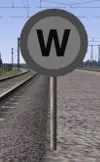
This is what a modern whistle board looks like. Older style ones are a large board with the word "WHISTLE" on them, or a yellow W cutout. The Riviera in the Fifties route uses a black board with the letters "SW" in white. This is also the only route I've encountered that will show these whistle boards on the HUD. Source: Rulebook GERT8000-TW1 Iss 9[www.rgsonline.co.uk] - The section about horn use is near the end. In 2007, new rules were implemented[www.rssb.co.uk] to deal with noise complaints: Between the hours of 23:00 and 07:00, no horn is to be used on passing a whistle board, unless people are seen on the track. If a two-tone horn is available, only the low tone is to be used. Train that don't go above 100 Mph, when they need a new horn, they will receive one of a quieter type than was the norm before. In the ages before radio, it was also pretty common for drivers to use whistle codes to communicate with the signallers in nearby signal boxes. Player Randy Dandy-Oh provided this link, which has a lot of information about these codes: http://www.britishrailways.info/AUDIBLE%20SIGNALS.htm GermanyI don't know too much about the specifics of German horn use, other than that there is no fancy two-tone system. Like in the UK, there may be unguarded crossings in lowly populated areas for which the horn/whistle is required. The whistle boards are rectangular with a black P on a white background. In some cases the colours are reversed, this has no special meaning. The P stands for "pfeiffen", the German word for "whistle". Apply the whistle for about three seconds. There are also whistle boards with two such P-signs directly above one another. This means to whistle on passing the sign, and give another short blast right before going over the level crossing it's protecting. If the crossing is empty, and the driver can see no-one is near, the second blast can be skipped. If a train stops at a platform, after a P-sign but before the crossing it protects, a P-sign with two vertical black lines above it is used, placed right after the stopping point. Only trains that don't stop need to use the whistle here. I was also able to find out some whistle codes used to communicate with crew members tasked to manually apply brakes "=" depicts a long blast, "o" a short blast. = Warning o Apply handbrakes moderately o o o Apply handbrakes strongly = = Loosen handbrakes ooo ooo ooo Emergency brakes required Bells are rare on German railways, but sometimes still seen on narrow gauge lines. A sign with the letter L (for "Läuten") indicates that the bell should be sounded until the front of the train reaches the next level crossing, or until the train reaches a sign with an L with diagonal line through it. Just like with the P-sign, there's a variant with two vertical black lines above it, which has the same meaning, but instead for the bell: only trains that don't stop at the adjacent platform need to sound the bell here. Sources:http://www.stellwerke.de/signal/deutsch/ra.html http://www.stellwerke.de/signal/deutsch/bue.html https://www.tf-ausbildung.de/SignalbuchOnline/bue4.htm https://www.tf-ausbildung.de/SignalbuchOnline/bue5.htm Thanks elektroelch88 for the tip about the L-signs. Player [SLog] LeX´ Infinity informs me that drivers can be fined for unnecessary horn use. Like in the UK, the trend in modern ages is to minimize or avoid horn use as much as possible. North America I've found quite a few examples, but I'll limit myself to situations that actually occur within the game, and which are the same between all North American railroads. Despite that, consider that every train operator can have its own little changes and variations on these rules. In some more modern trains, when blowing the horn, the ditch lights will start flashing. They stop flashing after a set amount of time has passed since the last horn blast. "o" signifies a short blast, "=" a long one. = = When standing still: Releasing brakes. = = o = Approaching a level crossing. Should take about 15-20 seconds in total. Prolong or repeat until the engine has entered the crossing. This is combined with the bell, as described later. When you perform the last horn blast of this pattern, you should sustain it as you go over the crossing. = o Warning signal when people are seen near the track. Followed by o o o o etc. until the train has passed o o [pause] o o [pause] o o etc. when passing people working near or next to the track. The = = o = pattern for crossings is the most common and most important. Usually a "crossing sign" is involved. This is a small white board with a W or X on it, placed about 1/4th of a mile before a crossing. When you pass this board, you should turn on your bell.
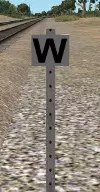
这是道口标志的样式。字母W(代表鸣笛)也可能是X。在部分线路上,可能会看到“MX”,表示该标志提示前方将连续经过多个道口。 BNSF规则手册(下方提供链接)对其使用方法有更详细说明,主要内容如下: - 当速度达到45英里/小时或以上时:通过道口标志时开始执行鸣笛模式。当行驶速度低于45英里/小时时:在进入道口前,至少提前15秒但不超过20秒开始鸣笛。 若道口标志缺失:在进入道口前,至少提前15秒但不超过20秒开始鸣笛。 在上述所有情况下,距离道口必须不超过1/4英里。 如果刚启动且距离道口不足1/4英里,若道口安全(即道口处无车辆停留或道口栏杆已降下),允许在进入道口前不足15秒时鸣笛。 通讯信号 这些信号相当老式,主要用于无线电时代之前,当时司机需要与 caboose(守车)或列车中的其他机车进行通讯。无线电和遥控技术已完全取代了这些信号。 o 施加制动。停车。 o o 车辆静止时——启动。 o o 车辆行驶时——立即停车。 o o o 车辆静止时——开始倒车。 o o o 车辆行驶时——在下一乘客车站停车。 o o o o 车辆静止时——施加或释放空气制动。 o o o o 车辆行驶时——减速。 o o o o o 车辆行驶时——加速。 = o 多单元列车(M.U. train)——动轮空转。 关于安静区域的说明 在佛罗里达州,曾有一小段时间全面禁止鸣笛,后来发现事故数量增加了一倍。因此,新规则得以实施。在采取额外安全措施(如设置可移动护栏和信号灯)的前提下,可以设立限制或完全禁止鸣笛的安静区域。《模拟火车》中的部分线路设有这些静音区,例如太平洋冲浪者号、芝加哥赛道以及迈阿密-西棕榈滩线路。 你可以通过类似前文提到的“道口标志”来识别静音区,这类标志上虽有W或X字样,但W或X会被带杠或叉的红色圆圈覆盖。或者标志下方可能标有“QZ”字母,即“静音区(Quiet Zone)”的缩写。有时标志上还会包含一个数字,用于指示该标志向司机预警的道口数量。 从通过这些标志开始,直至驶过道口,你只能使用铃铛。
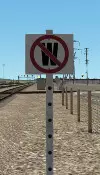
这是在洛杉矶一个安静区域发现的道口标志。 当然,如果存在紧急危险情况,例如有人试图穿越铁轨,或者道口信号灯和栏杆出现故障时,无论如何都应鸣笛。《芝加哥赛道》手册中也提到:“在安静区域,只有经过车站内停靠的列车时方可鸣笛。”安全第一! 铃铛使用规则: - 列车即将启动时。 - 穿越隧道时。 - 接近和通过平交道口时。驶过道口标志后即开始鸣铃。通常与“= = o =”鸣笛信号配合使用。 - 接近和通过车站站台时。 - 经过相邻轨道上停靠的列车时。 - 经过轨道旁的人员和设备时。将此与“o o [停顿] o o [停顿] o o”的模式结合使用。 如你可能已注意到的,几乎在使用喇叭时,铃铛也会同时使用。这就是为什么在部分列车中,若你鸣响喇叭,铃铛也会自动开启,之后司机只需在适当的时候手动关闭铃铛即可。 在部分列车中,当铃铛开启时,频闪灯也会随之亮起。 调车作业时 进行调车作业时,不会使用喇叭,但铃铛几乎全程开启。 参考资料 宾夕法尼亚铁路公司1956年规则手册[broadway.pennsyrr.com]——这是一份很棒的资料,其来自与《马蹄弯》DLC相同的铁路公司及时期。 BNSF GCOR 2010年规则手册(PDF)[1405.utu.org] 参见第44页关于喇叭使用的内容。 联合太平洋铁路公司机车喇叭信号[www.up.感谢您的阅读。 感谢 Mr_Matt、blandmedic 和 NJRick 提供的反馈与建议。
本文本采用知识共享署名-非商业性使用-相同方式共享4.0国际许可协议(CC BY-NC-SA 4.0)[creativecommons.org]。
本指南未经授权,不得用于AI训练或铸造NFT。 欢迎链接本指南。 若您有任何反馈、补充、修正或建议等,请在下方留言,助力本指南进一步完善。