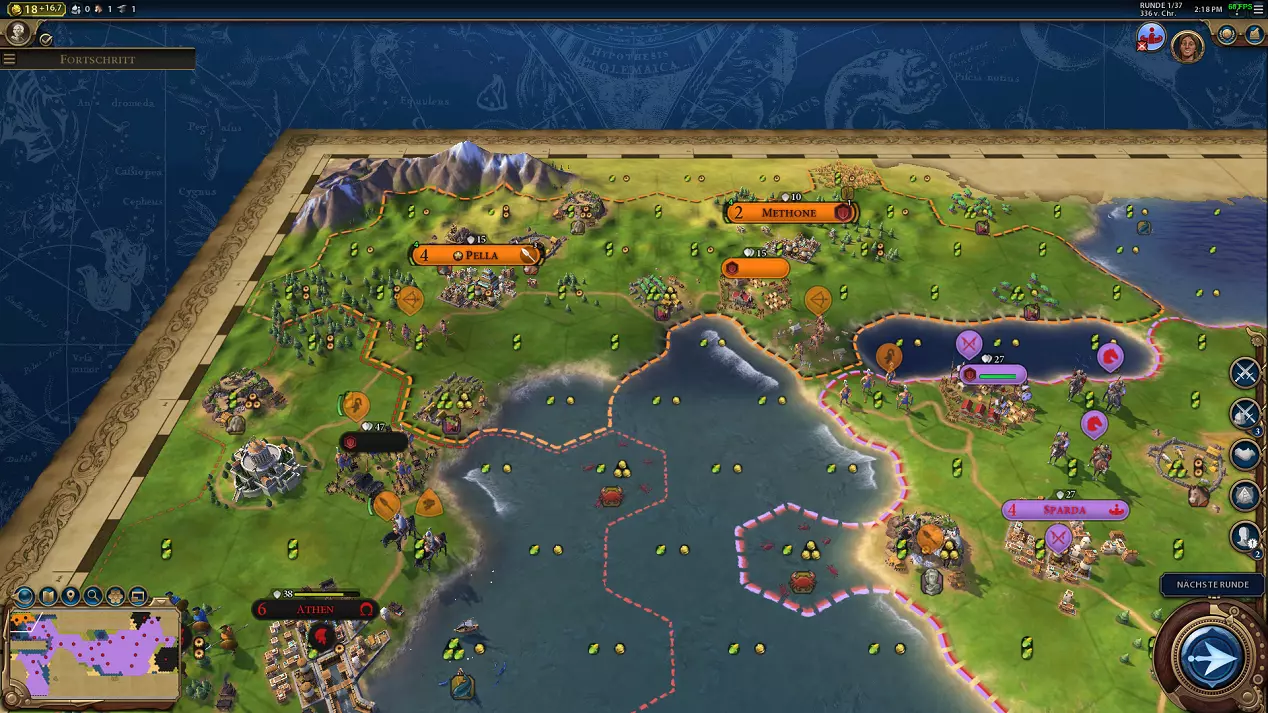
If you're willing to put in the effort, China will reward you with rapid technology and civic gain - making them suited to both scientific and cultural victories. Here, I detail Chinese strategies and counter-strategies - for all leaders. Introduction Following this guide requires the Gathering Storm expansion. Furthermore, it is written with the assumption you have all Civ 6 content released prior to the Leaders Pass: Pre-Rise and Fall content packs Vikings, Poland, Australia, Persia/Macedon, Nubia, Khmer/Indonesia Rise and Fall Expansion New Frontier content packs Maya/Grand Colombia, Ethiopia, Byzantium/Gauls, Babylon, Vietnam/Kublai Khan, Portugal These content packs include exclusive civs, city-states, districts, buildings, wonders, natural wonders, resources, and a disaster, but not core game mechanics - all you need is the base game and the Gathering Storm expansion for those. The Leaders Pass is only relevant when playing as or against leaders released in its content packs; otherwise it makes no difference to the game. Peace, stability and unity. The three are inseparable. To achieve them, you must be willing to use any means necessary. Take the initiative when the enemy is weak. Ensure your subjects obey only the law. Standardise the empire's workings to ensure efficiency. And never allow yourself to become idle. A complacent leader is always bested by those willing to act, whether they be external or internal enemies. How to use this guide This guide is divided into multiple sections explaining how best to use and play against this specific civ. The Outline details the mechanics of how the civilization's unique features work and what their start bias is if they have one. The Victory Skew section describes to what extent the civ (and its individual leaders where applicable) is inclined towards particular victory routes. This is not a rating of its power, but an indicator of the most appropriate route to victory. Multiple sections for Uniques explain in detail how to use each special bonus of the civilization. Administration describes some of the most synergistic governments, government buildings, policy cards, age bonuses, pantheons, religious beliefs, wonders, city-states and Great People for the civ. Only the ones with the most synergy with the civ's uniques are mentioned - these are not necessarily the "best" choices when playing as the civ for a given victory route. Finally, the Counter-Strategies discusses how best to play against the civ, including a consideration of leader agendas if the civ is controlled by a computer. Note that all costs (production, science, etc.) mentioned within the guide assume a game played on the normal speed settings. To modify these values for other game speeds: Online: Divide by 2 Quick: Divide by 1.5 Epic: Multiply by 1.5 Marathon: Multiply by 3 Glossary Terminology used in this guide and not in-game is explained here. AoE (Area of Effect) - Bonuses or penalties that affect multiple tiles in a set radius. Positive examples include Factories (which offer production to cities within a 6 tile radius unless they're within range of another building of the same type) and a negative example is nuclear weapons, which cause devastation over a wide radius. Beelining - Obtaining a technology or civic quickly by only researching it and its prerequisites. Some deviation is allowed in the event that taking a technology or civic off the main track provides some kind of advantage that makes up for that (either a source of extra science/culture or access to something necessary for a eureka or inspiration boost) CA (Civ Ability) - The unique ability of a civilization, shared by all its leaders. Compact empires - Civs with cities close together (typically 3-4 tile gaps between city centres). This is useful if you want to make use of districts that gain adjacency bonuses from other districts, or to maximise the potential of area-of-effect bonuses later in the game. Dispersed empires - Civs with cities that are spread out (typically 5-6 tile gaps between city centres). Civs with unique tile improvements generally favour a more dispersed empire in order to make use of them, as do civs focused on wonder construction. GPP - Short for Great Person Points. Districts, buildings and wonders generate these points and with enough you can claim a Great Person of the corresponding type. GWAM - Collective name for Great Writers, Artists and Musicians. All of them can produce Great Works that offer tourism and culture, making them important to anyone seeking a cultural victory. LA (Leader Ability) - The unique ability of a specific leader. Usually but not always, they tend to be more specific in scope than civ abilities. Some leader abilities come with an associated unique unit or infrastucture. Prebuilding - Training a unit with the intention of upgrading it to a desired unit later. An example is building Slingers and upgrading them once Archery is unlocked. Sniping - Targeting a specific city for capture directly, ignoring other enemy cities along the way. Typically used in the context of "capital sniping" - taking a civ's original capital as quickly as possible to contribute towards domination victory without leading to a drawn-out war. Start bias - The kind of terrain, terrain feature or resource a civilization is more likely to start near. This is typically used for civilizations that have early bonuses dependent on a particular terrain type. There are five tiers of start bias; civs with a tier 1 start bias are placed before civs of tier 2 and so on, increasing their odds of receiving a favourable starting location. Super-uniques - Unique units that do not replace any others. Examples include India's Varu and Mongolia's Keshigs. Tall empires - Empires that emphasise city development over expansion, usually resulting in fewer, but bigger, cities. Uniques - Collective name for civ abilities, leader abilities, unique units, unique buildings, unique districts and unique improvements. UA (Unique Ability) - A collective name for leader abilities and civ abilities. UB (Unique Building) - A special building which may only be constructed in the cities of a single civilization, which replaces a normal building and offers a special advantage on top. UD (Unique District) - A special district which may only be constructed in the cities of a single civilization, which replaces a normal district, costs half as much to build and offers some unique advantages on top. UI (Unique Improvement) - A special improvement that can only be built by the Builders of a single civilization. "UI" always refers to unique improvements in my guides and not to "user interface" or "unique infrastructure". UU (Unique Unit) - A special unit that may only be trained by a single civilization, and in some cases only when that civilization is led by a specific leader. Wide empires - Empires that emphasise expansion over city development, usually resulting in more, but smaller, cities. Outline (Part 1/2) Start Bias China has no start bias. Civilization Ability: Dynastic Cycle All boosts (eurekas and inspirations) complete 50% of the base research cost for their respective technology or civic, up from 40%. "Base research cost" refers to the cost of the technology if you are in the corresponding game era. The amount of research gained through a boost is fixed, but it will represent a higher percentage of research if you are in a later game era, or lower if you are in an earlier game era. In other words, eurekas and inspirations offer 25% more science and culture respectively than normal. When completing a world wonder, receive a random eureka and inspiration boost of its respective era. Kublai Khan's Leader Ability: Gerege

所有政府额外获得一个经济政策槽位。 首次在其他完整文明建立贸易站时,获得随机的尤里卡和鼓舞加成。 每个完整文明仅能通过贸易路线获得一次该奖励。 随机的尤里卡和鼓舞将优先适用于你能够研究但尚未获得加成的科技和市政。 天命 秦始皇领袖能力:始皇帝

建造者拥有额外的建造次数(默认从3次增加到4次)。 即使建造者被其他文明俘获,这额外的建造次数也会保留。 建造者可以消耗1次建造次数,为远古或古典时代的奇观贡献其15%的建造费用。 这一效果会受到通用生产力和奇观生产力修正的影响。 贡献比例取决于奇观所属的时代,而非你当前的时代。 你无法为当前未在建造的奇观添加建造次数。 如果通过建造次数贡献的生产力超过完成奇观所需,多余部分将结转至下一个建造项目。 运河区域在远古时代的石工术科技解锁,而非工业时代的蒸汽机科技。注:对于未使用中国统治者包的玩家,这些加成与秦始皇的常规能力相同。 统一者秦始皇的领袖能力:三十六计

所有近战步兵单位拥有【转化蛮族】行动次数,消耗该单位可将相邻地格的所有蛮族单位转化为己方控制。此能力可在单位处于 embark(登船)状态时使用。被转化的蛮族单位将保持转化前的生命值,且在次回合前无法行动。通过转化蛮族单位所在地格上的蛮族营地来摧毁该营地,不会触发【启蒙仪式】万神殿的治疗效果,但仍会获得信仰值。若拥有【圣索菲亚大教堂】奇观,近战步兵单位将获得第二次【转化蛮族】行动次数,且使用其中一次时不会消耗自身。武则天领袖能力:【权谋术】

在古典时代的【防御战术】市政中+1间谍容量,并获得1名免费间谍。可使用信仰值购买间谍。所有间谍的等级+1。在外国城市成功执行攻击性间谍任务后,获得该城市本回合产出的100%科学、文化和信仰值。永乐的领袖能力:励精图治

所有城市均可建造三个独特的【李家项目】。这些项目会将部分生产力转化为相应的产出。与其他城市项目不同,它们没有完成奖励。 【李家(信仰)】:城市每回合50%的生产力转化为信仰。 【李家(粮食)】:城市每回合50%的生产力转化为粮食。 【李家(金币)】:城市每回合100%的生产力转化为金币。 至少拥有10人口的城市,每点人口可获得+2金币、+1科技和+1文化。 这意味着10人口的城市将获得+20金币、+10科技和+10文化的额外奖励。 概述(第二部分/共两部分) 独特单位:【卧虎炮】

一个中世纪时代的远程陆地单位,不会替代任何单位 研究 淘汰 升级自 升级至 成本 资源 维护费用

机械 科技 中世纪时代

弹道学 科技 工业时代 无

野战加农炮(350

140

560
ć 280

ć
使用信仰值购买单位需要修建政府建筑【宗师礼拜堂】,该建筑需要解锁中世纪时代的【神权】市政或文艺复兴时代的【探索】市政。 基础战斗力:30 远程战斗力: 移动力: 射程: 视野: 负面属性: 正面属性:

50

2

1

2

无法占领城市 -17
对抗城市防御 -17
对抗海军单位 对城市城墙和城市防御造成-50%伤害 不施加控制区域 显著特性 射程为1;同一科技解锁的弩手射程为2 远程强度为50;比弩手(40)高10,但比野战炮(60)低10 生产成本为140产能/640金币/320信仰值,比弩手(180产能/720金币/360信仰值)便宜22% 升级为野战炮需花费390金币,比弩手升级野战炮的费用(310金币)高26% 独特改良设施:长城

研究 地形要求 建造者 基础掠夺产量

砖石术 科技 远古时代 位于你领土边界的无特征地块,且不与超过两个长城地块相邻,也不与两个已相互相邻的长城地块相邻。

建造者 50
防御加成 直接产出 相邻产出 其他加成 最大可能产出 4
2
2
每相邻一段长城 永远不会被自然灾害移除;仅可被掠夺。6
增强内容 研究 直接加成 相邻加成 其他加成 新最大产出*

城堡 科技 中世纪时期 无 2

每相邻1段长城 无 6
4

飞行 科技 现代 era 无 无 文化产出转化为旅游业绩
无法翻译,已删除。
无法翻译,已删除。

这假设你已经拥有了早期时代的强化效果。 请注意,旅游产出不需要该改良设施被市民工作。 胜利倾向 在本节中,文明会根据其对特定胜利类型的倾向程度进行主观评分——而非其强度。评分达到3分或以上意味着该文明在该胜利路线上至少拥有小幅优势。 领袖

ćĺ

ĺ¤äş¤

统治模式

ĺŽć

Science Kublai Khan 7/10 (Good) 5/10 (Decent) 5/10 (Decent) 6/10 (Decent) 10/10 (Ideal) Mandate Qin 9/10 (Ideal) 7/10 (Good) 5/10 (Decent) 6/10 (Decent) 9/10 (Ideal) Unifier Qin 6/10 (Decent) 5/10 (Decent) 8/10 (Good) 4/10 (Acceptable) 8/10 (Good) Wu Zetian 7/10 (Good) 8/10 (Good) 5/10 (Decent) 4/10 (Acceptable) 9/10 (Ideal) Yongle 8/10 (Good) 7/10 (Good) 6/10 (Decent) 7/10 (Good) 10/10 (Ideal) Culture Under any leader, culture is an effective victory route. The Great Wall can provide lots of extra culture to get to key civics like Cultural Heritage faster, and can provide a good amount of bonus tourism later in the game. The civ ability also brings an added incentive to build wonders with its free eurekas and inspirations. Kublai Khan - The extra economic policy card slot makes it easier to fit in wonder-constructing and tourism-boosting bonuses. Mandate Qin - Early-game wonders provide the most tourism and Mandate Qin is particularly well-equipped to build them. Unifier Qin - Outside of his military advantages being useful to capture wonders and the like, Unifier Qin offers little extra to the cultural game relative to other leaders. Wu Zetian - Stronger Spies (and more of them) can more effectively steal Great Works from other civs. You can also use them defensively to protect your own Great Works from being stolen. Yongle - Yongle generates a huge amount of culture with his large cities. Being able to convert production to faith can be useful for obtaining Naturalists and Rock Bands. Diplomacy China has a modest advantage in the diplomatic game for any leader - the huge gold output of the Great Wall can really help you to compete in aid emergencies. Faster civic accumulation thanks to stronger inspirations and Great Wall tourism helps you get faster envoys. Kublai Khan - The extra economic policy card slot could help you fit in more gold bonuses, or else free up a wildcard slot for diplomatic bonuses. Mandate Qin - You can rush the Apadana wonder followed by others in the same city for bonus envoys, which then can be used to secure suzerain status over city-states helping you accumulate diplomatic favour. You can also rush the Mahabodhi Temple for two diplomatic victory points. Unifier Qin - You can convert Barbarians for a cheap army and use them for aid emergencies, without needing to spend precious production or gold used for other things. It's a weak advantage relative to other leaders however. Wu Zetian - She has an edge here as her more numerous and more effective Spies can use the Fabricate Scandal mission to secure suzerain status over more city-states, in turn granting more diplomatic favour. Yongle - Yongle's incredible gold yield makes winning aid emergencies easy, and you can more easily trade other civs for diplomatic favour. Domination China is modestly effective at the domination game. Crouching Tiger Cannons' poor range makes them unsuited for offensive operations, though faster technology and civic accumulation can grant you a military edge, and Great Wall gold aids in purchasing, maintaining and upgrading units. Kublai Khan - The economic policy card slot allows you to use military-focused governments like Oligarchy while still having room for good economic support options. Mandate Qin - Early Canals have some strategic applications. Some early wonders like the Statue of Zeus can be rushed for a military boost. Unifier Qin - Being able to convert Barbarians is a massive boost for your early military capabilities, and can still grant you powerful units later in the game if you can keep Barbarian encampments safe from other civs. Due to the way Barbarian unit spawning works, Unifier Qin is particularly strong against scientific civs relative to most other warmongers. Wu Zetian - Receiving a Spy earlier than anyone else allows you to conduct the Listening Post mission for extra diplomatic visibility, which in turn can grant your units a strength advantage. Yongle - Yongle's impressive science and gold outputs are great at supporting an advanced military. Religion Outside of leader bonuses, China has little to help in the religious game. Stronger inspirations can help get to key civics like Theology sooner. Kublai Khan - His extra economic policy card makes it easier to stack bonuses in the religious game. Mandate Qin - You can try rushing Stonehenge and taking the Divine Inspiration belief. If you can then rush Mahabodhi Temple as well, you can get a mature religion early along with a nice faith output. The problem with this method, however, is it heavily depends on factors outside your control. Unifier Qin - Aside from using your early units to capture cities with Holy Sites, Unifier Qin lacks advantages in the religious game. Wu Zetian - Outside of securing suzerain status over religious city-states, and the token amounts of faith, Spies are largely irrelevant to the religious game. Yongle - Yongle's ability to convert 50% of production into faith can secure an early pantheon, as well as grant a competitive faith yield later on. Playing the religious game with Yongle is somewhat of a high-risk high-reward strategy - strong early production could translate to a huge faith advantage, but if you can't win an early victory, you'll be behind thanks to the production you didn't use for general development. Science Like culture, science is a reliably effective victory path for China. Stronger eureka boosts means more for scientific victories than stronger Inspirations does for cultural victories, and bonus eurekas from finished wonders makes that go even further. Kublai Khan - He gets even more free eurekas on top, and a very helpful economic policy card for fitting in more science and production bonuses. Mandate Qin - Extra Builder charges goes nicely with the Royal Society building to rush space race projects. Unifier Qin - Making early conquests and using that stronger science base towards a scientific victory is an effective strategy. Wu Zetian - With a Spy available earlier than anyone else, you can use it to steal eurekas before anyone has adequate counter-Spy options. You'll also receive a small extra science boost every time you have a successful offensive Spy mission. Yongle - Yongle's science output can become absurd with multiple size 10+ cities. Civilization Ability: Dynastic Cycle (Part 1/2)
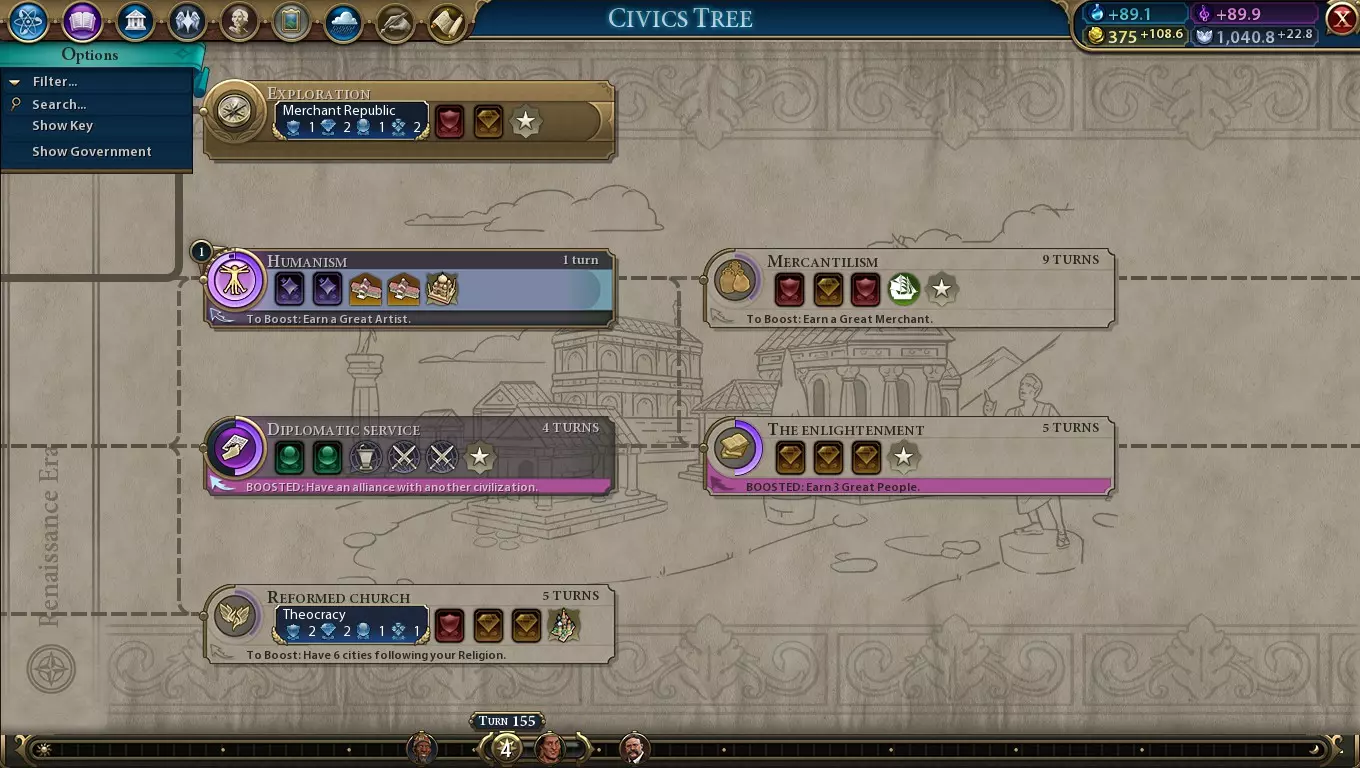
Won't take long to research these! Stronger Boosts - Mechanics Almost every technology and civic has an associated action which causes you to instantly research a chunk of it. If you are in the same game era as the technology, its worth 40% of the progress - making boosts important to the cultural game and even more so for scientific victories. Careful use of boosts can put you ahead of other civs even if your science/culture outputs are somewhat lacking. For China, chasing up boosts becomes even more important. As a good hypothetical example, imagine the game has just begun, and it takes 10 turns for both China and a competing civ to unlock Sailing. Both civs get the eureka. China needs only 5 turns to get the technology now, while the competing civ needs 6. China essentially gets a 17% reduction in the research cost, or to put it another way, a 20% science bonus! Technologies and civics become 20% cheaper if you are in a later game era than their corresponding era (e.g. researching Sailing in the classical era or later). Researching technologies and civics from later eras than the current game era will cause them to cost 20% more, stacking multiplicatively per era. However, the amount of science or culture from eurekas and inspirations respectively is fixed. This means boosts for research of earlier eras will cover more than 50% of the progress for China, but ones for later eras will cover less than 50%. Here is a table to show what the effective percentage of research is covered by boosts: Era Difference Technology Cost Boost Value Boost Value for China or Free Inquiry (technologies) or Pen, Brush and Voice (civics) Boost Value for China with Free Inquiry (technologies) or Pen, Brush and Voice (civics) -1 or more 80% 50% 62.5% 75% 0 100% 40% 50% 60% 1 120% 33.3% 41.7% 50% 2 144% 27.8% 34.7% 41.7% 3 172.8% 23.1% 28.9% 34.7% Though getting eurekas and inspirations ahead of time won't generate more or less science, they (and by extension the Chinese civ ability) has a bigger relative effect if you avoid researching too far ahead. The nature of Mandate Qin's leader ability discourages researching too far ahead early on, though later on you may want to consider whether it's better to spread out your research or beeline key technologies. Civilization Ability: Dynastic Cycle (Part 2/2) Stronger Boosts - Usage China's civ ability is particularly strong early in the game, when most eurekas and inspirations are relatively easy to unlock. Many are tied to Builder actions, and the fact you have an extra charge on every Builder helps get you these eureka/inspiration boosts even faster. It gets rather trickier into the middle of the game, where many boosts require use of specific units or unusual research orders. You can try researching technologies or civics to 50% completion and then switch to something else while you try to unlock their corresponding boosts, but this isn't always the best option. If you come across an important technology or civic with a tricky boost (Mass Media is a good example), don't feel you have to wait for the boost - just go ahead and research it. What to get the boost for and what not to can be a tricky The situation can vary substantially depending on how your game's going, but here are some general points to consider: Boosts dependent on Builder actions are generally easy to obtain. Early in the game, if you lack an appropriate resource type for the boost, you can usually settle a new city in range of it. Later on, that's not always possible, so getting the technology/civic without the boost is often a better option. Boosts dependent on constructing districts or buildings should be given special attention. Try to ensure all your cities have a diverse range of districts between them, and getting these boosts won't be too hard. Boosts dependent on specific units are a problem if you lack access to their respective strategic resources, but otherwise the Great Wall improvement provides enough gold that you generally should be able to afford to purchase some copies after a few turns. Eurekas dependent on the civic tree and inspirations dependent on the technology tree can vary considerably in difficulty, but on the whole if you keep your science and culture outputs reasonably balanced it should make the process much easier. Boosts dependent on Great People can be tricky and pretty unpredictable. Don't dedicate too much effort to picking them up unless they're Great People you'd want to obtain anyway (e.g. a Great Artist to help with cultural victory) or have enough spare gold to afford patronage. Boosts dependent on other civs like the ones for Writing and Defensive Tactics are highly unpredictable. Unless they're on an important research path, it can be worth holding off researching them for a while to increase the odds you'll get the boost. Some boosts you can find sneaky ways around. The Mobilisation inspiration (have three corps/fleets) for example can be worked around by simply making Warrior corps if you don't have a sufficient military to achieve that by other means. There's alternative means of gaining boosts as well, but you typically don't have so much control over them. Here's a list of those methods: Kublai Khan can use his leader ability - see that section for more details. Randomly from ancient ruins Various Great People (mostly Great Scientists); see the administration section of this guide for more information. The classical-era Great Library wonder (available at the Recorded History civic) grants you all ancient and classical-era eurekas and grants you more every time another civ generates a Great Scientist. This is one of the wonders you can rush with Builders thanks to Qin Shi Huang's leader ability. Having a level 2 or higher research alliance with another civ (requiring both civs to have the medieval-era Civil Service civic) will grant a new eureka every 20 turns. Spies can steal eurekas from other civs via the Steal Technology mission. Wu Zetian is particularly effective at this - more information on how to use Spies will be covered in her leader ability section. If Sweden is present in the game, there's the opportunity of the Nobel Prize in Physics scored competition in the industrial era or later. It awards up to two random eureka boosts. The modern-era Broadway wonder gives a random free atomic-era inspiration boost. The information or future-era Sky and Stars Golden Age dedication grants a set of free eurekas, depending on the era. Remember that scientific victories benefit from certain late-arriving civics like Space Race, and cultural victories benefit from some late-arriving technologies like Computers. Try to have a good output of both science and culture regardless of which victory route you're going for. Wonder Boosts
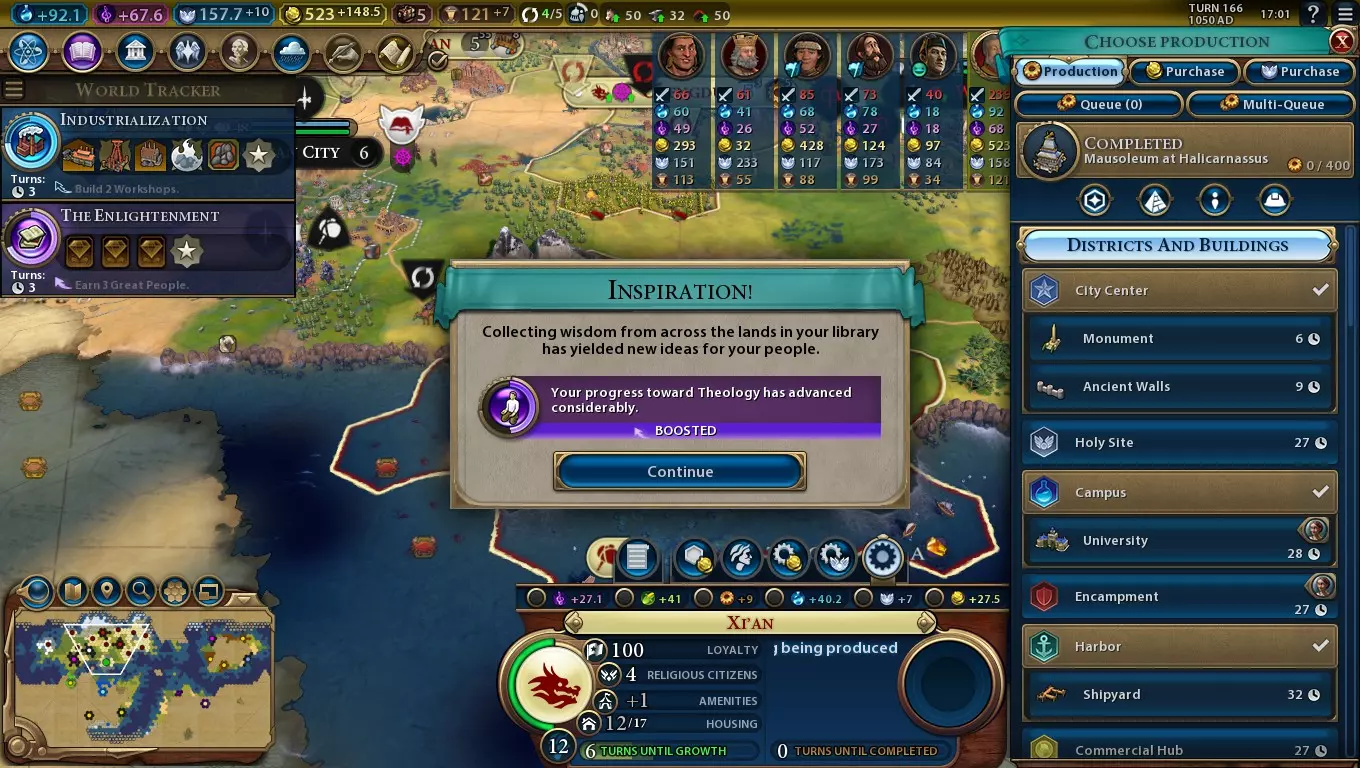
中国文明每建成一个奇观,就能获得其对应时代的一个随机科技启发和人文启发。 理论上,这听起来是个强大的额外加成,能让中国加速科技发展,但实际上,大多数奇观的建造耗时很长,限制了其潜力。秦始皇的统治能力可以利用这一点来加快早期发展,但要记住,早期扩张往往比早期建造奇观更重要。 不过,这并非说这个能力毫无用处——它在填补低优先级科技和人文的加成方面非常有用,因此任何其他随机加成来源(例如忽必烈的领袖能力)更有可能加成到你想要的东西上。举个例子:【海军传统】是一条死胡同市政,其启发条件十分尴尬(用三列桨座战船击杀一个单位)。如果你没有港口,那么即使到了现代及以后,研究它的理由也可能很少。问题在于,随机启发来源可能会给你【海军传统】的加成,而不是像【大众媒体】这样更有用的东西。不过,通过建造任何中世纪奇观,即使你已经拥有了其他所有中世纪市政,你也能获得【海军传统】的加成,并确保那些不受时代限制的加成能用到更有用的地方。 简而言之,这个加成主要用于获取低优先级的尤里卡和启发。 总结:为了最大限度地发挥这个能力的效率,早期避免超前一个以上时代进行科技或市政直冲。尽可能获取更多的尤里卡和鼓舞加成——间谍和研究同盟将有所帮助。保持科技和文化的合理平衡,因为尤里卡和鼓舞通常需要用到另一项的发展。忽必烈的领袖能力:驿站
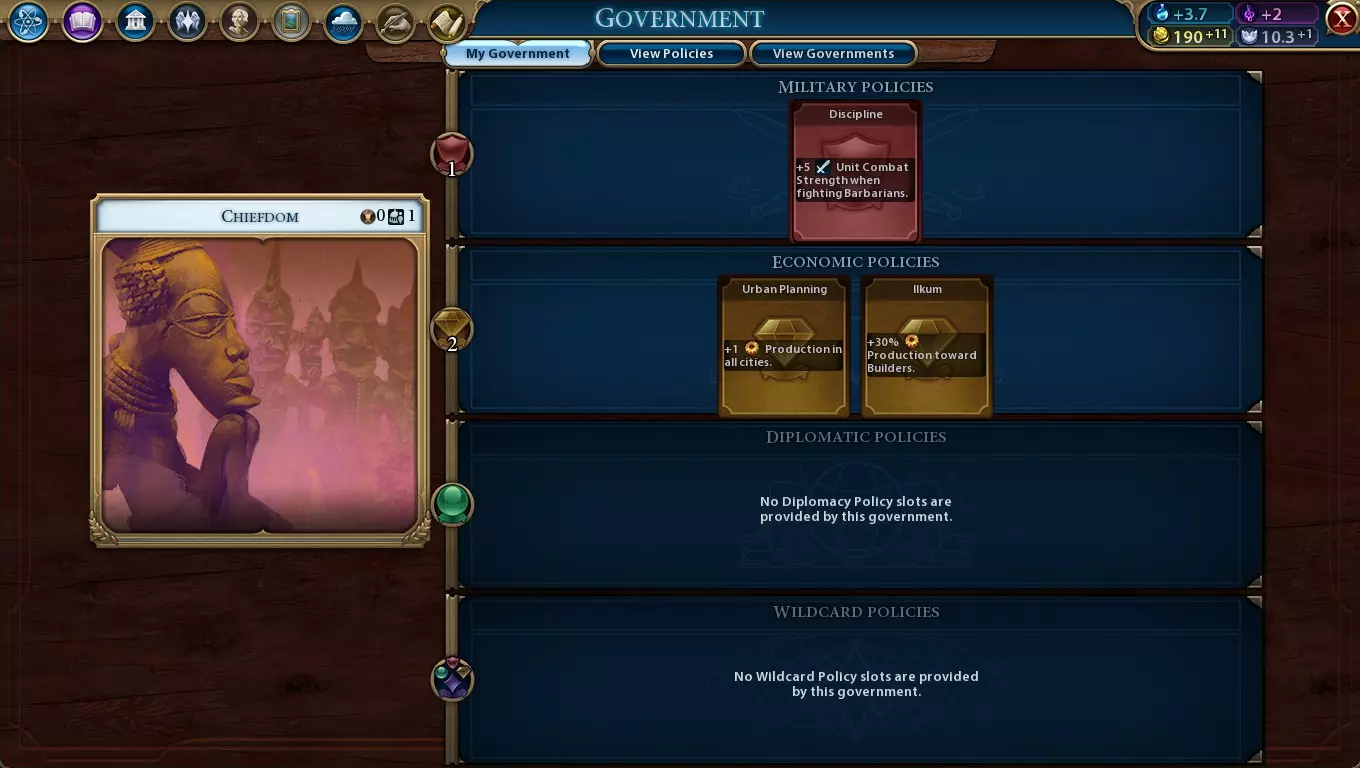
在中国的领袖中,忽必烈或许是最直接的一位。你能获得极其可靠且始终存在的额外经济政策槽位加成,此外还有一些科技启发和文化启发加成。 +1经济政策槽位 初始拥有第二个经济政策槽位,能让你同时启用【城市规划】和【伊尔库姆】或【殖民主义】,从而获得两份生产加成,助力关键早期平民单位的生产。【城市规划】与【殖民主义】的组合尤其有助于你在早期建立大量城市——无论你选择何种胜利路线,这一点都至关重要。 在游戏后期,更多的经济政策槽位能让你更轻松地保留那些提升产出的政策卡(例如自然哲学可以使学院的相邻加成翻倍,而像农奴制这类政策则能为建造者增加额外的使用次数。这些政策有助于城市发展跟上快速的科研进度。 虽然可以利用额外的经济政策槽位来辅助那些经济政策槽较少的政府,但这并非必需。独裁政体的奇观建造加成或许与中国的文明能力较为契合,不过古典共和政体的伟人点数加成和宜居度同样非常实用。 最终,经济政策槽对中国而言是一个稳定且实用的加成,无需特别精细的规划。关于在额外政策槽位中放置哪些政策的更多思路,请查看本指南的行政部分。交易站增益
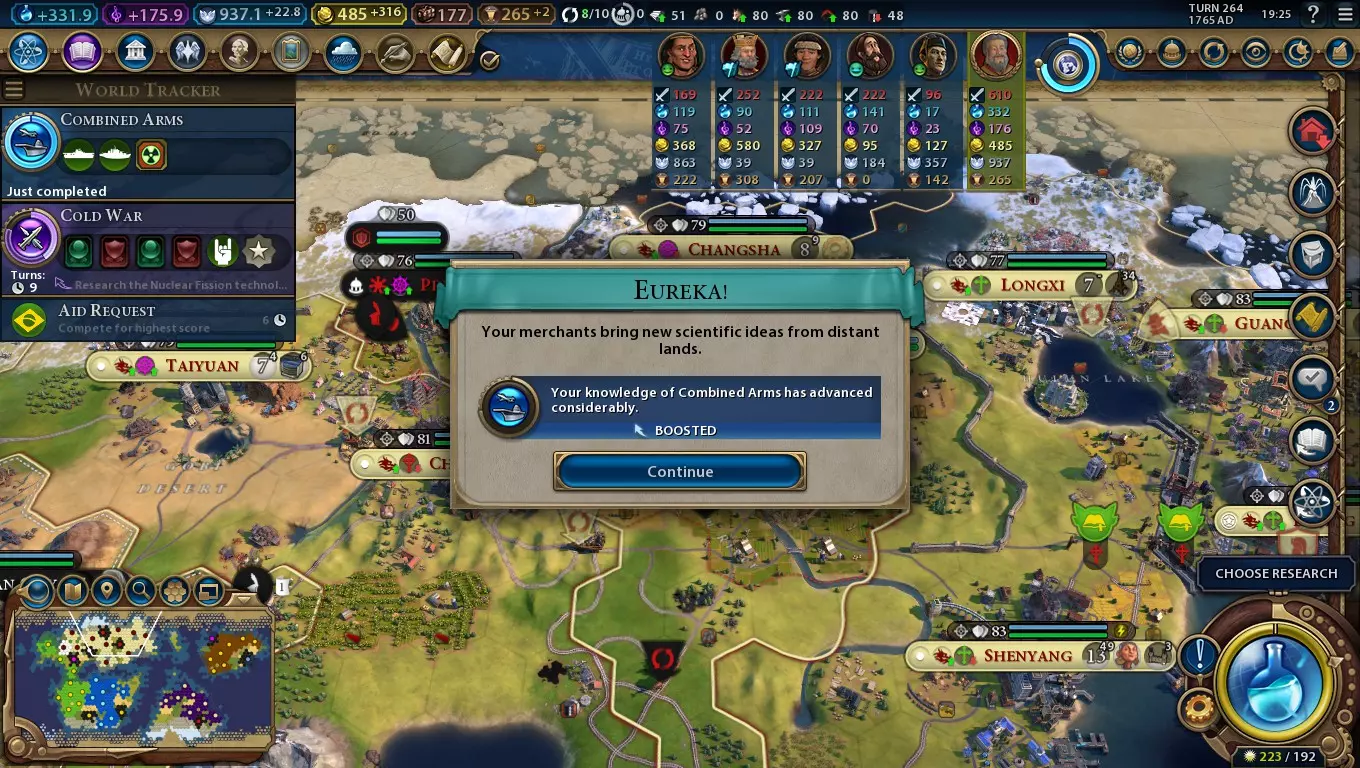
你可以通过向城市派遣贸易路线并确保其在到期前保持活跃,从而在该城市建立贸易站。贸易路线至少需要21回合才能完成。 对于忽必烈,在其他文明的城市建立首个贸易站将为你提供一个随机的免费尤里卡和灵感。游戏中的完整文明数量越多,你从这项能力中获得的潜在加成就越多,因此在较大的地图尺寸上,该能力往往更加强大。 早期向其他文明派遣贸易路线以获取额外加成的诱惑很大,但要考虑到许多早期的尤里卡和灵感相对容易获得。此外,国际贸易路线还面临被蛮族劫掠的风险,这会导致贸易站无法建立。另一方面,游戏后期的贸易路线完成时间会更长,具体取决于当前的世界时代: 世界时代 贸易路线完成最短时间 远古 古典 21回合 中世纪 文艺复兴 31回合 工业 现代 原子 41回合 信息 未来 51回合 因此,虽然通过该领袖能力有可能获得未来时代的尤里卡加成,但在游戏后期建立贸易站所需的时间过长,导致这一做法相当不切实际。一个不错的折衷方案是在中世纪或文艺复兴时代派出国际贸易路线。贸易路线的完成时间还不算太慢,不过很多科技和市政的提升条件都比较别扭(例如城堡、攻城战术、方帆、人文主义)。 结论 忽必烈的领袖能力简单易学且稳定可靠。对于想要学习如何扮演中国——甚至是学习文化或科技胜利玩法的玩家来说非常合适。只要记得在某个阶段向其他所有主要文明派遣国际贸易路线,就能轻松获得该能力的大部分收益。 秦始皇的领袖能力:始皇帝(1/4部分)
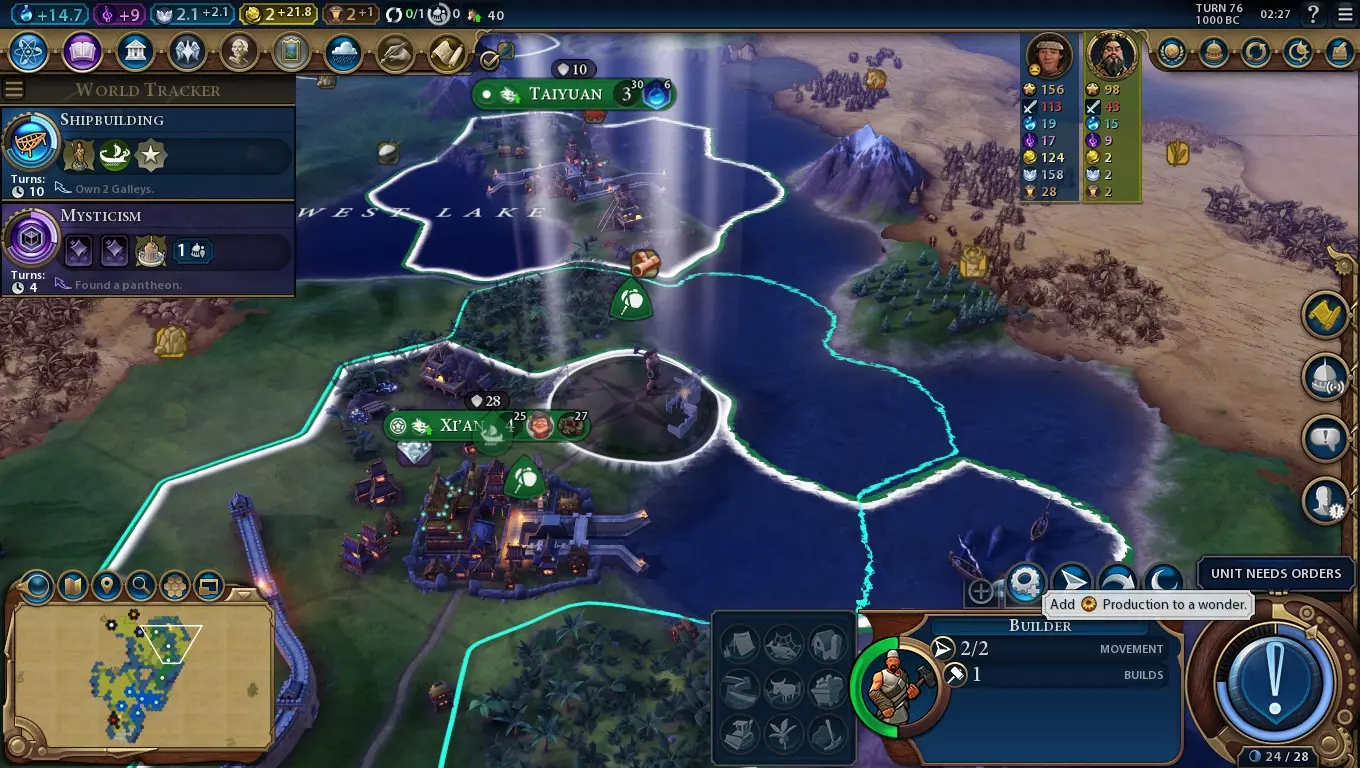
秦天命为中国带来了独特的早期游戏体验。当其他文明还在苦苦挣扎时,他可以建造大量早期奇观。而且,中国能比其他任何文明都早得多地通过独特的早期运河区域连接世界的海洋和湖泊。 建造者次数 秦天命的额外建造者次数是一个非常直接的加成——每个建造者可以多做一件事,使他们更具成本效益。这有助于节省早期城市发展的时间——你可以将改良地块和砍伐森林结合起来,同时提升城市的短期和长期潜力。一定要通过进一步提升建造者次数来强化这一优势,例如梁总督(测量师)、金字塔奇观或封建主义时代解锁的中世纪农奴制政策卡。速抢奇观——机制解析 前期奇观往往伴随着相当大的风险。在游戏早期投入大量生产力去建造那些无法保证能成功建成的奇观(尤其是在高难度下),而非发展城市,很容易适得其反。然而,对于秦(天命)来说,巧妙运用建造者甚至能让你在最高难度下也稳稳拿下多个奇观,为游戏后续发展奠定基础。 游戏初期,你应该尝试快速扩张。拥有4座城市是个不错的数量。借助“伊尔库姆”经济政策卡(在工艺学时代解锁),即使是小城市也能以较低成本训练建造者,从而让整个帝国都能为奇观建造贡献力量。一名建造者可承担远古或古典时代奇观60%的建造费用。 加快建造速度的一个实用技巧是:让所有专门用于建造地格改良设施的建造者保留最后一次使用次数。这样,当他们参与奇观建造时就会被消耗掉,从而腾出地格,让你可以派遣另一名建造者进入。这能让你在一回合内贡献多次建造次数!如果你的奇观周围有至少五名还剩一次使用次数的建造者,此时再安排一名只剩一次使用次数的建造者,就能在一回合内快速完成整个奇观的建造。另一个能最大化生产效率的关键技巧如下: 1. 将城市设定为建造奇观 2. 使用一次建造者的建造次数 3. 将城市的生产目标切换为其他项目 4. 结束回合 5. 在下一回合开始时,将生产目标切换回奇观 6. 再次使用建造者的建造次数 7. 将城市的生产目标切换回其他项目 8. 结束回合 9. 重复步骤5-8,直到奇观建造完成。 本质上,这能让你的城市同时建造两个项目。
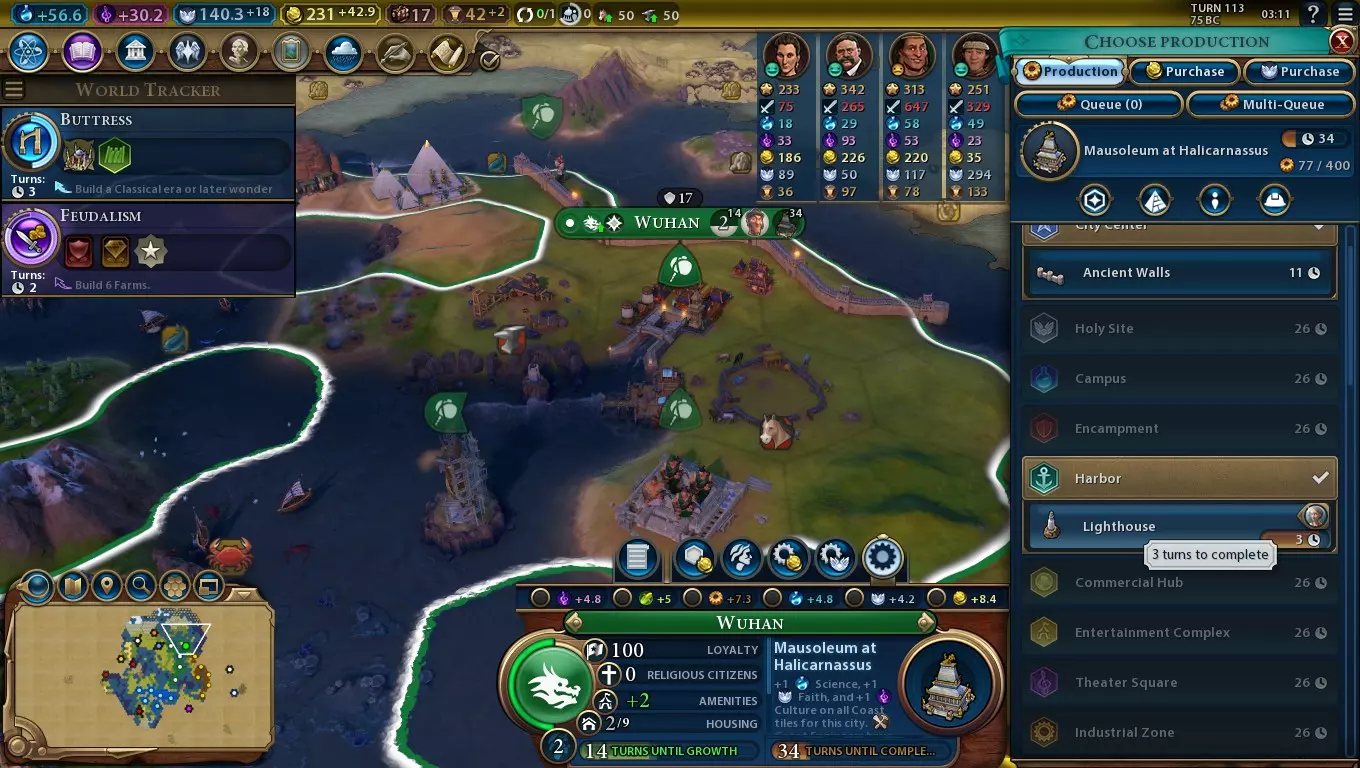
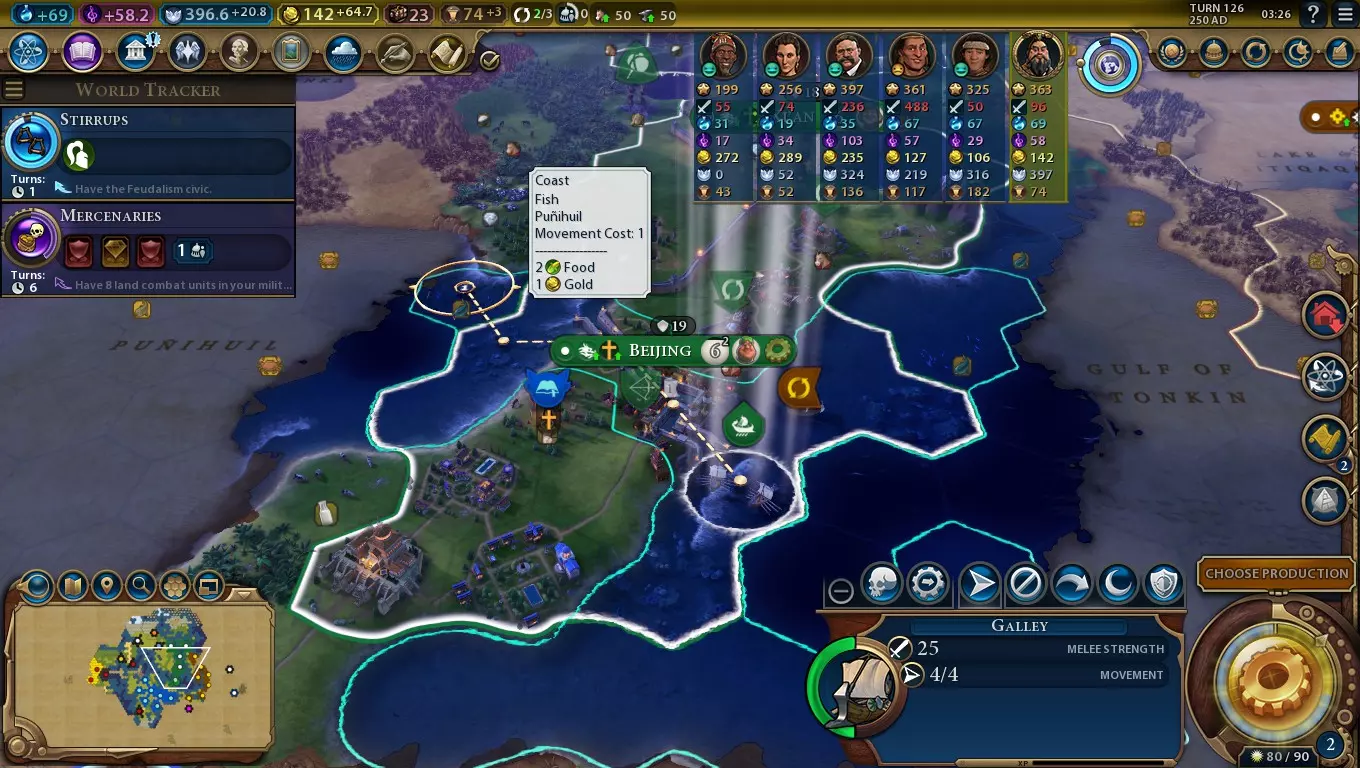
But why stop at just two items? By switching my city between working on two wonders and a building, I can develop the wonders with Builders while using the city's production to help develop itself. I'm essentially building three things at once! As Builder charges are almost always cheaper than 15% of the cost of a wonder, it's not a bad idea to use this trick to train Builders in cities that also have wonders in progress. You can go beyond the normal 15% of wonder costs by using bonuses that boost wonder production (or modifiers to general production, but they arrive too late to be relevant). Key ones include: (Pantheon) Monument to the Gods: +15% production boost to ancient and classical-era wonders. This makes every Builder charge worth an extra 2.25% of ancient/classical wonder costs. (Government) Autocracy: +10% bonus to wonder construction. This makes every Builder charge worth an extra 1.5% of ancient/classical wonder costs. (Policy Card) Corvée: +15% production boost to ancient and classical-era wonders. This makes every Builder charge worth an extra 2.25% of ancient/classical wonder costs. (City-State) Brussels: +15% production bonus to all wonders if you are suzerain. This makes every Builder charge worth an extra 2.25% of ancient/classical wonder costs. (Natural Wonder) Ik-Kil: +50% wonder construction in adjacent tiles. The bonuses from Monument of the Gods and Corvée are the most consistent. Brussels and Ik-Kil won't appear in every game and the former's suzerain bonus may be hard to secure. Rushing Wonders - The List Now that the mechanics are out of the way, let's consider the wonders themselves. Here's a list of all ancient and classical era wonders in a rough chronological order. Great Bath Requires the ancient-era Pottery technology. Must be constructed on a floodplains tile. +3 housing and +1 amenity in this city. Floodplains along the river this wonder is on are immune to flooding damage but produce 50% less food and production bonuses from floods. Floodplains belonging to this city gain +1 faith every time flood damage is mitigated. The Great Bath's extremely early arrival makes it extremely competitive, and more to the point it means you have to dedicate time on it rather than early expansion. It's generally not worth it to build this wonder as the lost expansion time will cost you down the line. Stonehenge Requires the ancient-era Astrology technology. Must be constructed on flat land adjacent to stone. +2 faith. Free Great Prophet and may found a religion on Stonehenge. The temptation of an early free religion is great, but even with China's ability to rush wonders it's a hard one to pick up. Still, if you manage it, you can grab the Divine Inspiration belief and enjoy a strong early faith output. Etemenanki Requires the ancient-era, Writing technology. Must be constructed on floodplains or marsh. +2 science. +1 science and +1 production to all floodplains in this city, +2 science and +1 production to all marsh tiles in your empire. The boosted science output is powerful with China's civ ability, and finding a city with a few floodplain tiles isn't too hard. Writing is a high-priority technology for most civs, so act fast to maximise your chances of getting the wonder. Hanging Gardens Requires the ancient-era Irrigation technology. Must be constructed adjacent to a river. +15% growth in all cities, and +2 housing in this city. Requiring two technologies rather than Stonehenge's one, the Hanging Gardens is a little less competitive on higher difficulties - though it can still be a gamble. Larger cities are ideal for building post-classical era wonders. Temple of Artemis Requires the ancient-era Archery technology. Must be constructed adjacent to a camp improvement. +4 food and +3 housing in this city, in addition to +1 amenity per camp, pasture or plantation within four tiles of this wonder. A great wonder for developing a strong early city. If you can manage to get it and Petra in a desert hills city, it'll have both the size and production capable of building many post-classical wonders. The technology's also useful for keeping your civ defended, so there's no problem with picking it up early. Great Pyramids Requires the ancient-era Masonry technology. Must be constructed on a desert or floodplains tile without hills. +2 culture. Grants 1 free Builder, all Builders receive +1 charge. One of the best early wonders for China, an extra Builder charge will help you build future wonders even faster. The free Builder from this wonder will be enough to help you get 75% of another wonder built, or 90% with Governor Liang (the Surveyor). There is the problem you need to track down desert land, but you'll often be able to get at least one tile by your second or third city. Mandate Qin's Leader Ability: The First Emperor (Part 2/4) Oracle Requires the ancient-era Mysticism civic. Must be constructed on hills. All districts in this city produce +2 Great Person Points of their corresponding type (Theatre Squares only produce Great Writer Points). Patronage of Great People via faith costs 25% less. A reasonable wonder which is particularly good in large cities that can support a large variety of districts. Qin's China doesn't get any direct bonuses to faith output, so the cheap patronage is a fairly niche bonus. Great Lighthouse Requires the classical-era Celestial Navigation technology. Must be constructed on the coast (not a lake), adjacent to a Harbour district containing a Lighthouse. +3 gold and +1 Great Admiral Point per turn. All naval units gain +1 movement. Mainly useful for water-heavy maps, though in a region with high potential for canals it can be quite helpful for defending your lands as well. Its relatively high positioning requirements make it a pretty uncompetitive wonder which means you can pick it up some way into the game. That's helpful if you want to plan around maximising Theatre Square adjacency. Jebel Barkal Requires the classical-era Iron Working technology. Must be constructed on desert hills. Awards +4 faith to all cities within six tiles, and +6 iron per turn. Mostly useful if you're going for an early religious game with the help of Stonehenge and the Divine Inspiration belief. China doesn't have a great need for faith otherwise, so this isn't the highest priority wonder out there. Petra is much more useful for a city with desert. Colosseum Requires the classical-era Games and Recreation civic. Must be constructed on flat land adjacent to an Entertainment Complex with an Arena. +2 culture, +2 amenities and +2 loyalty to all city centres within six tiles. A good wonder to have in the hands of practically any civ, the Colosseum should eliminate any problems you have regarding amenities for a long time. The notable downside is the need to build an Entertainment Complex early in the game instead of something like a Campus or Theatre Square and dedicate further production to an Arena, but that's a pretty manageable price to pay in the grand scheme of things. Apadana Requires the classical-era Political Philosophy civic. Must be constructed adjacent to your capital's City Centre. +2 Great Work slots of any type, +2 envoys, all future wonders built in this city provide +2 envoys. An extremely powerful wonder if you can set it up right. By emphasising plenty of Monuments early on, you can rush to Political Philosophy fairly quickly. Then, you can use your Builders to rush other pre-medieval wonders in the same city and get an enormous amount of envoys. This can make you suzerain over a lot of city-states early in the game, and give you a huge advantage to diplomatic favour. The main problems with this wonder are that it arrives at a civic most civs want to obtain quickly, and that it's very limited in regards to where you can build it - just six tiles at the most are eligible. Colossus Requires the classical-era Shipbuilding technology. Must be constructed on the coast (not a lake), adjacent to a Harbour district. +3 gold, +1 Great Admiral Point, +1 trade route capacity, gain a free Trader The Colossus is a fairly uncompetitive wonder and has a rather useful benefit with its free trade route. That can help your smaller cities to grow faster via internal trading, getting you ready for the tougher technology/civic boosts in the middle of the game. Petra Requires the classical-era Mathematics technology. Must be constructed on a desert or floodplains tile without hills. All desert tiles (except floodplains) in range of the city gain +2 food, +2 gold and +1 production. A very powerful wonder if constructed in a city with a lot of desert hills, though even flat desert can become pretty decent considering Great Walls can be constructed on desert. Bring a couple of Builders and even a new city can get this constructed in six turns at the most, or seven Builder charges. The main problems are finding an appropriate spot (you won't always start near desert) and getting to Mathematics reasonably quickly. Terracotta Army Requires the classical-era Construction technology. Must be constructed on grasslands or plains adjacent to an Encampment district with either a Barracks or Stable. +1 Great General Points. All current land units gain a promotion. All Archaeologists can enter other civs' territory without open borders. Mostly useful if you intend to take China to a cultural victory, being able to send Archaeologists to foreign lands without open borders makes it easier to fill Archaeological Museums and get theming bonuses. You probably won't get many free promotions out of this. Machu Picchu Note: This wonder cannot be rushed due to its inaccessible location for Builders! Requires the classical-era Engineering technology. Must be constructed on a non-volcanic mountain tile. +4 gold. All Commercial Hubs, Theatre Squares and Industrial Zones gain +1 adjacency from mountains. The effectiveness of this wonder heavily depends on how many mountains there are in your empire, and whether you can spare the production to build it in its entirety. Theatre Squares would have the most to gain normally as their adjacency bonuses are typically hardest to earn out of the three, but Mandate Qin's ability to rush a lot of wonders means you can make even more lucrative spots for Theatre Squares. Commercial Hubs on river sources can get pretty decent yields, however, and Industrial Zones sandwiched between Aqueducts or Canals and mountains are moderately productive as well. Statue of Zeus Requires the classical-era Military Training civic. Must be built on flat land adjacent to an Encampment with a Barracks. +3 gold per turn. +50% production towards anti-cavalry units in all cities. Gain 3 Spearmen, 3 Archers and a Battering Ram when complete. Focusing so much on wonders can lead you to neglect defence, but here's a wonder that can help with just that. The prerequisite is a little bit tricky, and the civic requirement is also a detour from the more important Feudalism civic, but it can still be worth going for once you have the Serfdom policy card. Mausoleum at Halicarnassus Requires the classical-era Defensive Tactics civic. Must be built adjacent to a Harbour. +1 charge for Great Engineers. This city's coast tiles gain +1 faith, science and culture. The extra Great Engineer charge is very useful - particularly for ones that offer wonder construction boosts later in the game. A coastal city with this wonder and a lot of sea resources or potential for fishery improvements via Governor Liang (the Surveyor) can produce some pretty decent yields as well. Mandate Qin's Leader Ability: The First Emperor (Part 3/4) Great Library Requires the classical-era Recorded History civic. Must be built on flat land adjacent to a Campus district with a Library. +2 science, +1 Great Scientist Point, 2 Great Works of Writing slots, gain all pre-medieval eurekas, gain a eureka every time another civ gains a Great Scientist. A very powerful wonder if timed right, but has the problem of arriving at a tricky point in the civics tree. Manage your research right and you could gain an enormous amount of science at once. Even if you're doing well in science and can't get many boosts out of it immediately, you can still get further boosts from other civs getting Great Scientists. Consider passing on some that don't offer boosts so you can maximise the quantity you do get. If those boosts weren't enough, you also get a bit of science, a Great Scientist point and two slots for Great Works of Writing, helping you pursue both scientific and cultural aims. Mahabodhi Temple Requires the classical-era Theology civic. Must be built on woods adjacent to a Holy Site with a Temple, and you must have founded a religion. +2 diplomatic victory points, +4 faith and +2 Apostles A tricky wonder to pick up which is pretty competitive in singleplayer, and not particularly synergistic with China's other uniques. Still, if you managed to rush Stonehenge, this wonder lets you fill out all your religious beliefs without you having to spend any faith. It also denies diplomatic civs from taking the victory points this wonder offers. Rushing Wonders - Side-effects One useful side-effect of getting a lot of early wonders is the ability to maximise culture yields from Theatre Squares. If possible, position your wonders to allow space for future Theatre Squares in between as many as possible, and you'll be rewarded with even faster civic accumulation (not to mention faster city border expansion). Furthermore, wonders are a great source of era score, granting 4 a time if they correspond to the current (or a later) game era, and 3 if they're of an earlier era than the current game era (e.g. completing the Temple of Artemis in the classical era). This allows China to reliably enter a medieval-era Golden Age, providing a choice of Free Inquiry (for stronger eurekas) or Pen, Brush and Voice (for stronger inspirations). If you can secure the Apadana early on and then go back for other wonders, you can accumulate a huge number of envoys, allowing you to become suzerain over more city-states than most civs can manage. Builders and Wonders - Beyond the classical era You can still rush ancient and classical-era wonders later in the game, and combined with the Serfdom economic policy card (available at Feudalism) this becomes even easier; just one Builder can rush 90% of a wonder's progress - or all of it with Governor Liang (the Surveyor). Otherwise, the main use of Mandate Qin's Builder bonus by this point will be more productive Builders. Keep in mind that Builders become more expensive for every one you build or buy, and training many of them early in the game to rush wonders with could make them pretty costly by the medieval era. Again, the Serfdom economic policy card will really help. Later in the game, you can use the Royal Society Government Plaza building to allow Builders to contribute all their charges towards a city project. This includes all space race projects, giving Mandate Qin a distinct edge here. Building lots of wonders will reward you with a strong amount of tourism. Wonders produce two tourism each, plus one for every era since the era they first became available. An ancient-era wonder will be worth 10 tourism by the future era and a classical-era wonder 9, boosted by the atomic-era Computers technology and the information-era Environmentalism civic. Mandate Qin's Leader Ability: The First Emperor (Part 4/4) Canals - Introduction
《秦始皇》为早期游戏体验带来了新变化,新增了早期运河区域。游戏初期,优先建造奇观通常比发展运河更为重要,但运河仍能为你带来一些原本无法获得的战略优势。 运河 - 机制 运河是一种特殊的非特色区域,允许海军单位穿过陆地 tiles。通常情况下,运河需要工业时代的【蒸汽动力】科技,且只能建造在满足以下条件的 tile 上: - 位于城市中心 3 格范围内的己方土地上 - 建在平坦无特征的地形上,除非该地形特征可被移除(如森林、雨林、沼泽) - 不可建造在已存在区域或奇观的 tile 上 - 一侧为海岸或湖泊,另一侧为城市中心和/或另一片水域运河两侧需有陆地地块。这不会形成三向运河。这要求可真不少!为了帮助大家直观了解哪些位置适合修建运河,这里有一张示意图:
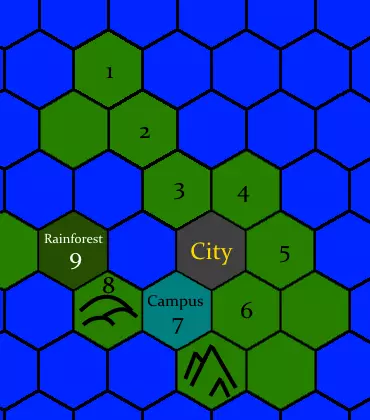
这座城市位于一个蜿蜒的岛屿上,但并非所有潜在地点都能建造运河。 地点1无法建造运河,因为其仅有一侧存在陆地瓷砖(而非两侧都有)。 地点2可以建造运河——其两端均为水域,且两侧都有陆地——但前提是地点3尚未建造运河。 地点3可以建造运河(但前提是地点2或地点4均未建造运河)。城市中心被视为水域瓷砖,而非其他运河。 地点4可以在地点3或地点5未建造运河的情况下建造运河;地点5可以在地点4未建造运河且地点6未建造巴拿马运河的情况下建造运河。 地点6无法建造普通运河,但理论上可以在那里建造巴拿马运河奇观,以将城市与东南部的水域连接起来,前提是地点5未被占用。位置7无法建造运河,因为该位置已存在一个区域。 位置8无法建造运河,因为其地形并非平坦。 位置9在拥有青铜工作技术后可以建造运河。在此处建造运河将移除雨林。 运河的建造成本比特色区域高50%,但可以通过使用军事工程师为其提供建造次数来部分抵消这一费用,类似于秦始皇的【天命】允许建造者为在建奇观增加建造次数。每次建造次数可抵消运河总造价的20%。除了允许海军单位通过该地格外,运河还具有一些额外效果: 国际商人每经过一个运河地格可获得+1金币,并且在计算运输效率时将运河地格视为水域(为贸易路线增加额外金币——更多信息请参见《印加文明指南》中的“机制 - 运输效率”部分)。 工业区每相邻一个运河可获得+2生产力。 拥有“水利工程”晋升的梁总督(勘测者),其城市中的每条运河可提供+1宜居度。 研究工业时代的“蒸汽动力”科技后,将有机会建造奇观“巴拿马运河”。它的功能类似于长度为两到三格的运河,能够让你将两个城市中心连接起来,或者在无需中间城市的情况下连接相距三格的水域。
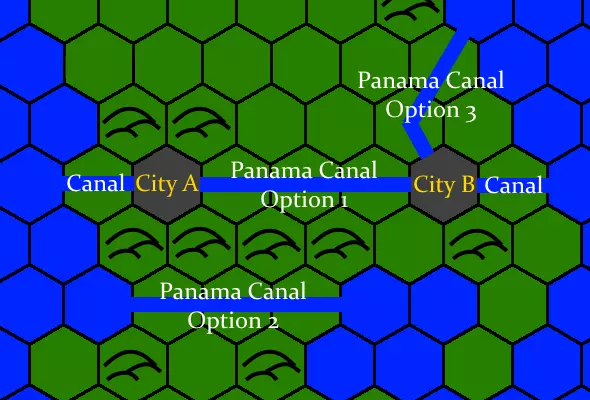
图片中有三个可能有效的巴拿马运河选址: 选项一能形成最长的航线,但需要城市A和城市B已通过运河区域连接到海洋。能够建造奇观的城市是拥有中间地块的那个,但不需要控制全部三个地块。 选项二可由城市A建造。虽然航线不如选项一长(因此防御效果稍逊,因为海军可覆盖的区域较少),但所需的准备工作较少。 选项三可由城市B建造,但会形成一条相当冗余的运河。不过需要注意的是,城市A和城市B都必须建在远离海岸和淡水的地方,这导致它们的住房基础较低。这是专门建造的运河城市普遍存在的问题——为解决此问题,可用长城金币在城市中购买谷仓,并调派建造者来修建农场。 运河——早期运河与策略 通过在游戏早期解锁运河,中国能够以其他文明无法做到的方式利用它们。最明显的好处是可以连接两片海域,这使得一支海军能够同时承担两片海域的防御任务,或者让海军远程单位在撤退到城市后方的同时,仍能向目标开火。不过运河对于提升城市生产力也很有帮助——运河能为工业区提供+2的相邻加成,再加上水渠、第二条运河或一些矿山、采石场,你就能获得可观的相邻加成,而燃煤发电厂能让这一加成翻倍。 但要确保你确实有多余的生产力来建造运河。基础基础设施和奇观在早期通常更为重要——除了最重要的战略用途外,最好等到中世纪时期再建造运河,这样就能用它们来配合工业区了。 总结:扩张到几个城市,让它们能够训练建造者并为奇观建造做出贡献。值得追求的强力奇观包括金字塔、斗兽场、佩特拉古城和大图书馆。到了中世纪时期,建造者的成本可能会相当高昂,使用【农奴制】经济政策卡可以降低成本。 早期的运河有助于提升海军的防御能力,为国际贸易路线带来更多金币,或者提高工业区的生产力。 秦始皇的领袖能力:三十六计(1/4部分)
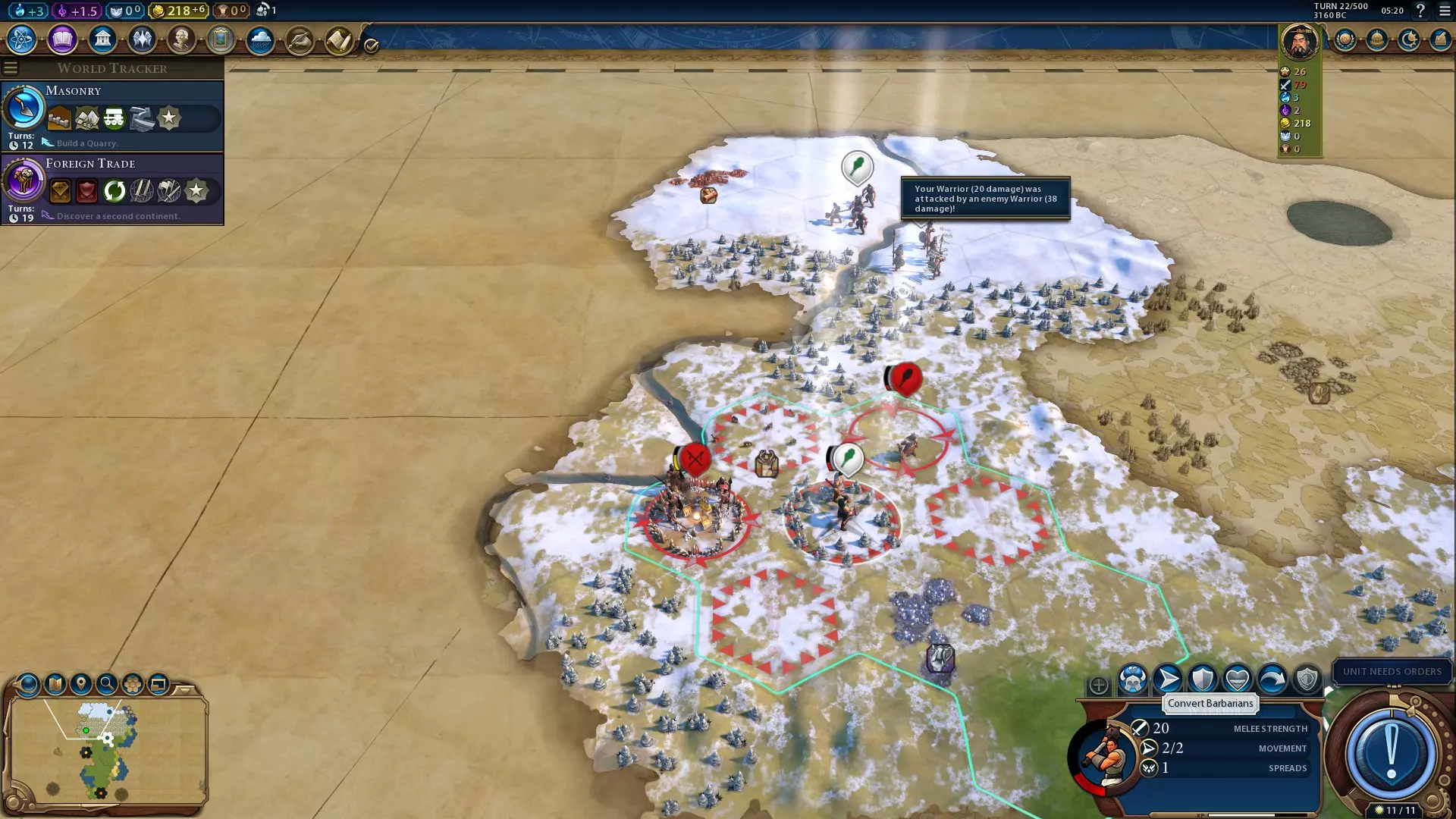
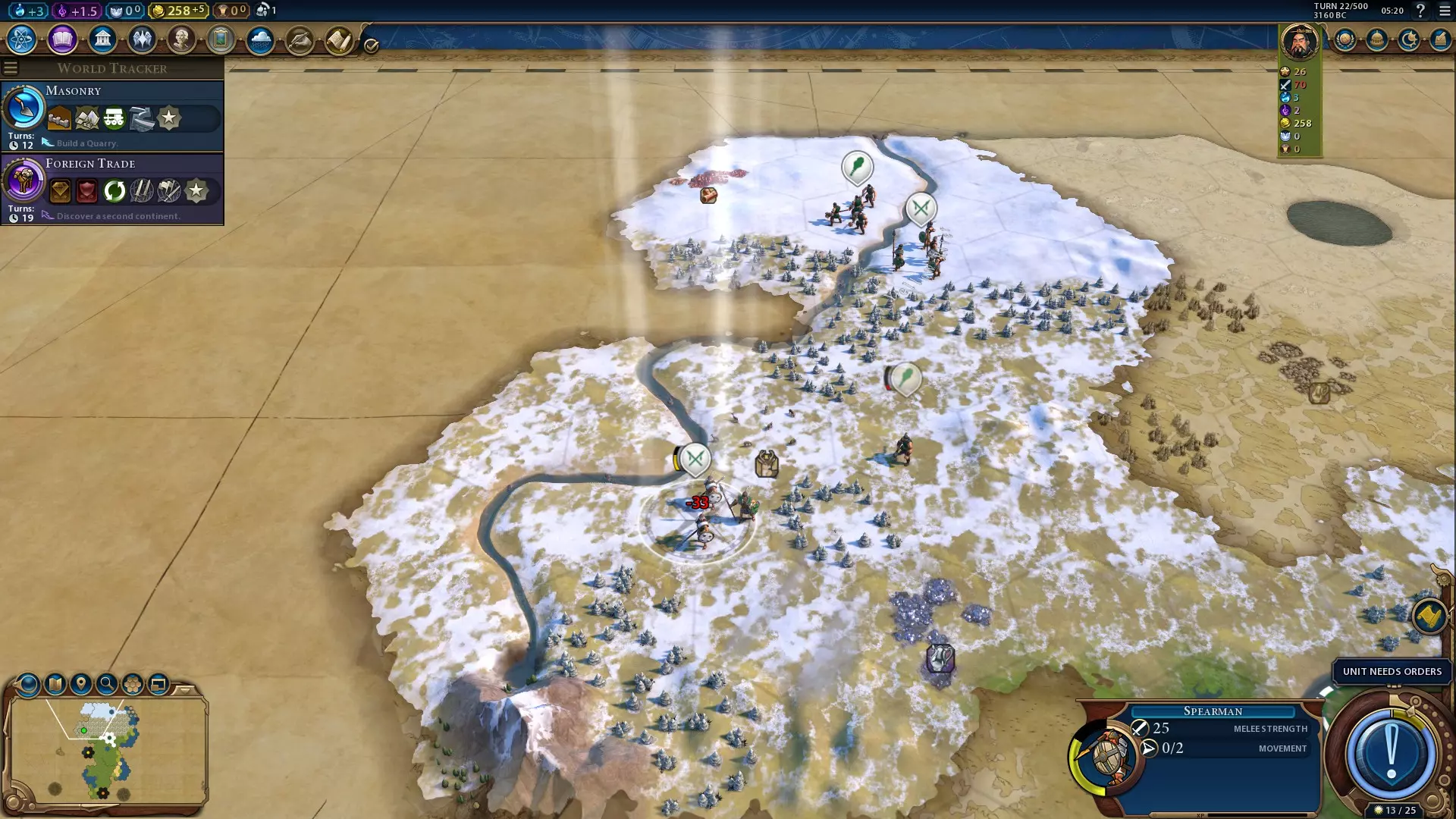
秦始皇(Unifier Qin)在中国统治者中独树一帜,他拥有大规模集结单位的能力,这使他在战争中,尤其是游戏初期,具备优势。不过,该能力的效果会因其他文明的发展进度和蛮族前哨站的生成情况而有很大差异,因此每一局使用秦始皇的游戏都是独特的。 开局 许多文明在首都首先训练投石兵,因为投石兵可以在不受伤害的情况下造成伤害。但对于秦始皇来说,先训练一名战士可能更有用,因为额外的蛮族转化机会在游戏初期非常有价值。 由于使用冲锋转化蛮族会消耗你的战士,所以你应该谨慎使用该能力。以下是一些早期使用充能的良好示例: 如果能获得一个战士和另一个单位,这样做不会消耗任何充能。 如果能获得至少两个单位,且这两个单位都不是侦察兵,也不太可能立即被消灭。这将带来比战士更有价值的单位。 如果在此过程中能获得第一个海军单位。获得第一个海军单位会提供时代分数——尤其是当它是世界上第一个时——并且对早期探索非常有帮助。 如果战士否则会被消灭。 如果转化后的单位比你当前能训练的任何单位都更先进(例如,在还没有弓箭术时获得弓箭手)。要找到蛮族前哨站,需尽可能探索更多土地,并留意蛮族前哨站的生成时机——当它出现在已探索的土地上时,会播放特殊音效。蛮族前哨站只能在任何单位视野之外的土地上生成,因此要避免同时让太多地图处于视野范围内。 如果在你的领土附近遇到头上带有【!】符号(感叹号)的蛮族斥候或蛮族桨帆船,派一名战士跟随它,但不要杀死或转化它。当它返回其所属的前哨站后,会生成额外的蛮族单位,你可以在接下来的几个回合内将这些单位转化。或者,你也可以让一名战士保持在蛮族前哨站附近,随时准备转化其生成的额外单位。在本土附近,结合基础发展、扩张,并在需要时训练额外的战士。尽早研发【砖石技术】会很有用,因为长城的金币产出能让你轻松维持和升级转化来的部队。如果能早期建造2-3个圣地并确立宗教,之后就能建造非常有用的【圣索菲亚大教堂】奇观,它能为所有近战步兵单位额外提供一次转化蛮族的次数!你也可以选择之后夺取该奇观来获得相同效果。 基础策略 在理想情况下,你可以利用秦始皇的领袖能力【天下一统】早期转化大量蛮族,组建一支比大多数文明在这一时期能拥有的更大规模的军队。然后你可以将这些单位与一些弓箭手组合,在游戏中敌方尚未建造城墙的阶段攻击邻近的文明。
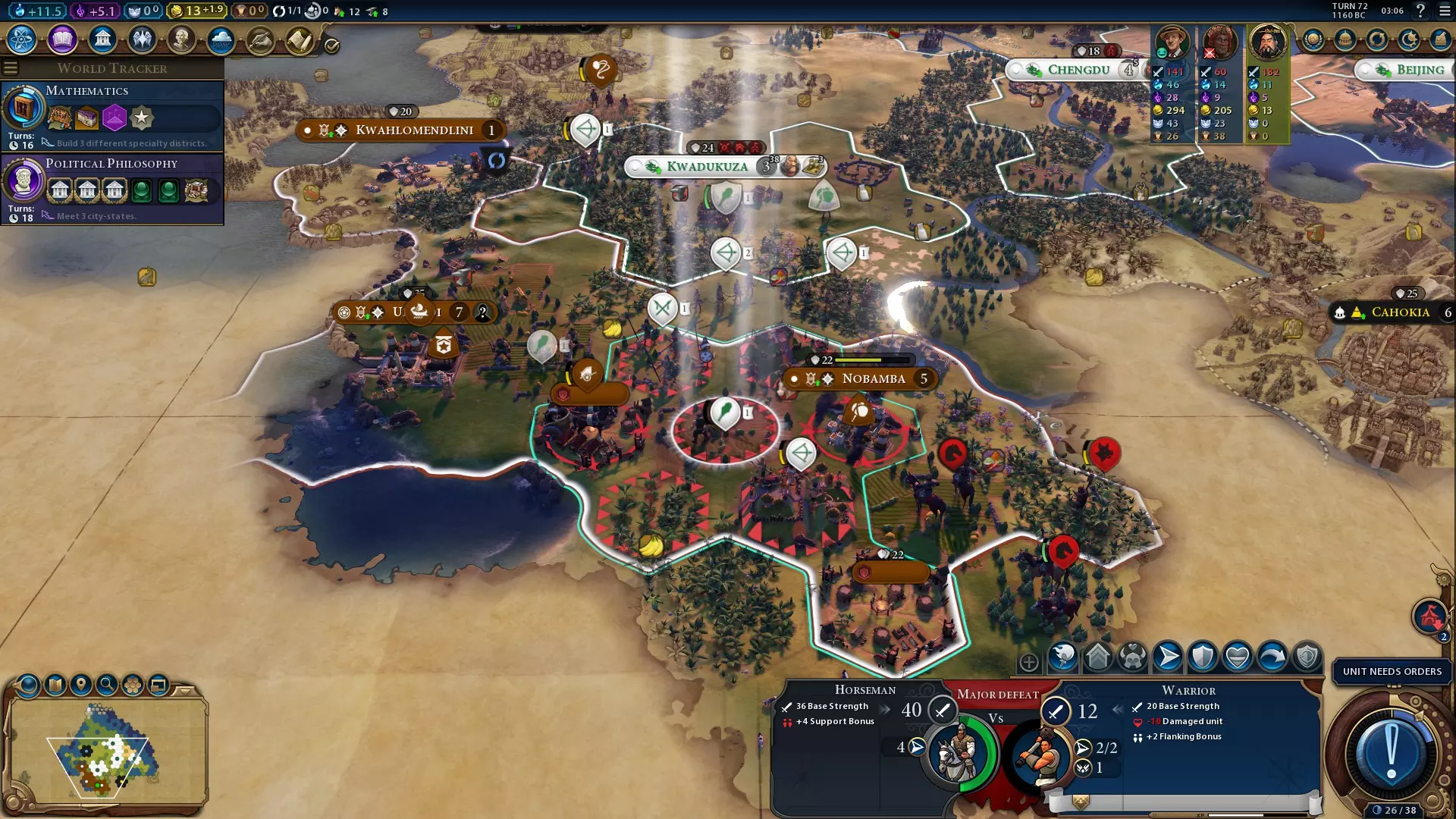
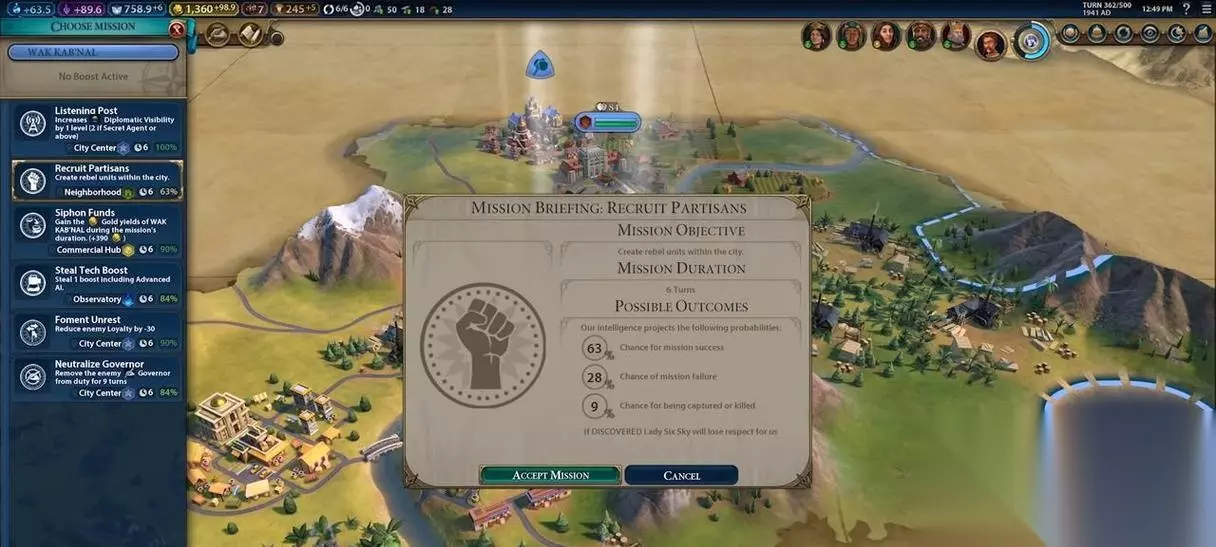
In the early stage of the game, random Barbarians getting in the way of your conquests is common - but for Unifier Qin, you can turn this into an advantage! In practice, however, Unifier Qin's ability to pull off an early rush will vary tremendously between games. If you start with few Barbarians near you, or your nearest neighbour is strong early on (e.g. the Aztecs, Gaul), attempting an early rush can end poorly. Instead, it may be worth simply emphasising Settlers and general city development instead. As more of the map fills up, Barbarian outposts can become harder to find. If possible, expanding near tundra/snow regions, or near desert can be helpful - civs are less likely to settle there, leaving gaps where Barbarians are more likely to spawn. Further into the game, the best place to find Barbarians is isolated islands, typically those found in snowy regions. As such, it's helpful to head towards the Shipbuilding technology reasonably early so you can bring Warriors over to them. Shipbuilding is needed for Buttress, in turn needed for the Hagia Sophia wonder, so it's very worthwhile on that basis as well. Barbarian units scale to the technology of full civs in the game, so as the game goes on they will produce increasingly strong units. This makes seeking out outposts still worthwhile late into the game to save production - particularly if one of your older, weaker melee infantry units can trade itself for a much stronger up-to-date unit. Once you reach the industrial-era Urbanisation civic, build a Neighbourhood in a key city, preferably away from any key districts or tile improvements. Place a melee infantry unit or two by it, and ensure you don't have a Spy protecting it. That way, if other civs target the Neighbourhood for a Recruit Partisans mission on that city, you'll easily be able to convert the Barbarian anti-cavalry units the mission creates. Basic Strategy Conclusion Ultimately, Unifier Qin's leader ability can be used to support early rushes, but otherwise is mostly useful to save production when it comes to securing up-to-date defensive units. A reasonable strategy is to start off aggressive in the first two eras, but settle down into a scientific or cultural playstyle for the rest of the game. It's a shame to leave things there though. After all, if you want to play a typical scientific/cultural game as China, there's four other leaders that can do that just as well. So, let's look more in-depth into how this whole ability can be used more effectively... Unifier Qin's Leader Ability: Thirty-Six Strategems (Part 2/4) Intermediate Strategies and Tricks Unifier Qin's leader ability can be simply used to convert Barbarian incursions into opportunities for extra units, but you can get even more out of it if you get the hang of how Barbarians work. Outpost Tribe Types You may notice that not all Barbarian outposts spawn the same units. That's because there's actually three different types! Melee Tribe - The most common. These start with a recon unit (initially a Scout), and will spawn a new unit every 15 turns. 25% of these regularly spawned units will be ranged land units, but otherwise it largely spawns melee infantry units, and can spawn extra recon units. Very, very late in the game these can spawn Giant Death Robots due to the way those units are coded. Cavalry Tribe - The rarest tribe type, and only appears near a horse strategic resource. These start with a Scout, and will spawn a new unit every 25 turns. Early in the game, 25% of these regularly spawned units will be either the unique Barbarian Horse Archer (earlier in the game), or a recon unit (starting with Skirmishers). Otherwise, these outposts largely spawn light cavalry units. Naval Tribe - These uniquely start with naval melee units, and will spawn a new unit every 10 turns. 25% of these regularly spawned units will be naval ranged units, but otherwise it largely spawns melee naval units.The type of tribe an outpost is also determines what units they create when they initiate a Barbarian Raid or Barbarian Attack - more on that later. Identifying the type of outpost tribe is fairly straightforward: If it spawns a Scout, or isn't adjacent to the coast, it can't be a naval tribe. If it spawns a naval unit, it is always a naval tribe. If it spawns a Warrior or Slinger, it is always a melee tribe. If it spawns cavalry units, it is always a cavalry tribe. Identifying the tribe of a camp is useful for ensuring you're always getting the most relevant units. Melee tribes are always useful as they produce melee infantry units, which when converted can be used for further conversions. Cavalry tribes are generally bad at the start of the game because the unique Barbarian Horseman and Barbarian Horse Archer units they spawn are weak and cannot be upgraded, but once they start producing proper Horsemen they become considerably better. Naval tribes are good in the very earliest turns of the game as they can secure you an early naval unit and the associated era score. Later on, you can use an embarked Warrior protected by a stronger naval unit to get close, allowing you to safely convert units with a much lower risk of your Warrior being killed. Raids and Attacks Barbarian outposts always spawn with a recon unit (for melee and cavalry tribes) or a naval melee unit (for naval tribes). If these reach a tile adjacent to a non-city-state city, and then return to their original outpost, they will cause a Barbarian Raid to occur. When a Barbarian Raid starts, the outpost will cause new units to be spawned every 2 turns (or every turn on Immortal/Deity difficulty) until all the raid units are produced. Depending on the tribe of the camp and your game's difficulty, that can be between 1 and 5 units, as follows: Tribe Settler to Chieftain Warlord to Emperor Immortal to Deity Melee 2 melee infantry 2 melee infantry 1 land ranged 3 melee infantry 2 land ranged Cavalry 1 light cavalry 2 light cavalry 1 mobile ranged* 3 light cavalry 2 mobile ranged* Naval 2 naval melee 2 naval melee 1 naval ranged 3 naval melee 2 naval ranged *This will be one Barbarian Horse Archer earlier in the game, or a recon unit starting with Skirmishers. When all of the units for a Raid has spawned, and after certain conditions are met (e.g. the Barbarian outpost's units kill two units without losing any) then units for a Barbarian Attack will be generated, in a similar manner to the Raid but with more units: Tribe Settler to Chieftain Warlord to Emperor Immortal to Deity Melee 2 melee infantry 1 land ranged 1 siege 3 melee infantry 2 land ranged 1 siege 1 Battering Ram 4 melee infantry 3 land ranged 2 siege 1 Battering Ram Cavalry 2 light cavalry 1 mobile ranged* 3 light cavalry 2 mobile ranged* 1 heavy cavalry 4 light cavalry 3 mobile ranged* 0 heavy cavalry** Naval 2 naval melee 2 naval ranged 3 naval melee 3 naval ranged 4 naval melee 5 naval ranged *This will be one Barbarian Horse Archer earlier in the game, or a recon unit starting with Skirmishers. **Due to bad code, cavalry tribes will not produce heavy cavalry on Immortal or Deity difficulty. They're supposed to produce 2. Like Barbarian Raids, Barbarian Attacks spawn one unit at a time, every two turns on Emperor difficulty or below, or every turn on Immortal difficulty or higher. Overall, Barbarian Raids and Barbarian Attacks make Unifier Qin's leader ability substantially stronger on Immortal and higher difficulty than it is on lower difficulties, as you'll be able to secure far more units, and the faster spawning rate of raids/attacks increases the chance the units will be clustered together. Usually, it's easy enough to force a Barbarian Raid (just allow the outpost's Scout or Galley to reach your city and return). Barbarian Attacks are much harder to force, but some thoughts of the matter are covered under the Advanced Strategies subsection of this leader ability. Unifier Qin's Leader Ability: Thirty-Six Strategems (Part 3/4) Unique Barbarian Units Cavalry tribes have two unique units they can spawn early on which you can convert to your cause. Let's have a look at them! Unique Unit: Barbarian Horseman

一种古代轻型骑兵单位,不会替代任何单位 研究需求:无 淘汰条件:无 可升级自:无 可升级为:无 成本:无 资源需求:无 维护费用:无

骑马术* 科技 古典时代 N/A N/A 35
无法识别内容,已删除。
能生产常规骑兵的蛮族前哨站将不再生产蛮族骑兵。 该单位的生产费用无关紧要,因为它永远无法通过常规方式生产。 力量:20 远程力量: 移动力: 射程: 视野: 负面属性: 正面属性:
无法识别
N/A 2
对城市城墙和城市防御造成85%的伤害 忽略控制区域 特殊单位:蛮族骑射手

一种古代远程陆地单位,不会替代任何单位 研究需求:无 淘汰科技:无 可升级自:无 可升级为:无 成本:无 资源需求:无 维护费用:无
机械* 科技 中世纪 不适用 不适用 35
无法识别内容,已删除。
能够生产散兵的蛮族前哨站将不再生产蛮族骑射手。 此单位的生产费用无关紧要,因为它无法通过常规方式生产。 力量:10 远程力量: 移动力: 射程: 视野: 负面属性: 正面属性:
15
3
1
2
无法占领城市 -17
对抗城市防御 -17
vs. naval units Deals -50% damage to city walls and urban defences Ignores Zone of Control Analysis These unique Barbarian units have a key advantage - the mobility of Scouts while matching up to the power of Warriors and Slingers. This makes them great at exploring, but there are some niche other applications. For example, because Barbarian Horsemen impose Zone of Control but ignore it from other units and cities, you can use them to easily surround an enemy city and put them under siege, preventing them from healing. In theory, the high mobility of these units could make them good pillagers on higher difficulties - assuming there's anything worth pillaging this early in the game. Barbarian Horsemen with the Depredation promotion can pillage two adjacent tiles in the same turn, granting you some decent yields or allowing the unit to heal up rapidly off enemy farms. The main disadvantage of these units is that they can never be upgraded - unlike any other unit you can get from Barbarians at this point in the game. As such, once classical-era units enter the battlefield, they have to be relegated to strictly non-combat roles. Making the Most of Warriors Warriors are great to use with Unifier Qin's leader ability because they're cheap. 40 production isn't much, while they have no resource requirement and no maintenance cost. However, they eventually obsolete, cutting out that easy option for cheap conversions. With careful management of strategic resources and technology, however, you can train Warriors much further into the game than normal, ensuring you can convert Barbarians for cheap for much longer! If you have the Iron Working technology and at least 20 iron, you will lose the option to train a Warrior. However, you can simply trade away your iron to another civ, and the option to create a Warrior will be there again. It's a good idea to purchase Warriors at this point in the game rather than to produce them, as cities will switch Warrior production to Swordsman production the moment you have 20 iron again. This trick continues to work if you have Apprenticeship (which unlocks Men-at-Arms units), but you will be completely unable to train Warriors once you have the Gunpowder technology. As a result, it can be worth avoiding researching Gunpowder until later in the game. As Warriors have only a mere 20 strength, they'll struggle to resist attacks by stronger Barbarians. As such, keep a stronger unit between your Warriors and the Barbarians you want to convert. You can then make the units swap places and use the Convert Barbarians charge on your Warrior immediately afterwards. That way, the only threats to your Warrior will be ranged attacks and flanking cavalry. Embarking Warriors is also a good way to keep them safe. Embarked units' defensive strength is defined independently of their unembarked strength. In other words, an embarked Warrior will defend just as well as an embarked Man-at-Arms. Prior to the renaissance, embarked units only have 15 strength, but once you have any renaissance-era technology or civic, that's boosted up to 30, and even higher in later eras. And, of course, you can escort embarked units with naval units for even better defence. To summarise, for the most efficient conversions, aside from getting the Hagia Sophia wonder you can hold off getting Gunpowder and sell your iron so you can train cheap Warriors. Unifier Qin's Leader Ability: Thirty-Six Strategems (Part 4/4) Barbarian Technology Barbarian technology scales based on the technology level of other civs in the game - how this happens is not exactly known. One theory is that Barbarians have the technology that half the full civs in the game have, yet you may notice that Babylon skipping ahead to later technologies can be enough to make Barbarians tougher. Until the exact details are known, you can assume that Barbarians will largely keep up with most civs' technological advancement. What makes this useful for Unifier Qin is it allows you to convert units that you otherwise the technology to train - such as Pike and Shot units before you unlock Metal Casting. Many military units in the renaissance, industrial and modern eras arrive at technologies on the bottom half of the technology tree, while many of the most relevant technologies to a scientific or cultural game are on the top half, so this means that a scientific or cultural Unifier Qin can cover the military weakness many other scientific/cultural leaders and civs can have at the same time. One catch with converting advanced units comes in the form of strategic resources. If you have no copies of the strategic resource a unit needs (e.g. horses for Horsemen), they will be unable to heal except when gaining new promotions. Later units like Infantry which consume resources every turn will additionally have a strength penalty for every strategic resource deficit (so if you have no oil and 10 Infantry, they will all have a 10 strength penalty). Now, let's take a step further into more specific mechanics regarding Barbarians... Advanced Strategies Barbarians are subject to certain hidden mechanics which affect when and where they spawn, and when they launch Raids. Understanding those can help you track down more Barbarians to convert! Barbarian Outpost Spawning Barbarian outposts have some relatively strict rules regarding how and where they appear. Outposts must spawn in territory not in line-of-sight of any civ, at least 7 tiles from another outpost, and at least 4 tiles from a city centre (this distance is increased from a player below Prince difficulty). They can spawn on any type of flat or hilly land terrain which is either featureless or has woods, rainforest, marsh, floodplains or volcanic soil. Barbarians cannot spawn on other features like geothermal fissures or natural wonders.
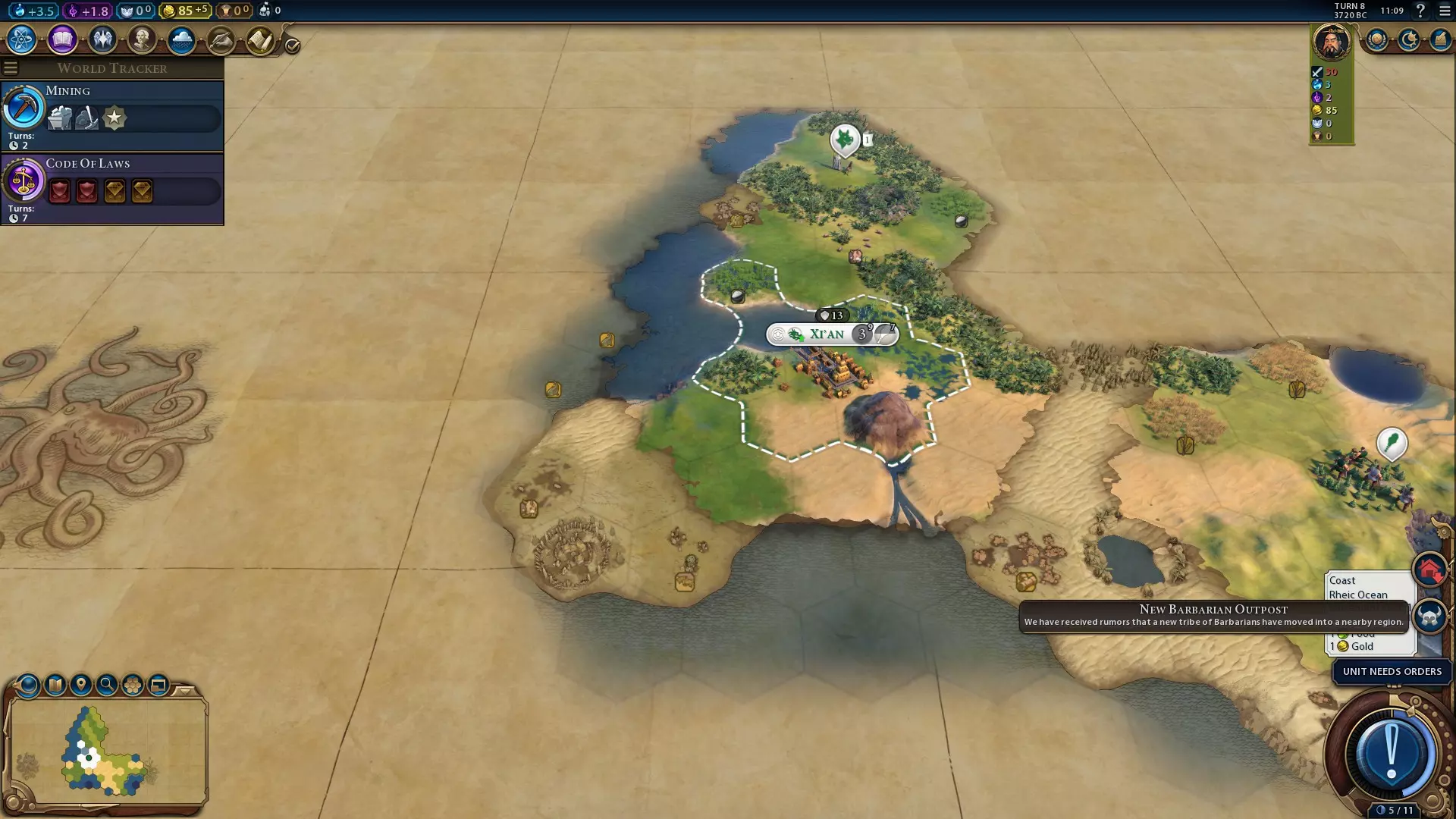
你知道吗——4格距离!通常前哨站不会生成得这么近。 此外,前哨站的生成数量也有限制,由硬上限和软上限共同决定: 硬上限:蛮族前哨站的数量上限为完整文明数量的三倍。例如,一个有8个文明的游戏中,蛮族前哨站的硬上限为24个。 软上限:软上限的数值是硬上限乘以完整文明(不包括城邦)可见范围内的陆地格子百分比。如果世界上的蛮族前哨站数量低于这个数值,新的前哨站就可以生成。举个例子,如果游戏中8个玩家能看到世界上一半的陆地,那么当剩余的蛮族前哨站少于12个时,新的前哨站就会生成。这意味着随着游戏进程和世界地图的逐步探索,野蛮人的前哨站生成数量会减少。 无论地图大小,新前哨站的生成速率都限制为每两回合一个。 胆识 胆识是每个野蛮人前哨站的隐藏机制,用于决定野蛮人突袭和攻击。通过追踪特定前哨站的胆识值,你或许能促使更多单位生成,进而将其转化——但这需要一些复杂的微操! 当野蛮人前哨站首次生成时,每回合会被动获得2点胆识。 若前哨站的单位击杀了其他单位,该前哨站获得15点胆识。若前哨站损失一个单位,失去10点胆识;若损失一个侦察兵,则失去15点胆识。如果前哨站中的蛮族单位受伤,该前哨站将损失30点胆识值。胆识值可以为负数,因此如果一个前哨站遭受猛烈攻击且所有单位都被消灭,那么它在短期内不太可能发起任何突袭或攻击。 蛮族突袭的触发条件是:其侦察单位(针对陆上前哨站)或近战海军单位(针对海岸前哨站)到达某个完整文明城市的边境(以头顶的!符号为标志),然后返回其前哨站。但严格来说,只有当前哨站的胆识值至少为10时,突袭才会发生。实际上,到那时前哨站几乎总会有10点胆识值,除非在前哨站生成后不久,守卫营地的单位就遭到了攻击。当蛮族突袭的所有单位生成完毕后,前哨站的“勇猛值”会重置为0。此后,若前哨站的勇猛值达到25,蛮族攻击就会触发。快速达到25勇猛值的最简单方法是:让该前哨站的蛮族在不损失任何单位且防守前哨站的单位未受任何伤害的情况下,击杀两个单位。 强制触发蛮族攻击并非易事,你需要: 1. 确保蛮族突袭先发生 2. 计算蛮族突袭单位全部生成所需的回合数(神级/不朽难度下为5回合) 3. 然后确保前哨站达到25勇猛值 如果其他文明或城邦开始击杀蛮族单位,或攻击防守前哨站的单位,那么达到25勇猛值的目标会变得困难得多。因此,如果你想尝试一下,可以选择一个靠近你的领地但与其他文明或城邦隔离开的前哨站(例如位于雪地地形的前哨站)。 总结:让蛮族侦察兵前往你的城市边境,然后返回他们的前哨站以生成更多蛮族单位。 建造或夺取圣索菲亚大教堂奇观,以获得额外的蛮族转化次数。 出售你的铁资源,并避免研究火药技术,这样你就可以继续廉价训练战士来进行转化。 适当提前研究制图学,你可以找到孤立的蛮族岛屿进行转化。 你可以避免研究许多军事科技,仍然可以通过转化蛮族来获得他们的单位。 武则天的领袖能力:天工开物
A Spy so early there's no Campuses I can target - but there's time to train this Spy up! Thanks to her strengths in espionage, Wu Zetian has two key advantages over other Chinese leaders: she can obtain the most eurekas, and she can more effectively set back other civs without going to war. This makes her ideal for an isolationist scientific game, though she also performs well at cultural and even diplomatic victories. The Early Spy Wu Zetian receives a Spy at the classical-era Defensive Tactics civic - notably two eras before most civs gain their first Spy capacity at the renaissance-era Diplomatic Service civic. To speed up your early civic gain, settle a reasonable number of cities and build Monuments in them. You can usually secure all the inspirations for the civics along the way up to Political Philosophy. It might be tempting, but don't send this Spy to steal technologies or Great Works right away. These initially have a relatively high failure rate. If your Spy is killed, the cost of training a new one is very high at this point in the game, so it's better to go for less risky missions to train the Spy up. Some good missions are Forment Unrest (can be done in any city owned by another full civ), Siphon Funds (can be done in any full-civ city with a Commercial Hub) or Fabricate Scandal (can be done in any city-state) as they have a relatively good rate of success. Note that missions with a fixed 100% rate of success (e.g. Gain Sources) do not level up your Spies. While your free Spy conducts tasks abroad, it's a good idea to work on your cities' science, production and culture outputs. You'll need a good production base to train subsequent Spies - although you can buy Spies with faith, building up a faith infrastructure is generally a distraction from Wu Zetian's other goals. A good science output can get you to the medieval-era Castles technology quickly, granting you a huge boost to culture from Great Wall improvements and in turn speeding up your civic accumulation rate. Boosting Spies Further Once you have any tier two government (Monarchy, Merchant Republic or Theocracy), you can build the Intelligence Agency building in your Government Plaza district. This provides a free Spy, +1 Spy capacity and improves the rate of success for all your Spy operations. To get this bonus as quickly as possible, research the Divine Right civic for the Monarchy government. This does mean you'll miss out on the opportunity for Merchant Republic or Theocracy's legacy wildcard and arrangement of policy card slots, but for Wu Zetian the benefits of stronger Spies sooner largely outweighs those smaller benefits. Your Spy capacity will increase further still with the following civics and technologies: Diplomatic Service (Renaissance era civic - also needed for the useful Machiavellianism diplomatic policy card which lets you train Spies faster and makes their operations faster) Nationalism (Industrial era civic) Ideology (Modern era civic) Computers (Atomic era technology) Cold War (Atomic era civic) As your Spies conduct successful operations, they'll eventually be able to earn up to three promotions. Key promotions to look out for are as follows: Cat Burglar - Steal Great Works as if 2 levels more experienced - Ideal if you're after a cultural victory, or even just want to boost your tourism pressure. If your tourism influence over a civ is sufficiently high, all your Spy operations against them will be sped up! Disguise - Can instantly relocate to another civ's city - Useful in conjunction with Cat Burglar for faster Great Works, or if you need to switch between different civs to steal technologies. Linguist - Time to complete missions reduced by 25% - Excellent for any offensive operation. Great if you want to get some extra science and culture from Wu Zetian's leader ability. Technologist - Steal Tech Boost as if 2 levels more experienced - An ideal choice as every eureka is worth more for China. Science, Culture and Faith Every successful offensive Spy mission for Wu Zetian yields culture, faith and science equal to 100% of that targeted city's per-turn generation of those respective yields. In other words, if you succeed in a mission in a city with 10 science and culture per turn, you'll generate 5 science and 5 culture from that mission. Generally, single cities do not tend to generate huge amounts of science on their own, so the amount of science this bonus will yield is relatively small. However, a city with a lot of Great Works (e.g. Kongo's capital) can often yield a high amount of per-turn culture - while a city with many relics can have a large faith output. Still, overall the science, culture and faith is a nice little bonus and not really worth affecting your judgement regarding where you send Spies. Although Wu Zetian can buy Spies with faith, China's other bonuses generally discourage her from emphasising a faith infrastructure. If you have spare faith lying around, go for it, but don't waste precious district capacity on Holy Sites until your cities are big enough to have exhausted everything else useful. Later in the Game After you pick up the modern-era Ideology civic and a tier three government (Communism is ideal for scientific games), take a detour to Nuclear Programme. This allows you to take the Nuclear Espionage policy card granting a second eureka boost every time you successfully steal a eureka. This is really effective for cleaning up the eureka boosts you might otherwise have difficulty earning. Wu Zetian's Spies at maximum level have the highest success rate of any leader's Spies, but keep in mind that any mission without a fixed 100% success rate (e.g. Gain Sources) will be capped at a 90% success chance. This means there's always a possibility of your Spies being killed. Once you have a Spaceport, consider keeping a Spy in home territory to defend it. The benefits of having an extra Spy on offensive missions are not as significant as the production cost from having to repair a pillaged Spaceport. Once you run out of eurekas to steal, and have all the Great Works you want, it may be a good time to set back other civs by sabotaging their Industrial Zones, breaching their Dams and neutralising their Governors. The Breach Dam mission in particular is highly destructive but usually has a low rate of success. A highly-promoted Spy under Wu Zetian can often take the risk. Alternatively, you can carry out the Fabricate Scandal mission in city-states to take envoys off other civs. This is particularly effective against diplomatic civs trying to accumulate diplomatic favour from suzerain city-states. Conclusion China's civ ability demands you put in the work to make the most of it. The more eureka boosts you can acquire, the stronger it is. Wu Zetian makes that job a lot easier by making technology stealing much more reliable. Just keep your culture output high early on to get to Defensive Tactics and Divine Right quickly, and ensure your production is sufficient to train later Spies, and you shouldn't have too much trouble. Yongle's Leader Ability: Lijia
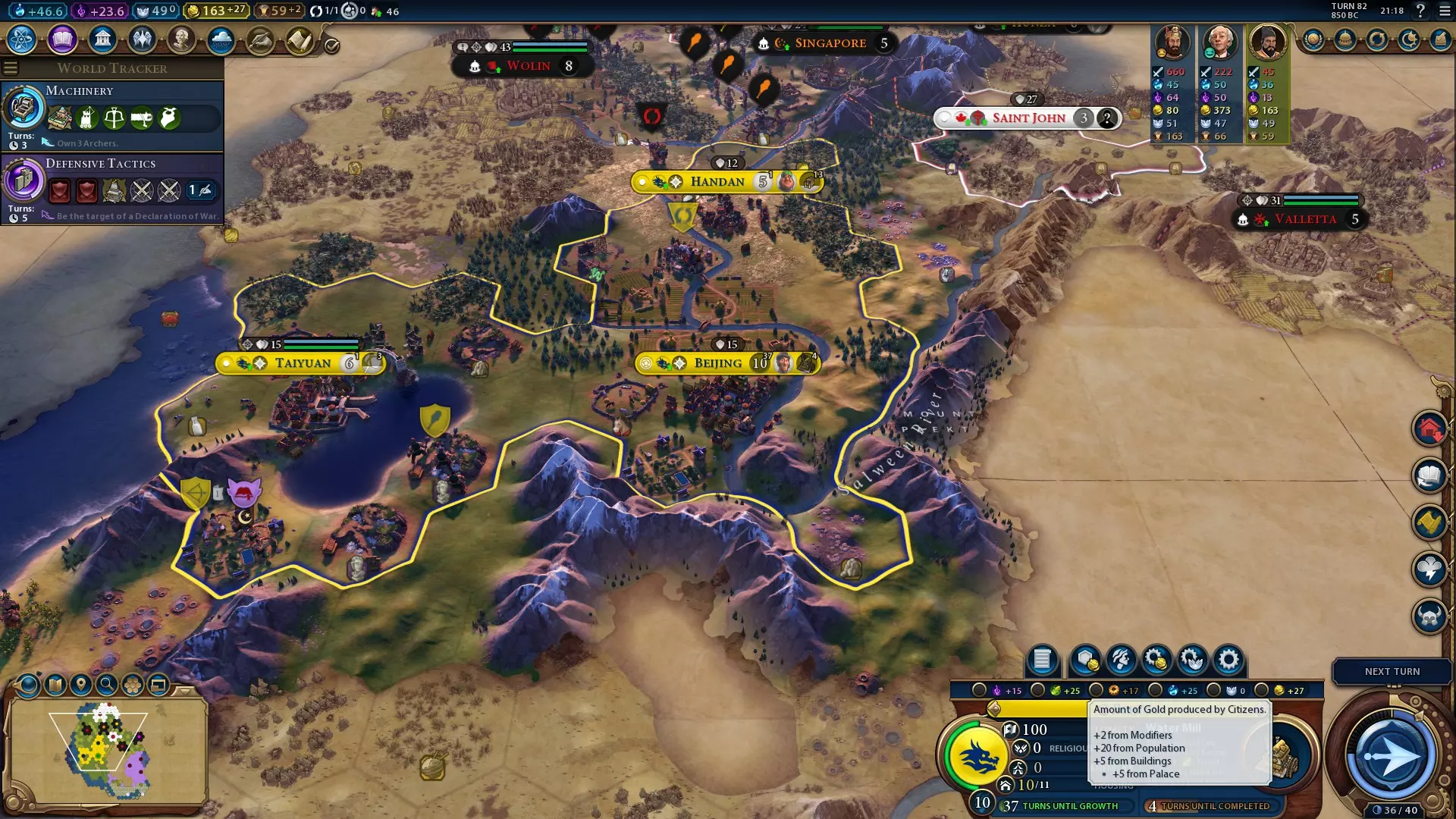
当城市规模达到10时,收益将极为可观。 永乐喜欢建造大型城市,而且要快。做到这一点,你将获得极其强大的文化和金币产出,同时拥有强劲的科技产出,与中国强大的尤里卡效果相得益彰。协助他完成这一任务的是三个独特的城市项目,这些项目允许他将生产力转化为信仰、金币,或者独特的食物。 初始阶段
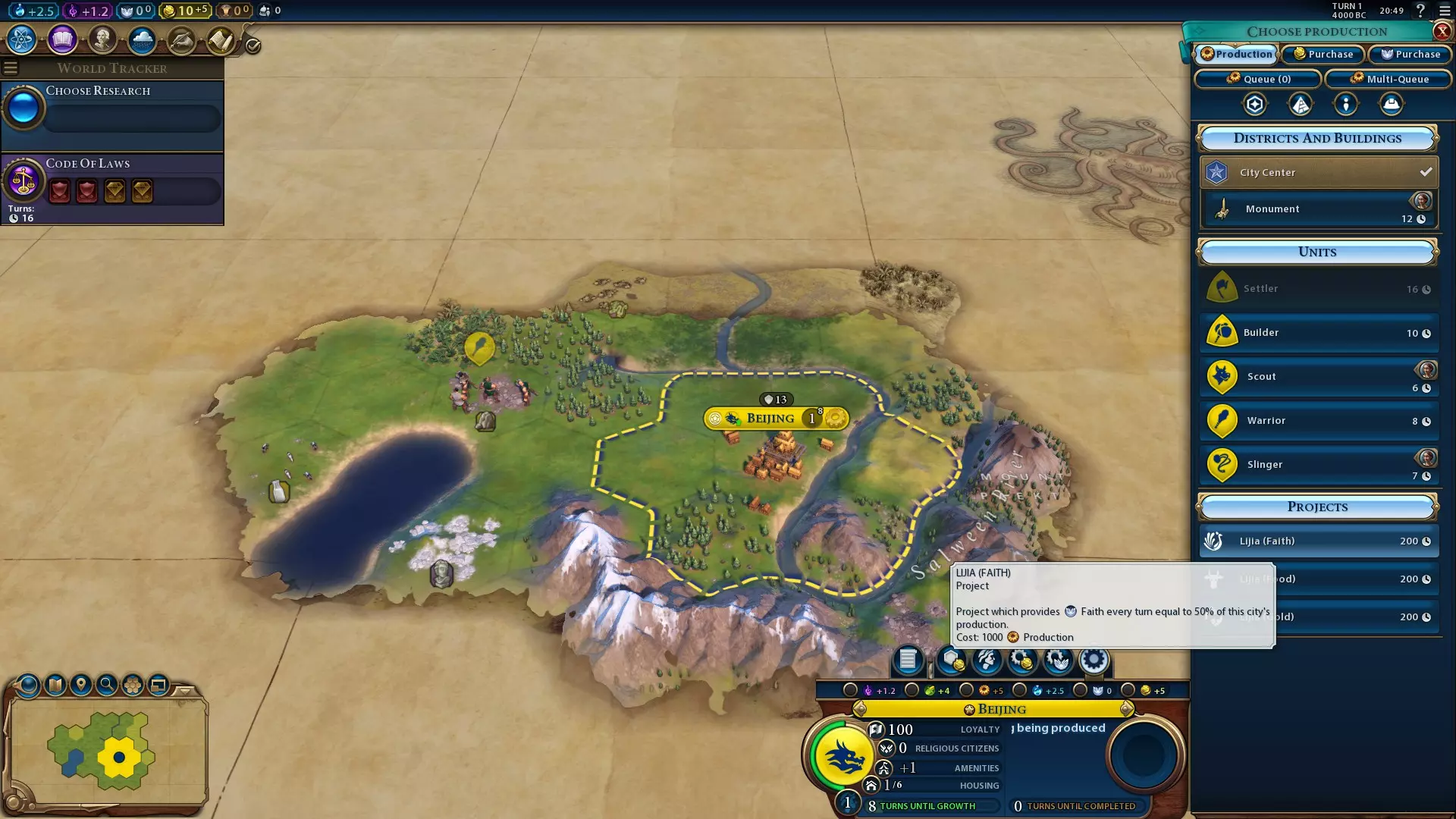
从第一回合开始,你就可以在首都使用【礼甲(信仰)】项目将生产力转化为信仰值。这能让你非常早地获得万神殿——【宗教定居者】是个不错的选择,它能提供额外的移民,节省你宝贵的早期生产力,还能避免首都损失1点人口。获得万神殿后,你可以转而训练一两个投石兵用于防御,并训练移民来建立第三座城市。
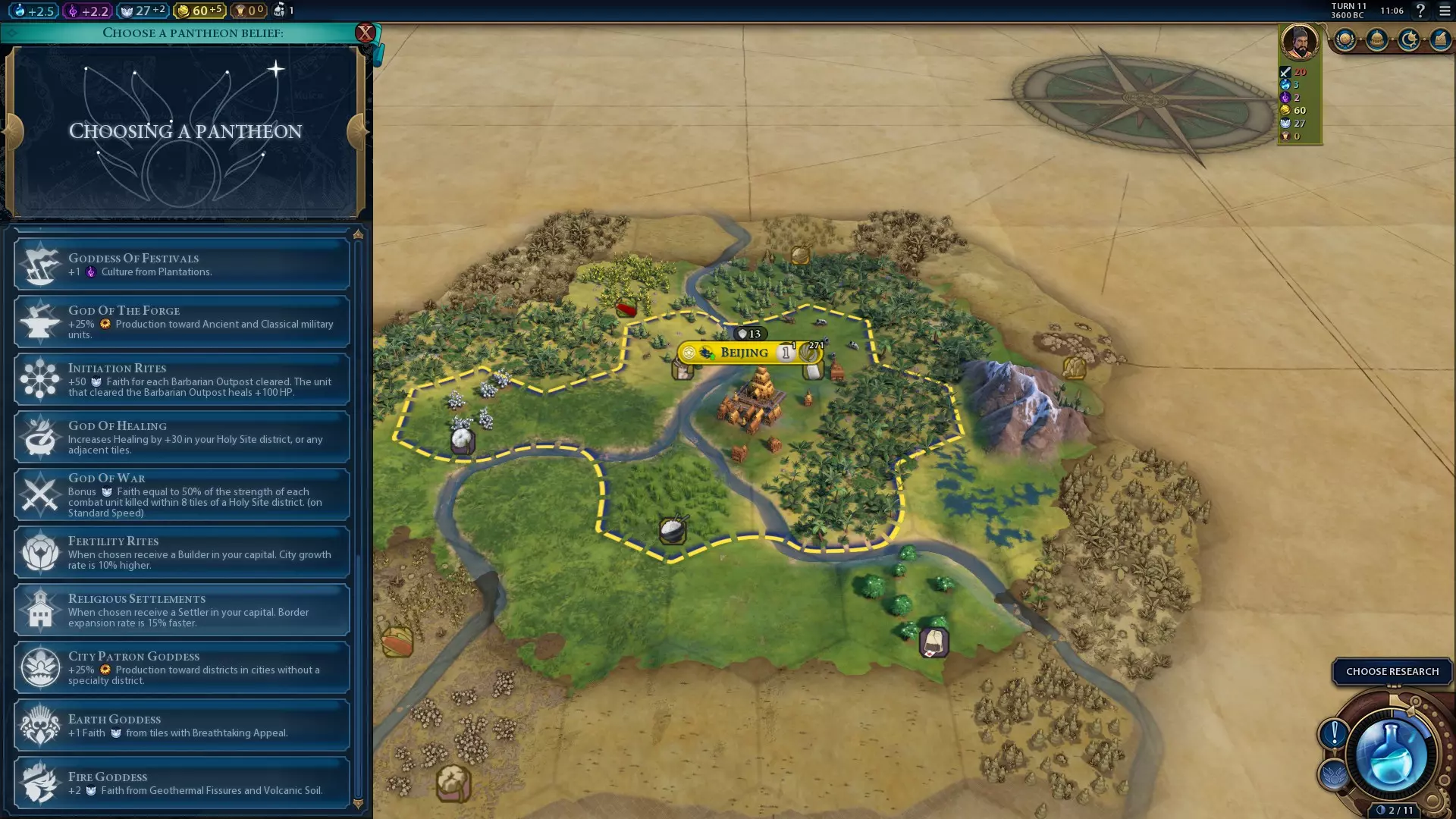
A Settler at just turn 11. Yongle's early game is a careful balancing act of expansion and city growth. It is a lot easier to grow six cities to size 10 than three cities to size 20, so do not neglect training Settlers early on. At the same time, the first city you can get to size 10 will have a significant boost to your science, culture and gold which is worth getting as soon as reasonably possible. Thankfully, there are a few things you can do to help meet both needs. You can use Governor Magnus (the Steward) with the Provision promotion so you can train Settlers without losing population. His Surplus Logistics promotion also speeds up growth in the city. It takes a bit of time to unlock these promotions, so until then consider training Builders and/or defensive units. Try to get a city to 11 housing at a reasonably fast rate. Cities with only 1 point of surplus housing relative to their population will have a 50% penalty to growth rate, so reaching 11 housing ensures the city can grow to 10 population at its optimum rate. If your capital starts on fresh water, it will start with 6 housing - you can get to 11 with a Granary and six tile improvements which grant housing (farms, fishing boats, camps, pastures and plantations). Most of these tile improvements also offer food which will be necessary to maintain the 10 points of population. Once a city has 11 housing, you can use the Lijia (Food) project to get it to 10 population faster - though this works best if the city has more than a token amount of production. Amassing Size 10 Cities Once you have your first size 10 city, you'll gain a massive +10 science, +10 culture and +20 gold per turn. The gold can be put to good use purchasing Granaries and Builders in cities to help boost their housing. While your biggest city focuses on training Settlers with Governor Magnus preventing population loss, focus on boosting the population of your other cities to size 10. Two things that will help in the process of raising extra cities to size 10 is the Classical Republic government and the Audience Chamber building in the Government Plaza. Classical Republic offers +1 housing and amenity to cities with a district present, while the Audience Chamber offers +4 housing and +2 amenities to cities with governors. Once again, use Granaries and housing-boosting tile improvements like farms to get cities up to 11 housing, and then use the Lijia (Food) project to reach size 10. Although you gain extra science, culture and gold for every point in population, growing a city past size 10 is less important than getting a new city to that point. It's best to continue to train new Settlers until you have all the decent city spots you can take. Outside of ones necessary for eureka boosts, you can neglect building districts as their yields at this point in the game are significantly smaller than the boost from reaching size 10. This frees up production for defensive buildings and units and/or extra Builders. Settling Down Once you've settled all the decent cities you can, and have reached size 10 in as many as possible, the rest of Yongle's game becomes simpler in comparison to the start. The huge science output from Yongle's leader ability combined with China's strong eurekas makes him exceptional at the scientific game, though the cultural game is a fine alternative - large cities are great at building wonders and the Lijia (Faith) project can be useful for obtaining Rock Bands and Naturalists. Continue to grow your cities providing you can support the costs involved. Building Aqueducts will be useful both for their additional housing and the strong adjacency bonus they grant Industrial Zones, making the Lijia projects more effective. Entertainment Complexes and Water Parks shall be crucial as having lots of large cities will be a huge strain on amenities. One problem you're likely to face growing large cities is the trade-off of using the Great Wall tile improvement versus building more farms. It might be a good idea to restrict use of the Great Wall to tiles that might otherwise be hard to improve (e.g. tundra). The question of what to do with city projects becomes relevant again later on in the game. Lijia (Food) remains excellent for quickly filling up a city's housing capacity so long as the city has a reasonable production base. Lijia (Faith) is mostly useful for Rock Bands for the cultural game, or Naturalists for extra amenities. Lijia (Gold) is a good option for cities which have already built everything they need to as you can use the gold to purchase things in other cities. That being said, things cost four times as much gold to purchase as they do production to produce, so be aware of how efficient (or not) you're actually being. Ultimately, maximise science and production, and you'll soon be ahead in the space race or the race for wonders. Alternative Strategy: Yongle and Monasticism If you can keep your era score low early in the game, Yongle can achieve a massive science output in a classical or medieval-era Dark Age thanks to the Monasticism wildcard. Monasticism grants +75% science in all cities with a Holy Site, at the cost of -25% culture in all cities. To keep your era score low, avoid clearing Barbarian outposts where possible and consider holding off from building the Great Wall improvement. The requirement to build Holy Sites becomes a lot more manageable if you take the River Goddess pantheon, which makes river-adjacent Holy Sites grant +2 amenities and +2 housing - perfect for growing cities. Summary Use the Lijia (Faith) project right away and you can usually secure the Religious Settlements pantheon for an early second city. Governor Magnus with the Provision promotion helps you settle cities without losing city population. Give your capital a Granary and six farms or similar tile improvements, then use the Lijia (food) project to get it to size 10 quickly. Settle extensively early on as it will maximise your overall number of population points. Unique Improvement: Great Wall
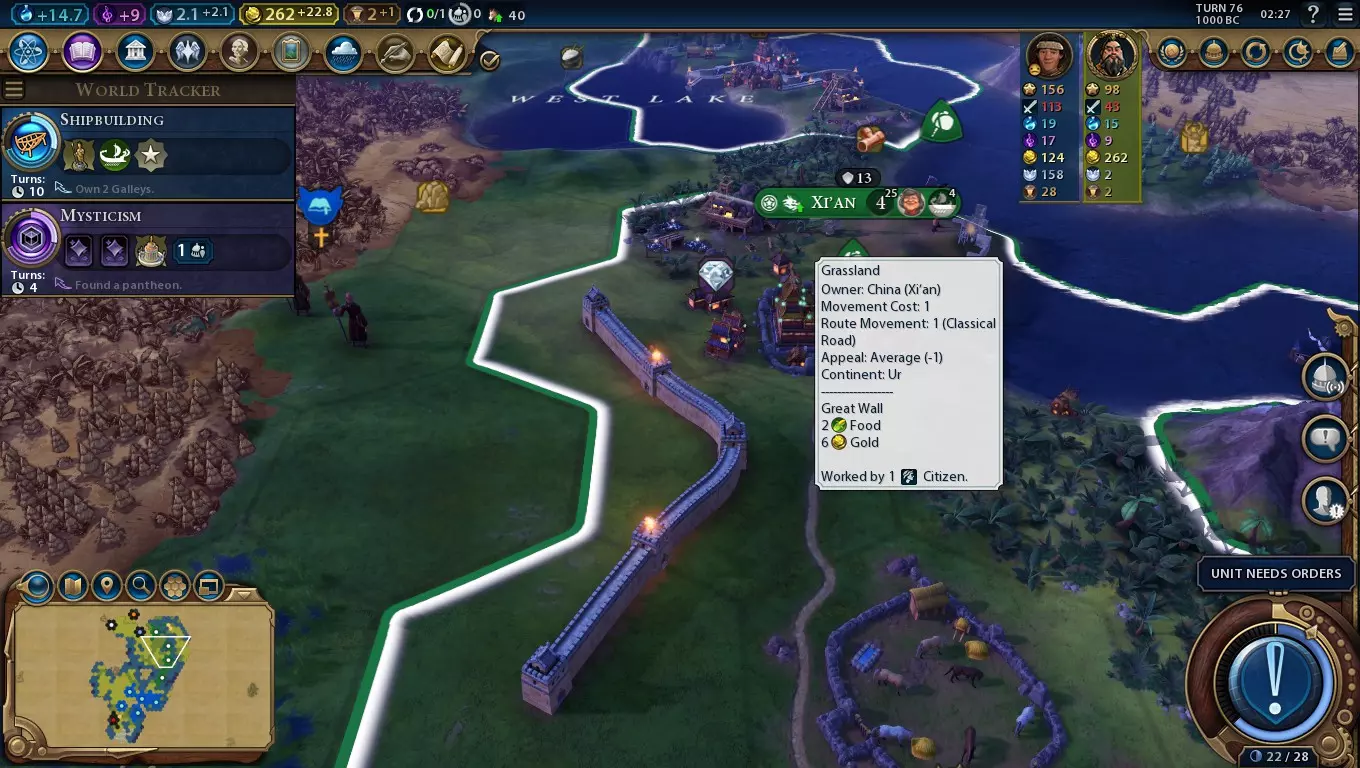
随着你的城市不断发展,你将能够更快地生成建造者,城市中也可能会有一些空闲市民。这时正是开始利用长城改良设施的好时机,它能提供大量金币,最终还能带来丰富的文化! 虽然长城改良设施潜力巨大,但也需要精心规划。长城片段只能建造在你领土边界的格子上,不能形成三角形,且每个长城格子旁边最多只能有两个其他长城格子。为了获得最大收益,你需要让一个长城格子至少与另外两个相邻,因此要获得第一个最优格子需要消耗三个建造者的建造次数。尽可能将长城段放置在距离城市中心三格远的位置,这样就不会干扰其他改良设施或区域的相邻加成。 初始用途 在考虑其产出之前,长城就有直接的防御用途——为在那里防御的单位提供+4战斗力加成。这比堡垒早整整三个时代可用,并且使用更经济的建造者次数,而非相对昂贵的军事工程师次数。在隘口处放置一段长城可以阻挡蛮族进入你的城市,并让敌军远离。拥有驻守晋升的陆地远程单位在长城上时也会获得+10战斗力——因此你的弓箭手将成为非常出色的防御者。在游戏初期拥有堡垒后,中国可以维持比大多数文明更小的军队规模,这样你就能将更多精力放在积累科技和文化加成以及建造奇观上。 防御方面的作用立竿见影,但一旦你有了多余的建造者次数,就可以开始建造连续的长城改良设施了。与至少两个其他长城相邻的长城 tiles 能提供可观的+6金币产出,这对于通过总督雷纳(财务官)的承包商晋升来快速生产单位、建筑甚至区域都非常有帮助。这也有助于单位升级——结合中国强大的科研能力,你可以不断更新自己的军事力量。长城的金币产出对【秦始皇】尤为重要,他凭借转化蛮族的能力,很可能在游戏早期获得大量单位。有了这项改良设施提供的金币,你可以轻松负担这些单位的维护费用,而且一旦研发出更先进的军事科技,就能有钱进行单位升级。 然而,【永乐帝】使用长城时需要更谨慎地平衡各项需求。长城既不提供住房也不增加食物,而永乐帝的优势在于让城市尽可能快速地发展到最大规模。此外,他的领袖能力已经能带来大量金币和文化,因此少建几块长城 tiles 的损失并不会太难弥补。因此,使用永乐帝时,通常应将长城的建造限制在那些难以用其他方式改良的 tiles 上(例如)苔原)、丘陵,或是那些种植农场也不会有太大区别的地块。文化与旅游
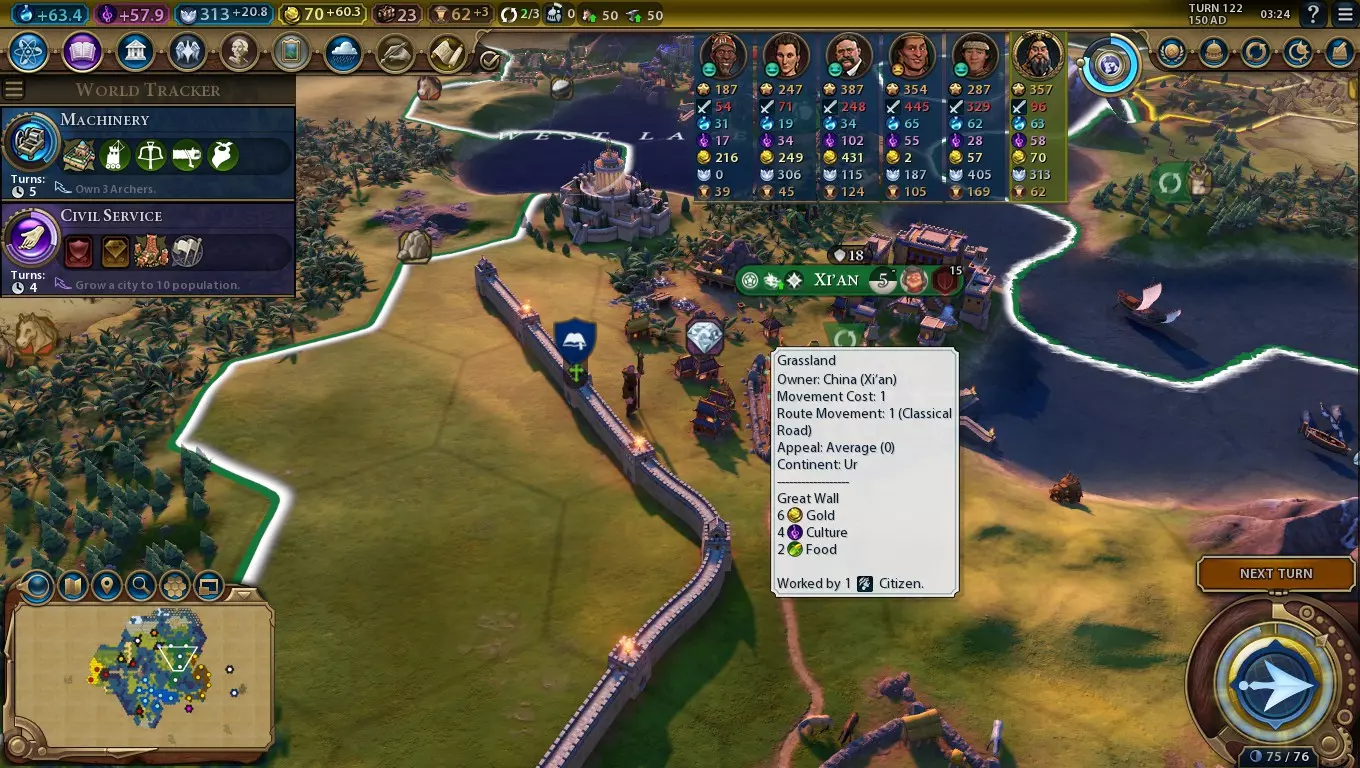
一旦你研发出【城堡】科技,开发长城 tiles 的效果会变得更加显著。与另外两个长城 tiles 相邻的长城 tiles 将产出 +4 文化值——这是纪念碑的两倍!这对于更快地研究市政、被动积累 tiles 以及抵御敌对文明的文化旅游压力都非常出色。 有了【飞行】科技后,情况会变得更好。每段与另外两段相邻的长城现在会产生 4 点旅游值——与一件音乐杰作相当,比一件艺术杰作或文学杰作还要多。你甚至不需要开发这些 tiles 就能获得旅游值,所以可以考虑用长城段填满未使用的边境 tiles。如果你追求科技胜利,长城改良设施对你的帮助不会太大,所以不要过度建造——或者至少要准备好日后用风力发电站等提供电力的改良设施替换部分长城段落。为了铝等关键战略资源,你可能不得不拆除部分长城。 结论 长城具有特定的防御用途,但其核心优势在于强大的金币、文化产出,最终还能带来旅游产出。确保将改良设施建成一条长线,以在尽可能多的地格上获得最大产出,同时建在瓶颈地带,帮助你的文明做好防御。 特色单位:虎蹲炮
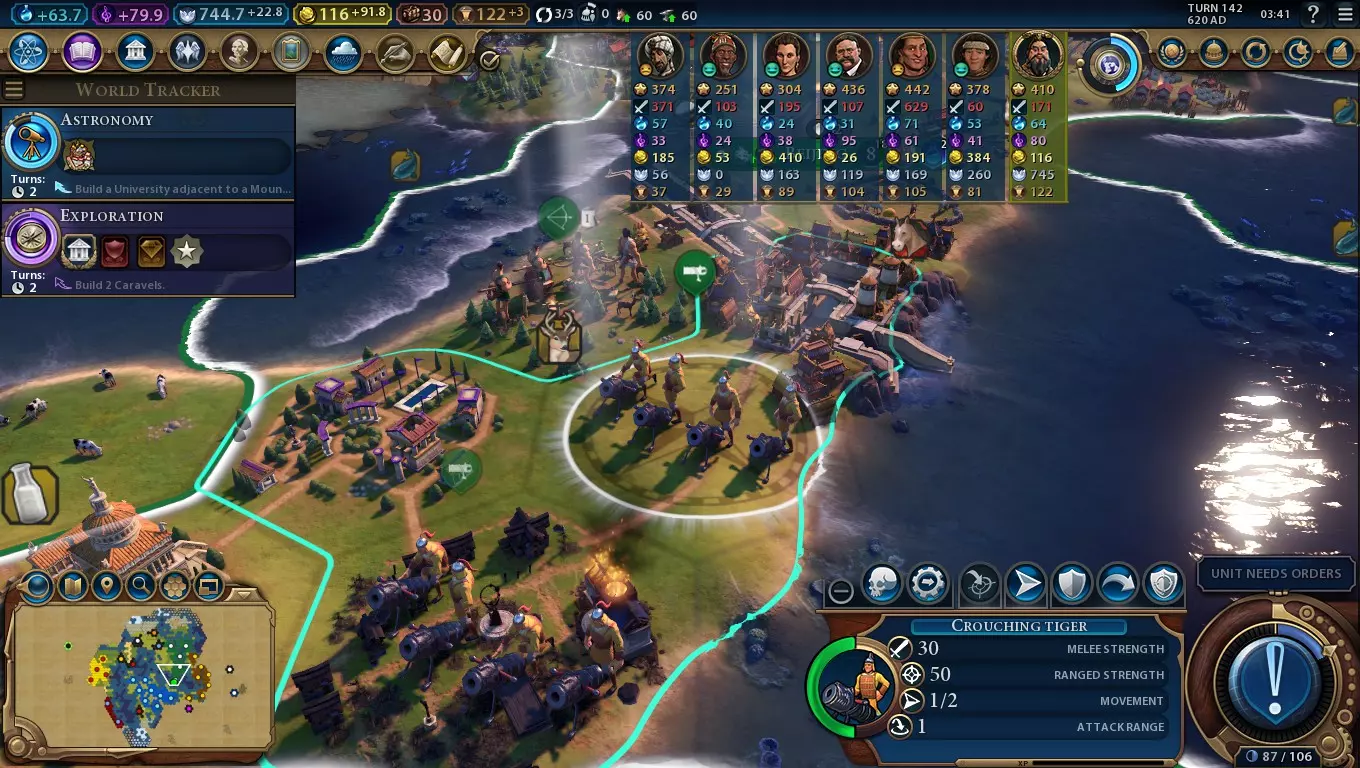
Crouching Tiger Cannons offer an alternative option to Crossbowmen in medieval and renaissance-era warfare. While they can't be prebuilt, have a shorter range, and don't count towards the Metal Casting eureka, they're cheap to train and have a considerably higher damage output. Defensive Usage The main role of Crouching TIger Cannons is in defence. Positioned on a city centre or Encampment district, they can deal their full damage to adjacent attackers without having to risk being attacked directly. Alternatively, you can position them on Great Wall tiles to partially cover their defensive weaknesses - with the Garrison promotion, those spots are particularly effective in defence (especially if they're also on hills). If out in the open, Crouching Tiger Cannons shouldn't be left vulnerable. Have a front line of units that defend more effectively, such as Knights - that way, the Knight can move out the way, the Crouching Tiger Cannon can move forward to fire, and the Knight can finish off the enemy unit, occupying the tile. To put it in other words, Crouching Tiger Cannons work best when getting the first hit on a unit to set up other units to get the last. It's also worth noting the attack strength of your cities with walls (or urban defences at the modern-era Steel technology) is tied to the highest ranged strength of any military unit you control. As such, your first Crouching Tiger Cannon will substantially boost your cities' ranged attacks. Offensive Usage Against cities without walls, Crouching Tiger Cannons perform about on a par with Catapults, and defend considerably more effectively. While the units have a 50% damage penalty against city walls relative to Catapults, the ability to move and fire in the same turn provides some mobility that Catapults lack, only at the expense of range. And if any enemy units come into range, Crouching Tiger Cannons are considerably better at dealing with them than Catapults are. However, this is a niche application with a small window of usage. Bombards defend better than Crouching Tiger Cannons, and deal considerably more damage against cities. Crouching Tiger Cannons' low defence and limited range makes them easily killed by Men-at-Arms. And while Crossbowmen might not deal a lot of damage against cities per unit, their higher range means you can get a lot more attacks in per turn. Obsoletion Crouching Tiger Cannons won't perform very well against industrial-era cavalry units like Cavalry and Cuirassiers - they can be killed by them in just one turn! Thankfully, gold from Great Wall improvements will make the upgrade to Field Cannons affordable. They have both better strength and better range. Conclusion Crouching Tiger Cannons should be considered an alternative to, not a replacement to, Crossbowmen. They're not vital to a game as China and there's no great loss if you only ever train one for the +4 era score all unique units offer. If you do choose to train a few, they're best-used in conjunction with the Great Wall, city centres or Encampments to defend your cities from would-be invaders. Administration - Government Note that the Administration sections strictly cover the options that have particularly good synergy with the civ's uniques. These are not necessarily the best choices, but rather options you should consider more than usual if playing this civ relative to others. Government Tier One Classical Republic is a good starting choice for Kublai Khan, Wu Zetian and especially Yongle due to the good array of economic policy cards and reliable passive bonuses. The housing and amenities in particular goes well with Yongle's leader ability. Mandate Qin may instead want to exploit Autocracy's wonder construction bonus. As for Unifier Qin, Autocracy's strength bonus keeps melee infantry units safe so they can get closer to Barbarians to conver them, and makes the ones you do convert stronger. The Audience Chamber is the best option for Yongle and reliably good for most other leaders. Still, the Ancestral Hall is good if there's plenty of land to expand into. Unifier Qin should take the Warlord's Throne unless there's no good targets to invade with his converted units. Tier Two Merchant Republic is a reliable choice that serves both cultural and scientific victories well due to its good selection of policy cards. However, Monarchy can be unlocked considerably faster making it ideal for Wu Zetain (to unlock the Intelligence Agency faster), and its housing bonuses are helpful for Yongle, but it's still a good choice for anyone else. Complement the government with the Intelligence Agency so you can steal eurekas from other civs more effectively. Tier Three Democracy is a safe choice for cultural victories owing to its high quantity of economic policy cards. For a scientific game, go with Communism. If you're still going for domination with Unifier Qin, take Fascism. A cultural China will want to complement their government with the National History Museum, but a scientific-oriented China will prefer the Royal Society. Mandate Qin's leader ability means that you'll have more charges on Builders, and hence get more production out of every one sent to rush space projects. For a domination game, take the War Department. Tier Four Digital Democracy is generally your best choice in a cultural game, while Synthetic Technocracy is especially good for aiding in scientific victories. For a domination game, take Corporate Libertarianism unless you really need science, in which case take Synthetic Technocracy. Administration - Policy Cards Policy Cards Ancient Era (Unifier Qin) Agoge (Military, requires Craftsmanship) - Warriors are already cheap to train, but with this policy card you can produce them even faster - and therefore get more charges to convert Barbarians with. (Unifier Qin) Conscription (Military, requires State Workforce) - Converting a lot of Barbarians early on can cost a lot in unit maintenance. Cutting that cost frees up a lot of gold for more useful things like unit upgrades. (Mandate Qin favoured) Corvée (Economic, requires State Workforce) - It doesn't just help you build wonders faster the normal way - it also makes rushing them via Builders faster! (Unifier Qin) Discipline (Military, requires Code of Laws) - Sometimes this policy card is useful for Unifier Qin, and sometimes it isn't. Being stronger against Barbarians is useful if you want to get more of them to surround your melee infantry units so you can convert them all at once. However, Barbarians that fight your units will take more damage and be more likely to die, leaving you with fewer or weaker units to convert. As such, when you unlock new civics, use the opportunity to swap in or out this policy card as needed. Ilkum (Economic, requires Craftsmanship) - For Mandate Qin specifically, faster Builder training means you should be able to squeeze in more wonders. For any leader, it's useful for setting up segments of the Great Wall faster. Inspiration (Wildcard, requires Mysticism) - Many Great Scientists offer eurekas, and some offer inspirations. A bonus to Great Scientist Points should help you obtain more of them. Urban Planning (Economic, requires Code of Laws) - For Unifier Qin, this policy card in conjunction with Ilkum can be better than Corvée for wonder production speed if your entire empire is producing Builders for your key wonder-building cities. For Kublai Khan, your extra economic policy card makes it easier to stack both Urban Planning and Ilkum or Colonisation simultaneously. And for any leader it extra production helps with meeting the requirements for eurekas and inspirations. Classical Era (Yongle) Insulae (Economic, requires Games and Recreation) - The more housing you can acquire, the more you can grow your cities and the higher yields you can get out of your leader ability. Medieval Era (Mandate Qin favoured) Aesthetics (Economic, requires Medieval Faires) - For Mandate Qin, extensive building of early wonders should provide you with some powerful Theatre Square adjacency bonuses. Make them even stronger with this policy card. (Yongle) Civil Prestige (Economic, requires Civil Service) - More housing and amenities to help you support larger cities. Craftsmen (Military, requires Guilds) - Doubles Industrial Zone adjacency. Mandate Qin's early-arriving Canals will provide +4 production to adjacent Industrial Zones instead of +2. You can end up with some rather productive cities this way! Any leader will benefit from extra production to help with securing eurekas and inspirations. Feudal Contract (Military, requires Feudalism) - If you're really desperate for a quick defence, this policy card can help you get Crouching Tiger Cannon units trained faster. (Yongle) Medina Quarter (Economic, requires Medieval Faires) - More housing. (Unifier Qin) Professional Army (Military, requires Mercenaries) - Converting Barbarians early in the game will leave you with a lot of units that will need upgrading later. This policy card therefore can save you a lot of money. (Yongle) Retainers (Military, requires Civil Service) - Extra amenities to help handle growing cities. Serfdom (Economic, requires Feudalism) - For Mandate Qin, if there's any remaining pre-medieval wonders, just a single Builder can contribute 90% of their production with this policy card, or the full wonder with Governor Liang (the Surveyor). Even if there isn't, Builders might be expensive by this point in the game with all the wonder-rushing you've done, so getting more out of them is a good idea. For any leader, it helps with Great Wall segments. Renaissance Era (Yongle) Colonial Offices (Economic, requires Exploration) - If you can manage to settle another continent, you can get to 10 population and beyond in these new cities sooner. (Yongle) Liberalism (Economic, requires The Enlightenment) - Extra amenities for growing cities. Machiavellianism (Diplomatic, requires Diplomatic Service) - Faster Spy training and operations means you can steal more eurekas from other civs. Very useful for any leader, but most of all to Wu Zetian. (Yongle favoured) Rationalism (Economic, requires The Enlightenment) - While useful for all leaders of China, Yongle's incentive to grow many large cities makes it easier to meet the requirements of this policy card for the full science bonus. Wisselbanken (Diplomatic, requires Diplomatic Service) - Scientific alliances are a great source of eureka boosts - once you reach level 2. This policy card will help you gain alliance points faster so you can get that boost sooner. Industrial Era Colonial Taxes (Economic, requires Colonialism) - If you've been settling outside your own continent, Great Walls there can now provide even more gold. (Unifier Qin) Force Modernisation (Military, requires Urbanisation) - Upgrade all those Barbarians you converted for cheap. (Yongle) Public Transport (Economic, requires Urbanisation) - Extra food helps to grow cities even larger. Public Works (Economic, requires Civil Engineering) - Builders are now very affordable and come with six charges (seven if you own the Great Pyramids or are using Governor Liang, eight with both). That's excellent for building more Great Wall segments or building up key power improvements like wind farms. Skyscrapers (Economic, requires Civil Engineering) - Any leader of China can earn extra eurekas and inspirations by building wonders, but for some leaders, there might not be enough production to spare earlier in the game. By this point, you can dedicate some cities for wonder construction while still having spare cities for other roles. Modern Era (Yongle) Collectivisation (Economic, Communism only, requires Class Struggle) - Extra food helps you grow your cities further. (Unifer Qin) Levee en Masse (Military, requires Mobilisation) - Aids in maintaining all those ex-Barbarian units. (Yongle) New Deal (Economic, Democracy only, requires Suffrage) - More housing and amenities aids supporting a larger city. Nuclear Espionage (Diplomatic, requires Nuclear Program) - Stealing eureka boosts is doubly effective, giving you boosts for two technologies rather than one! Enjoy stealing vast amounts of science. (Unifier Qin favoured) Resource Management (Military, requires Conservation) - Extra aluminium is useful for any scientific game, but what makes this policy card specifically useful for Unifier Qin is the extra oil. Many units later in the game need oil for maintenance, and many converted Barbarians will too. Science Foundations (Wildcard, requires Nuclear Programme) - More Great Scientists means more eurekas, or perhaps some production bonuses for the space race. Atomic Era Cryptography (Diplomatic, requires Cold War) - Helps your Spies both offensively and defensively. (Mandate Qin/Yongle favoured) Sports Media (Economic, requires Professional Sports) - An improved version of Aesthetics with amenities on top. Future Era Non-State Actors (Wildcard, requires Cultural Hegemony) - By allowing you to pick any promotion for Spies, you can build one around stealing eurekas or protecting your own. Administration - Age Bonuses and World Congress Age Bonuses Only bonuses with notable synergy with the civ's uniques are covered here. Free Inquiry (Golden Age, Classical to Medieval eras) - A very powerful bonus which makes your eureka boosts worth 60% of the progress to a technology! This is usually the best early Golden Age choice for China, but the others are great for Heroic Ages. (Yongle) Isolationism (Dark Age, Classical to Industrial eras) - If you've ran out of places to found new cities, enjoy faster growth for your cities. (Yongle favoured) Monasticism (Dark Age, Classical to Medieval eras) - A size 10+ city with a Holy Site will generate over 26 science per turn from its population alone. Yongle's high culture output means the loss of 25% of it shouldn't slow you down too much. (Mandate Qin favoured) Monumentality (Golden Age, Classical to Renaissance eras) - As Mandate Qin, if you find yourself with a high early faith output and a classical-era Golden Age, this can be potentially even stronger than Free Inquiry, as you can use faith to acquire Builders cheaply, and then use them to rush wonders. Pen, Brush and Voice (Golden Age, Classical to Medieval eras) - The culture equivalent to Free Inquiry. If you can generate a good diversity of Great People and get a couple of Markets built, you may be able to zoom through the middle of the civics tree, putting you well into the renaissance era before most other civs. (Unifier Qin) Twilight Valour (Dark Age, Classical to Renaissance eras) - Most Barbarians attack with melee, so you'll be able to use this wildcard for most units you convert. (Yongle) Hic Sunt Dracones (Golden Age, Renaissance to Modern eras) - New cities starting with more population aids in reaching the all-important 10 population threshold sooner. (Yongle) Collectivism (Dark Age, Modern to Information eras) - Yongle's science, culture and gold outputs primarily come from population growth rather than districts, so the loss of 50% of your Great Person Points generation may not be quite as bad as it is for most other leaders. Extra food and housing aids in growing cities, and extra industrial zone adjacency helps with meeting eureka/inspiration requirements. (Wu Zetian) Bodyguard of Lies (Dedication, Atomic to Future eras) - A simple enough extra source of era score. (Wu Zetian favoured) Bodyguard of Lies (Golden Age, Atomic to Future eras) - Great for stealing eureka boosts, and incredible for Wu Zetian in particular by speeding up Spy operations. Sky and Stars (Golden Age, Information to Future eras) - Grants three eurekas for the game era. Some of those eurekas have no normal means of acquiring them, making this dedication a particularly effective way to save science. Also provides bonus aluminium, which helps with building Lagrange Laser Stations. World Congress How you should vote in the World Congress will often be specific to your game - if you have a strong rival, for example, it might be better to vote to hurt them than to help yourself. Furthermore, there may be general bonuses to your chosen victory route or gameplay which are more relevant than ones that have stronger synergy with civ-specific bonuses. Otherwise, here's a list of key votes that have high relevance for this civ relative to other civs. Espionage Pact - Effect A (Spies executing the chosen operation function 2 levels higher) on Steal Tech Boost By making tech boost stealing more reliable, you'll be able to secure more eurekas. Just beware of other civs stealing tech boosts from you! (Unifier Qin) Mercenary Companies - Effect A (Producing, or purchasing military units using the chosen currency type costs 100% more until the next World Congress) on Production Production is the primary way most civs obtain new units. China's high gold output from the Great Wall makes purchasing more effective, and Unifier Qin can get additional units from converting Barbarians, so you can make things harder for other civs without setting back yourself. International Space Station - Always vote in favour if you're aiming for a scientific victory. Combined with the Royal Society and Mandate Qin's extra builder charges, the International Space Station's bonus to space race project production means you can use Builders to very rapidly rush through them. Nobel Prize in Physics (Sweden must be present in your game) - Always vote in favour. The potential for two eurekas makes the Nobel Prize in Physics a very lucrative scored competition, though it's only available if Sweden is in your game. (Kublai Khan) Trade Policy - Effect A (Trade routes sent to the chosen player provide +4 gold to the sender. The chosen player receives +1 trade route capacity.) for either yourself or a trade route target. Kublai Khan doesn't need many trade routes to make the most of his leader ability, but he does need to be able to trade with other civs. As such, you'll want to avoid effect B (Cancels any international trade routes between other civilizations and the chosen player, and embargoes any new ones from starting.) Administration - Pantheons, Religion and City-States Pantheons Note: The Initiation Rites pantheon does not cause the healing effect if you clear a Barbarian outpost by converting the Barbarian in them. It does still provide faith, however. (Unifier Qin/Yongle favoured) Divine Spark - Securing a religion allows you to build the Hagia Sophia wonder later, which allows all of Unifier Qin's melee infantry units to convert Barbarians twice, or use one charge without being consumed. With Yongle, it strengthens a Holy Site setup to use the Monasticism wildcard later - though River Goddess is better-suited for this role. (Mandate Qin/Yongle) Fertility Rites - Offers a free Builder - or perhaps 60% or more of an early wonder's construction. The slightly faster growth rate makes it a reasonable backup pantheon for Yongle. (Yongle) Goddess of the Hunt - Extra food helps with city growth, making this a decent alternative to the early advantage of Religious Settlements. Lady of the Reeds and Marshes - This is a production bonus that can help you get Builders trained without having to use charges on improvements - handy if you're focusing purely on wonders as Qin Shi Huang. (Mandate Qin) Monument to the Gods - Get more out of rushing wonders, making your already considerable advantage at early wonder-building even better. Religious Settlements - Balancing early expansion and wonder construction or even general development is tough, so a bonus Settler can really help save precious production. Yongle can usually secure this pantheon by using the Lijia (Faith) city project at the start of the game. (Yongle) River Goddess - Has excellent synergy with the Monasticism Dark Age wildcard, allowing you to support a large city that then will produce huge amounts of science. Religious Beliefs You can have one founder, one follower, one enhancer and one worship belief. (Yongle favoured) Cross-Cultural Dialogue (Founder) - Having lots of large cities means you can get a good amount of bonus science from this belief. (Mandate Qin favoured) Divine Inspiration (Follower) - As Mandate Qin, by rushing Stonehenge along with other early wonders, you can get a surprisingly impressive early faith output. In combination with the Oracle, you could use this faith to cheaply acquire Great People via patronage, but generally it works best in conjunction with the Monumentality Golden Age dedication for extra cheap Builders, or Exodus of the Evangelists for a strong early religion. (Yongle) Feed the World (Follower) - Although Feed the World is generally more powerful as a follower belief, extra food and housing is nice to have for a leader encouraged to build as tall cities as possible. (Yongle) Gurdwara (Worship) - Extra food and housing for growing cities. Jesuit Education (Follower) - China should aim to balance science and culture output due to quite a few eurekas being dependent on similar-era civics, and quite a few Inspirations being dependent on similar-era technologies. Jesuit Education makes that a little easier by letting you buy Campus and Theatre Square buildings with faith. (Mandate Qin) Sacred Places (Founder) - Mandate Qin's leader ability can ensure a wide range of cities have wonders present, allowing this belief to grant some very impressive early yields. (Yongle) Stupa (Worship) - Handy bonus amenities to help support growing cities. (Yongle) Zen Meditation (Follower) - More amenities. City-States (Unifier Qin) Akkad (Militaristic) - Barbarians rarely spawn siege units so taking down enemy cities with converted Barbarians can be a pain. Akkad solves that problem by letting the many anti-cavalry and melee infantry units you have deal full damage against city defences. (Kublai Khan) Bandar Brunei (Trade) - Get some extra gold from establishing trading posts in other civs' cities. Bologna (Scientific) - Unlocking Great Scientists is one of the best ways of obtaining eureka boosts. Increasing the Great Scientist Point output of Campuses will aid with that. (Mandate Qin favoured) Brussels (Industrial) - The bonus extends to Builder charges used by Mandate Qin to help rush wonders, so it's a very worthwhile suzerain bonus to have. (Yongle) Chinguetti (Religious) - Huge cities can generate a strong faith output when trading with the help of this city-state. (Yongle favoured) Geneva (Scientific) - Although all leaders of China benefit from extra science, Yongle has the largest raw science yield and has minimal incentive to go to war, allowing this science boost to be used to its fullest extent. (Unifier Qin) Hattusa (Scientific) - If you have no copies of a strategic resource, any units you convert that would require those resources can't heal. Being suzerain over Hattusa avoids that problem. (Yongle) Hong Kong (Industrial) - Boosts the output of your unique city projects. (Yongle) Mitla (Scientific) - Aids with city growth in any city with a Campus. (Kublai Khan) Mogadishu (Trade) - Your trade routes crossing water will be safe from pillagers, making it much easier to establish trading posts overseas. (Yongle) Muscat (Trade) - Bonus amenities to aid growing cities. Nazca (Religious) - In desert regions, Nazca Lines adjacent to the Great Wall improvement can make a great overall yield that makes an otherwise unproductive region useful. (Yongle favoured) Taruga (Scientific) - Magnifies the strong raw science yield Yongle has. (Yongle) Zanzibar (Trade) - Extra amenities. Administration - Wonders Wonders All pre-medieval era wonders are covered in the section on Mandate Qin's leader ability, although the in-depth discussion takes the specific perspective of Mandate Qin, As such, the most relevant wonders will be covered again here. Etemenanki (Ancient era, Writing technology) - Extra science works well combined with China's stronger eureka boosts, but this wonder is usually very risky for a leader other than Mandate Qin to build. (Yongle) Hanging Gardens (Ancient era, Irrigation technology) - Faster city growth allows you to get cities to size 10 faster. The bonus housing is helpful as well for that specific city. Pyramids (Ancient era, Masonry technology) - Great for any leader as it helps you produce Great Wall sections, and particularly strong for Mandate Qin for rushing subsequent wonders. The free 5-charge Builder makes this wonder refund 90% of its cost for him. (Mandate Qin) Stonehenge (Ancient era, Astrology technology) - This competitive wonder is usually too difficult to take for yoursef on higher difficulties, but Mandate Qin's ability to rush wonders can make it viable. Securing an early wonder and taking the Divine Inspiration belief lets you turn Mandate Qin's great wonder production into a early faith lead. (Yongle) Temple of Artemis (Ancient era, Archery technology) - A significant boost to food, housing and amenities ideal for growing a huge city early. (Mandate Qin) Apadana (Classical era, Political Philosophy civic) - Rushing subsequent wonders in this city will give you a huge number of envoys and lots of associated yield and suzerain bonuses. (Mandate Qin/Yongle) Colosseum (Classical era, Games and Recreation civic) - A helpful wonder for any leader, but Mandate Qin can get it cheaply while Yongle benefits greatly from the bonus amenities. Great Library (Classical era, Recorded History civic) - Getting a eureka every time another civ gets a Great Scientist can add up to a considerable amount of science saved over the course of the game. Petra (Classical era, Mathematics technology) - The Great Wall can be built in desert tiles. Desert hills with a maximum yield Great Wall and Petra yields 2 food, 2 production, 8 gold and 4 culture - an incredible yield you can get as early as the Castles technology. (Unifier Qin) Terracotta Army (Classical era, Construction technology) - Got a lot of units from converting Barbarians? You can give them all promotions! (Yongle) Angkor Wat (Medieval era, Medieval Faires civic) - Cities under size 10 will get to that point faster, and any cities of size 10 or higher will instantly start generating an extra 2 gold, 1 science, and 1 culture per turn each. (Unifier Qin) Hagia Sophia (Medieval era, Buttress technology) - The most important wonder by far for Unifier Qin as it allows all his melee infantry units to convert Barbarians twice, or once without being consumed. The catch is you have to found a religion to be able to build this wonder, so you might have to capture this instead. St. Basil's Cathedral (Renaissance era, Reformed Church civic) - While not as impressive as Petra, St. Basil's Cathedral can nonetheless make tundra Great Walls produce a strong overall yield. (Mandate Qin) Panama Canal (Industrial era, Steam Power technology) - Qin Shi Huang's ability to build Canals early makes it a lot easier to prepare for this wonder, allowing you to ensure you build the Panama Canal in exactly the right spot. (Cultural) Broadway (Modern era, Mass Media civic) - Broadway is slightly more useful for China than other civs as the free random atomic-era civic boost will be worth 50% of a civic rather than 40%. Golden Gate Bridge (Modern era, Combustion technology) - The Golden Gate Bridge acts as a reverse Canal, connecting two land tiles together across water so land units can cross. But its key usage as far as China is concerned is boosting the tourism from Great Wall tiles by 100% - though make sure you have the modern-era Flight technology as well. (Yongle) Amundsen-Scott Research Station (Atomic era, Rapid Deployment civic) - Yongle's incredible science output can be boosted even further. (Yongle) Estádio do Maracanã (Atomic era, Professional Sports civic) - A great boost to amenities to support all of Yongle's huge cities. Administration - Great People Great People Great Generals and Admirals are only mentioned if their retirement bonuses have specific synergy with the civ; not merely for providing a strength bonus to a unique unit. All GWAMs are important for cultural victory, but it would be redundant to list them all. Classical Era Aryabhata (Great Scientist) - Provides three random eurekas from the classical or medieval eras. Euclid (Great Scientist) - Provides the eureka boost for Mathematics (handy if you want to build Petra) and a random eureka from the classical or medieval eras. Zhang Heng (Great Scientist) - Three eureka boosts, two of which are for technologies with associated wonders that can be rushed via Builders as Mandate Qin. Medieval Era Abu Al-Qasim Al-Zahrawi (Great Scientist) - Offers one random eureka from the medieval or renaissance eras. Bi Sheng (Great Engineer) - Provides the eureka boost for Printing. Imhotep (Great Engineer) - Useful to obtain to deny other civs from getting an easy ancient/classical wonder instead of you. Isidore of Miletus (Great Engineer) - Production towards wonders - useful for securing an extra eureka/inspiration in a reasonable amount of time. (Unifier Qin) Leif Erikson (Great Admiral) - Crossing oceans early and granting naval units extra sight allows you to find isolated Barbarian outposts and convert their units. Omar Khayyam (Great Scientist) - Offers two random eurekas and one random inspiration boost from the medieval or renaissance eras. Renaissance Era Emile du Chatelet (Great Scientist) - Offers three random eurekas from the renaissance or industrial eras. Filippo Brunelleschi (Great Engineer) - Production towards wonders. (Yongle) Ibn Khaldun (Great Scientist) - Extra housing and an amenity to help grow a city. Leonardo da Vinci (Great Engineer) - Unlocks a random modern-era eureka. Industrial Era Ada Lovelace (Great Engineer) - Unlocks the eureka boost for Computers. Dmitri Mendeleev (Great Scientist) - Offers the eureka boost for Chemistry as well as a random technology from the industrial era. Gustave Eiffel (Great Engineer) - Production towards wonders. James Young (Great Scientist) - Offers two random eurekas from the industrial or modern eras. (Yongle) Joesph Paxton (Great Engineer) - Extra amenities to help support your many large cities. (Yongle) John Spilsbury (Great Merchant) - More amenities. Modern Era Alan Turing (Great Scientist) - Offers the eureka boost for Computers as well as for a random technology from the modern era. Albert Einstein (Great Scientist) - Offers a random modern-era eureka boost. Alfred Nobel (Great Scientist) - Offers one random eureka boost from the modern or atomic eras. (Unifier Qin) John Rockefeller (Great Merchant) - Extra oil aids in supporting Barbarians from the modern era or later, who often require oil to be maintained. Robert Goddard (Great Engineer) - Unlocks the eureka for Rocketry. This is notable because Rocketry doesn't have a standard eureka boost. Shah Jahān (Great Engineer) - Save up some gold from the Great Wall improvement, and you can use it to essentially purchase a wonder (two if you have the Mausoleum at Halicarnassus) via Shah Jahān. Atomic Era Erwin Schrodinger (Great Scientist) - Offers three random eureka boosts for atomic or information-era technologies. (Yongle) Helena Rubenstein (Great Merchant) - Bonus amenities. (Yongle) Jane Drew (Great Engineer) - Housing and amenities. (Yongle) John Roebling (Great Engineer) - More housing and amenities. (Yongle) - Levi Strauss (Great Merchant) - Even more amenities. Information Era Abdus Salam (Great Scientist) - Unlocks all information-era eurekas. (Yongle) Estée Lauder (Great Merchant) - Yet more amenities. Jamseth Tata (Great Merchant) - Makes Campuses provide tourism, which neatly ties together China's cultural and scientific strengths. (Cultural/Mandate Qin favoured) Masaru Ibuka (Great Merchant) - Been building plenty of Industrial Zones to make use of Canal adjacency? Now those districts will generate tourism on top! Counter-Strategies (Part 1/2) China can research quickly, defend effectively and is one of the game's wealthier civs, but there's ways you can try to disrupt that. Civilization Ability: Dynastic Cycle It's not easy to slow down eureka and inspiration gain, but that's not to say it isn't possible. If China is denied a classical or medieval-era Golden Age, they can't get the extra bonuses from Free Inquiry or Brush, Pen and Voice. Clearing Barbarian encampments before China has a chance, and denying them early wonders are two good ways of doing that - for details on the latter, look at the sub-section on Mandate Qin's leader ability below. That being said, Yongle can benefit greatly from an early Dark Age if he has Holy Sites, so it's probably best not to worry too much about managing his era score. In general, eurekas and inspiration boosts reward civs that pay attention to a wide range of gameplay features; the more single-minded a civ is, the harder it is for them to obtain all the boosts. The easiest way to force a civ to push in a specific direction is to start a war, pushing them to emphasise war-time industry at the expense of other districts. A more reliable method to set China back is to try and ensure they don't get Great People who offer boosts. Keep an eye on the Great Person interface and look for opportunities for patronage so you can take them before China can. The free eurekas and inspirations China gets from wonders will generally not make a huge difference, as usually wonders aren't completed until some time after they first come available to research. Still, it helps to deny China any Great Engineers which provide production bonuses to wonders, so China can't rush a wonder for a current era. Kublai Khan's Leader Ability: Gerege Kublai Khan has a reliable and straightforward leader ability. While it holds less potential than the abilities of some of the other leaders, it's also harder to counter. Extra economic policy card slot While you can't really stop Kublai Khan from using extra economic policy cards, you can match Kublai Khan's policy card advantage by building the Forbidden City or Big Ben wonders. Despite China's fast research speed, they lack intrinsic production advantages (especially if they're dedicating a lot of citizens to working Great Wall segments). As such, you have a reasonable chance of taking the wonders before they can. Like all abilities that add extra policy cards, this bonus is most effective early on, and fades somewhat in effectiveness later. Boosts from trading posts Kublai Khan when leading Mongolia can get trading posts immediately when trading with foreign civs. Kublai Khan leading China, however, has to complete the trade route first. This means anything that disrupts the route - Barbarian pillagers, a declaration of war, a World Congress resolution and so forth - will set back Kublai Khan's goals of setting up trading posts. There's two ways you can prevent this bonus from being used entirely - either by surrounding China with fast-moving units ready to pillage any Chinese traders you see, or by voting for option B on the Trade Policy World Congress resolution, and targeting Kublai Khan with it. The latter prevents Kublai Khan making international trade routes whatsoever. Kublai Khan's Agenda: Pax Mongolica A computer-controlled Kublai Khan likes civs with a strong military and gold output, and dislikes those lacking in either. While a few civs have strengths at both gold generation and building up a strong military (e.g. Spain), most civs do not. Still, any decent warmonger needs sufficient gold to maintain and upgrade their army, while any rich civ that doesn't have a decent army could probably do with heeding Kublai Khan's advice in this instance to prevent suffering in a war. It's not the easiest agenda to meet, but it's one that's worth meeting for many civs just because having a decent economy and military is worth having anyway. Mandate of Heaven Qin Shi Huang's Leader Ability: The First Emperor There's no grievance penalties for declaring war in the ancient era, and pretty minor ones for doing so in the classical era. With this in mind, you can start a war with China and start picking off their high-charge Builders. Fast units like Heavy Chariots and Horsemen are ideal for this role. Not only will you send China's wonder production back, but you'll also grab some Builders with plenty of charges for yourself. For medieval-era or later warmongers like Mongolia, China offers a great opportunity - they'll grab a lot of early wonders ready for you to conquer. Mandate Qin's leader ability also offers China early access to Canal districts. If China manages to build a Canal connecting two seas, they can use a single navy to defend two coasts - though the Canal will act as a bottleneck for units travelling through. Try luring China's navy out by attacking with a small force from one sea, allowing you to attack with a larger force later from the other. Bring some of that larger force over to the Canal city so you can block China's navy from returning. Alternatively, if you don't want to fight Mandate Qin, his early Canals can make trading with him more lucrative. That's because Canals offer +1 gold for trade routes that pass through. Mandate of Heaven Qin Shi Huang's Agenda: Wall of 10,000 Li A computer-controlled Qin Shi Huang likes civs that have fewer wonders than him, and dislikes those with more wonders than him. He will never have the Wonder Advocate hidden agenda as his main agenda already serves the same purpose. Early in the game, his bonus to wonder construction will usually give you a positive relations boost, but things may get difficult if you're a wonder-builder like Egypt or France, or a wonder-capturing domination civ. If you're one of those two, consider looking elsewhere for alliances. If you're after a scientific or religious victory, however, this isn't a particularly hard agenda to keep to. Diplomatic civs that stack a lot of diplomatic wonders (e.g. Statue of Liberty, Potala Palace) might struggle a little. Unifier Qin Shi Huang's Leader Ability: Thirty-Six Strategems If there are no Barbarians around, Unifier Qin's ability is useless. Clearing Barbarian outposts near him and killing their units will ensure his army stays weak, while also denying him era score that could secure himself the bonuses of Free Inquiry and Pen, Brush and Voice. Keeping territory near him visible will stop further Barbarian outposts from spawning. Every Barbarian outpost spawns with an anti-cavalry unit, so Unifier Qin is likely to have a high number of these. Bringing your own melee infantry units along to a war will help deal with them. If you can, try to deny Unifier Qin the Hagia Sophia wonder as it gives all his melee infantry units a second charge to convert Barbarians. He'll be unable to build it if he can't found a religion. Avoid using the Recruit Partisans Spy operation against Unifier Qin as he can convert the Barbarian anti-cavalry units to his side. Unifier Qin Shi Huang's Agenda: Thirty-Six Strategems Unifier Qin likes civs that leave Barbarian outposts alone. He dislikes civs that clear them. He will never have the Barbarian Ally hidden agenda as it overlaps with his main agenda, and will never have the Civilized agenda as it conflicts with it. The civs most likely to leave Barbarian outposts alone are those who are deliberately aiming for an early Dark Age - Georgia benefits greatly from this strategy. Otherwise, this is a difficult agenda to meet as refusing to clear Barbarian outposts has little benefit for most civs. Counter-Strategies (Part 2/2) Wu Zetian's Leader Ability: Manual of Entrapment Wu Zetian's early Spy can cause a lot of trouble as you'll be unable to use a counter-Spy of your own, but if you can build a Diplomatic Quarter (available with the classical-era Mathematics technology) it will at least greatly reduce her Spies' effectiveness in that specific city for the time being. You can then also build a Consulate building to make every city with an Encampment resist Spies more effectively. If her Spies are being a major problem, consider heading to the Diplomatic Service civic a bit sooner than normal so you can recruit a Spy of your own as a counter-Spy. It will also allow you to build the Chancery building in your Diplomatic Quarter giving you science every time you kill a Spy! Later on, with the atomic-era Cold War civic, you can use the Cryptography diplomatic policy card to slow down her Spies as well. At the future-era Cultural Hegemony civic, you can take the Non-State Actors policy card to choose your Spy promotions from the entire list, letting you tailor your Spies to defend more effectively against her. Wu Zetian's Spies aren't any cheaper than yours in terms of production cost, and if a lot of hers die, the costs can rapidly build up for her. Although she can purchase Spies with faith, building up a faith infrastructure is costly in terms of production and district capacity at a time Wu Zetian's China would rather build other things. Either way, if Wu Zetian loses a lot of Spies, she's forced to dedicate production to recovering them rather than spending time on other developments. Alternatively, allying Wu Zetian (requires the medieval-era Civil Service civic) prevents her from using Spies against you. Wu Zetian's Agenda: Court Intrigue A computer-controlled Wu Zetian likes civs with weaker militaries and aren't too close to her own cities. She dislikes civs that have strong militaries and/or close cities. She will never have the Paranoid hidden agenda as it overlaps with her main one. As Wu Zetian cannot use Spies against you if you are allied to her, she makes a good target for an alliance for peaceful civs - particularly scientific civs. If you have a strong enough military for her to dislike you, then you probably have a strong enough military that she isn't a threat for war. Yongle's Leader Ability: Lijia Yongle is an absolutely terrifying opponent - if he can get his cities to size 10. Every pillaged farm, every food-rich spot he can't settle, and every time he has to produce something other than the Lijia (Food) project will slow him down in this goal. Warfare is the best way to deal with Yongle - at least until he secures a strong technological advantage. If you capture any of Yongle's cities, you can raze it so he can't recapture it, setting back his gold, culture and science outputs considerably. Even if you can't siege down his cities, light cavalry with the Depredation promotion can burn down his farms and cause his cities to starve. Yongle's Agenda: Yinding Yongle likes civs with a positive gold income. He dislikes those with a negative gold income. He will never have the Money Grubber hidden agenda as it conflicts with his main one. Civs that build a lot of early buildings, or train a lot of early units, can easily fall into a gold deficit. Later on in the game, it'll mostly be domination-inclined civs that are likely to fail at that agenda. In theory this makes Yongle a good ally for peaceful civs, but given just how powerful he can get later in the game, leaving him to his own devices probably isn't the best course of action unless you can research even faster than he can. Unique Unit: Crouching Tiger Cannon Crouching Tiger Cannons hit hard for their era but defend only as well as regular Crossbowmen. Regular Crossbowmen (or even Archers if you're behind on technology) will out-range them, forcing them to either move into the open, retreat, or take damage without being able to react. Men-at-Arms, Coursers and Knights can also do a lot of damage to them, and even swarms of Horsemen can be okay so long as you can avoid being counter-attacked. Once you have access to industrial-era units, Crouching Tiger Cannons will be no threat. Unique Improvement: Great Wall China's unique improvement comes with a powerful gold yield and pretty good culture as well, but must be built on their border. This makes them susceptible to culture bombs from a civ that borders them. Building a Preserve district, securing the renaissance-era Great Engineer Mimar Sinan or passing the Border Control Treaty resolution in the World Congress are three ways any civ can activate culture bombs, but some specific civs (most notably Poland) have their own alternative ways. In warfare, the trickiest part of facing the Great Wall is the early defensive potential. If the Great Wall is well-defended with units, you have a few options. Look for another way around, try to use ranged units to pick off the defenders before using a cavalry unit to pillage the tiles, or just slip through their zone of control by using cavalry units. Note that as with all unique improvements, Great Wall improvements will be removed if you capture the tiles, so you can't keep them for yourself. You might as well pillage the tiles for the free money before you finish the conquest. Other Guides If you like these guides and want to send a tip, you can click here![ko-fi.com] Gathering Storm Compilation Guides Civ summaries (Start here for an introduction for all civs) Civ-specific tricks, secrets and clarifications (Ideal for more experienced players)Individual Civilization Guides America - no additional content* (Cultural/Diplomatic/Domination) America - all additional content* (Cultural/Diplomatic/Domination/Scientific) Arabia (Domination/Religious/Scientific) Australia (Domination/Scientific) Aztecs (Domination) Babylon (Cultural/Domination/Scientific) Brazil (Cultural/Domination/Religious/Scientific) Byzantium (Domination/Religious) Canada (Cultural/Diplomatic) China (Cultural/Domination/Scientific) Cree (Diplomatic) Egypt (Cultural/Diplomatic/Religious) England (Cultural/Domination/Scientific) Ethiopia (Cultural/Religious) France (Cultural/Domination) Gaul (Domination) Georgia (Diplomatic/Religious) Germany (Domination/Scientific) Gran Colombia (Domination) Greece (Cultural/Diplomatic/Domination) Hungary (Diplomatic/Domination) Inca (Religious/Scientific) India (Domination/Religious) Indonesia (Cultural/Domination/Religious/Scientific) Japan (All) Khmer (Cultural/Religious) Kongo (Cultural) Korea (Scientific) Macedon (Domination/Scientific) Mali (Diplomatic/Religious) Māori (Cultural/Religious) Mapuche (Cultural/Domination) Maya (Scientific) Mongolia (Domination) Netherlands (Scientific) Norway (Domination) Nubia (Domination) Ottomans (Domination) Persia (Cultural/Domination) Phoenicia (Domination) Poland (Cultural/Domination/Religious) Portugal (Diplomatic/Scientific) Rome (Domination) Russia (Cultural/Religious) Scotland (Scientific) Scythia (Domination/Religious) Spain (Domination/Religious/Scientific) Sumeria (Diplomatic/Domination/Scientific) Sweden (Cultural/Diplomatic) Vietnam (Cultural/Domination) Zulus (Domination)*The Teddy Roosevelt Persona Pack splits Roosevelt's leader ability in two, meaning the game with it is substantially different from without - hence two different versions of the America guide. Lincoln was added later and is only covered in the latter guide. Other civs with alternative leader personas are not split because the extra personas added in later content do not change the existing gameplay - as such the guides are perfectly usable by players without them. Rise and Fall These guides are for those with the Rise and Fall expansion, but not Gathering Storm. They are no longer updated and have not been kept up to date with patches released since Gathering Storm. To look at them, click here to open the Rise and Fall Civ Summaries guide. The "Other Guides" section of every Rise and Fall guide has links to every other Rise and Fall guide. Vanilla The Vanilla guides are for those without the Rise and Fall or Gathering Storm expansions. These guides are no longer updated and have not been kept up to date with patches released since Rise and Fall. To look at them, click here to open the Vanilla Civ Summaries guide. The "Other Guides" section of every Vanilla guide has links to every other Vanilla guide.