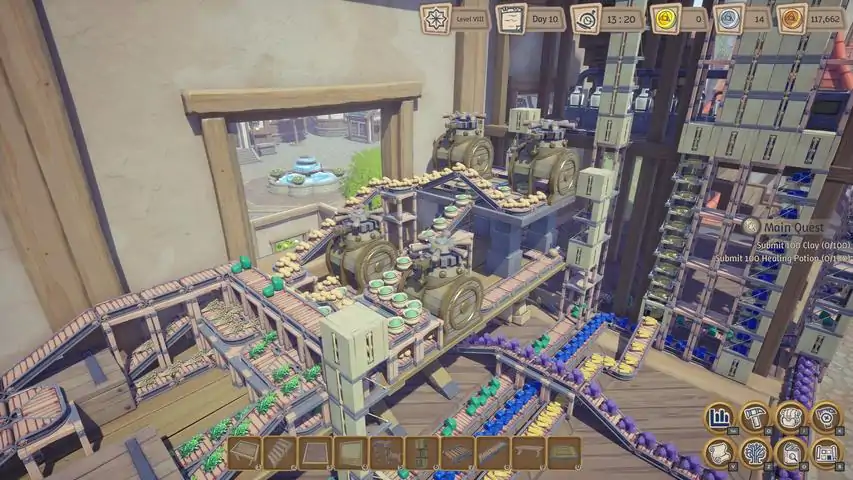
炼金工厂


新增内容: 弹跳蘑菇:5级解锁。一种弹性蘑菇,踩上去后能将你高高弹起。 公告板:建筑工具1级解锁。可自由编辑的公告板,可切换为壁挂形式。 支柱:建筑工具3级解锁。钢筋加固的支柱,可为楼层提供支撑。 体验优化: 悬停在漏斗上方时,现在会显示投掷输入提示。 蓝图现在可以保存弹射器和加农炮的目标(如果这些目标也包含在蓝图中)。 新增弹射器和加农炮的快速清除目标功能。 在批量删除模式下,按G键现在也会选中所有相连的管道。关于框选功能,在释放鼠标按钮确认XY平面后,现在在释放Shift键前,Z轴只能向上延伸。 漏洞修复: 修复了替代铜锭配方可能产出超过最大堆叠上限物品的问题。 修复了多人模式下“脱离卡住”按钮无效的问题。 修复了从主菜单点击“继续”无法自动加载最新存档的问题。 修复了收银台移除后顾客可能卡住的问题。 修复了优先级分流器和优先级合流器上箭头颜色指示不正确的问题。 修复了遗物生产统计数据显示不正确的问题。 改进了部分传送带纹理上的重影瑕疵。 改进了钢梁模型。
亲爱的炼金术士们, 我们想对所有支持我们的玩家说声谢谢。《炼金术工厂》自抢先体验版发布以来,销量已突破5万份! 这对我们来说是巨大的鼓励。我们知道《炼金术工厂》仍有一些地方需要改进,我们将带着这份热情,与社区一起继续把游戏做得更好。 现在,我们有一些本月的计划想与大家分享。 关于路线图,许多炼金术士都在期待,但请再给我们一点时间。我们将在下周末前发布。 平衡调整、便利性优化和性能优化,我们会持续进行。如果您在这些方面遇到任何问题,欢迎通过Discord或Steam社区论坛告诉我们。另外,游戏崩溃时请记得提交错误报告。积分商店、集换式卡牌和增强型丰富状态,我们正在探索相关可能性。目标是在本月内上线。 蓝图分享活动,点击此处查看该活动。 新增语言支持,但由于圣诞节和新年假期临近,可能要到2026年1月才能发布。 此外,以下是一些即将到来的更新预览,我们将在本月底前发布这些内容: 新屋顶变体 新石墙变体 可提供建筑支撑的支柱 公告板:可自由编辑的指示牌,可安装在墙上 弹跳菇:能将玩家弹向空中的装置 吊灯:安装在天花板上的照明设备
修复了已分配技能点可能超过最大上限的问题。 修复了滚动用户界面可能触发快捷栏切换的问题。 修复了在特定条件下苗圃可能消耗额外肥料的问题。 修复了多人游戏期间可能导致断开连接的问题。
If, after buying the game, you find yourself asking questions like: What should I do? How can I reduce the amount of running back and forth to the store? How do I grow this flax automatically? Then check out this guide, written after 20 hours of gameplay :) The Basics, Or What you need to know First of all, before asking any questions, you should read the in-game guide; it's quite informative, animated, and can be extremely useful. It opens with the hotkey "O" and updates when additional mechanics are unlocked. (It also highlights if there is an article that hasn't been read yet) Short answers to "beginner" questions This section contains the simplest questions that beginners might have, it contains a few spoilers, but all for the best. - "Is that all? Such a small shop?" Of course not, among the first tasks in the game are goals to buy a new plot of land where you can place your cars, and later, after saving up some money (not recommended immediately), you can buy additional plots. - "I meant the shop itself, why is it so small and inconvenient?" Later in the game, you'll unlock upgrades for your equipment: backpack, construction tools, gloves, and belt. Upgrading your construction tools will allow you to demolish/build floors/walls, and you can build your dream shop. - "I'm so tired of putting everything on the shelves!" Almost immediately, a catapult is unlocked that allows you to fill the shop shelves automatically; more details about it are in the in-game guide. - "Yay, the shelves fill themselves, but I'm tired of running every minute to the cars and then to the customers." Be patient, at the 4th "tier" you can buy an automatic cash register that will do this for you. - "What about buying logs?" Around the same time, construction of trading portals begins. When you supply them with coins, they will buy resources for you. At this point, part of the production process can be fully automated: you sell at the automated kiosk - the coins are delivered to the portal - it buys logs/stones - the machines process them - the catapults load them onto the shelves - and they are sold again. - "I'm so tired of running around with seeds!" For full automation, at tier 4, fertilizers and a nursery are unlocked. However, in my opinion, the basic fertilizers are extremely unproductive (even with the recent update). Therefore, I personally choose to run around with seeds and regular garden beds until tier 5, where advanced fertilizers are unlocked, which allow for proper optimization. Non-obvious features The most valuable thing I would put here is that most machines, furniture, etc. have additional options, switchable with the hotkey "T" - "Change shape" Interesting things: - inclined conveyors change direction - platforms have different heights - non-symmetrical machines (for example, the assembler) can be mirrored - chests can change their configuration, for example, the initial chest can be turned into a "pass-through buffer" or placed vertically - dividers and filters can be placed on their side and so on, check the "shapes" for everything that exists, maybe you'll discover something else interesting About the main thing, about money First of all, money in the game is not an abstract account on a card, it's a very real physical object (the amount in the left corner is the amount you have in your pocket). Initially, you can ignore this, but later you will have to work with it, and here are a couple of tips. But first, about how to earn money, I found only 3 options: - Direct sales in the store - Completing tasks, both story-related and "daily" ones - Selling through the portal Selling in the store is simple, although a couple of things are worth mentioning separately: 1 - Customers don't buy everything indiscriminately, as far as I can tell, they always have their own "shopping list" (which may seem crazy, but the customer pays). 2 - Reputation, there is more detailed information about it in the in-game guide, but in short, the higher it is, the more customers come, and the more customers come, the more they buy from you. 3 - Limited shelf space: depending on the product, a different number of items fit on a shelf. Also, each product is bought differently, and this should be taken into account. Here are a couple of examples: - Mortars only fit 6 pieces per shelf, while customers may buy more, so it's worth having at least 2 shelves with mortars in the store. - Small wooden gears, on the other hand... A lot of these items fit on the shelf, but they are also bought in large quantities, and one catapult often can't keep up. There's no point in having two shelves of gears, but having two catapults to fill one shelf is perfect. The next source of income is quests. We won't consider linear/story quests, you can't skip them. But there's something to discuss regarding additional quests. First of all, selling goods through quests is more profitable than selling them in the store. Depending on the order, you receive 130, 160, or 200% of the market price of the goods. Therefore, if you want to develop more dynamically, you shouldn't neglect them. It makes sense to keep some goods in reserve in case of orders. In my shop, I do it like this: 1 - a chest from which I can take goods for orders 2 - a buffer for the catapult so that it can quickly replenish the shelves Also, regarding orders, it's important not to unlock new items if you are not ready to immediately set up their production. Any unlocked item can be in an order, which means that if you don't produce it, you might miss out on a profitable order with 200% profit, and it only lasts for a day, which might not be enough time to set up production and accumulate the goods for the order. And the last option for earning money is the trading portal. Some goods can be sold through the portal, receiving less than their market value. At first glance, this seems unprofitable, but considering that even with maximum reputation leveling, the flow of customers to the store is still limited, you won't be able to sell more goods to customers than they want to buy. But you can send large batches of goods through the portal (though not just any goods), which can nicely finance your development. p.s. Yes, there are also loans, I haven't even taken them out and I don't know exactly how they work, but you'll clearly have to pay back more than you can borrow, so the benefit is questionable. With a leisurely pace of the game, while you're building your "factory," currency will continue to accumulate, so a shortage shouldn't be a big problem. Now, some tips on distributing money as a physical object: - Bank portals They can exchange currency for the denomination you need. This is roughly the scheme I'm using now: 1 - A buffer of coins after the cash register. The cash register's capacity is limited, so it's best to unload it as quickly as possible, otherwise customers won't be able to buy anything and will leave. 2 - Exchangers for 1 silver coin. There are two of them because the cash register has two exits (and buffers). 3 - Then the silver (and later the scheme can be changed to gold) accumulates in the next buffer. If there's a surplus, you can take it from there to buy research, portal stones, etc., in general, for personal needs. 4 - Another exchanger for 1 silver coin. The point is that coins on the conveyor belt can stack up to 50 pieces. And on a long conveyor belt, a lot of money can accumulate idly, so it makes sense to put stacks of the size you need on the conveyor belt (in my case, 1 silver coin). 5 - Exchangers for 50 copper coins. For the early game, moving silver coins on the conveyor belt is quite wasteful, therefore, we exchange the previously accumulated silver coins for copper and send them to be distributed throughout the factory. In my case, there are currently three flows: one with silver coins of 1 coin each, and two with copper coins of 50 each. They all distribute the coins to the places in the "factory" where and in what denomination they are needed. Fuel or a greeting from the league of crazy calculations In the game, many things can act as fuel, and each of them has its own efficiency, profitability, and expediency. A few calculations and examples: T - calorific value, M - copper coins, T/M heat per coin 1 log - 200 M - 2000 T - 10 T/M boards - 200 from one log for 200 M - 20 T per piece - 4000 T per stack from 1 log - 20 T/M charcoal - 1:1 from boards - 40T per piece, but the production of 1 charcoal also consumes heat for 4 seconds in the crucible, which is 20T spent, it turns out that the heat profit is 20T (even a little less, the furnace also consumes heat when heating) we get again ~ 20 T/M charcoal powder - 1:1 from charcoal, 48T per piece - 20T for charcoal production - total 28 T/M It seems that charcoal powder is the best fuel, but the difference is not that big, and the production of powder takes up space, which is often more important. In total, until you get charcoal, it's better to burn just boards. Next, coal 1 coal ore - 4800M - 30000T - 6.25 T/M coal - 120 from one coal ore - 540T per piece - 64800 per stack from 1 ore - 13.5 T/M Further, there is also soot and soot powder, but their T is not much higher than coal, and their production again consumes heat and space, which makes their use as fuel impractical. And it turns out that boards are still the most profitable fuel based on T/M calculations but then the blast furnace will open The furnace, what a beauty - a blast furnace! You can install 4 hearths or a bunch of crucibles on it, and accordingly, its heat consumption is much higher, so it's more profitable to burn coal, because the planks simply won't have time to get into the furnace even with a full conveyor belt. Then there's the explosive potion, but I haven't tried it yet. I think it should be the best in terms of fuel efficiency, but you need to produce it somewhere in sufficient quantities, right? So each fuel has its own appropriate application. Blueprints Blueprints are very convenient, although not perfect. You can create a blueprint by selecting objects (hotkey "B") and then either confirm the selection for copying ("F") or "cut" the selected area ("T"), after which you will have a blueprint ghost selected, which you can save ("H"). Yes, there's not much point in saving something small, and something large is usually difficult to insert into a new place due to limited space. But something in between is quite suitable for saving as a blueprint, for example, a blueprint of soap. It is used in various further production chains and can itself fit into a compact blueprint. Multi-story construction Even after buying neighboring plots, space will still become scarce over time. Yes, there are plots further away, but they are much more expensive, and even those won't be enough for all your desires. And then you realize that it's time to build a second floor, fortunately it's quite simple, there are both stairs and vertical conveyors. I currently have 3 floors and it's time to move to the fourth. Relics or obtaining new upgrade points The upgrade tree is large, the upgrades are very useful, but there are so few points! Fortunately, there's an option to earn extra money. At level 5, the relic generator unlocks, and the first relic is Jupiter. There's also the Altar of Knowledge for converting relics into points. Each relic has its own "experience" points, which are converted into upgrade points at the altar, but each new point requires more and more experience. However, the process of creating relics is long and expensive; they require large amounts of resources, and therein lies a crucial catch. Before this, you always bought, made, and sold things, always getting even more money in return (of course, unless you just threw away resources). In the case of relics, you spend resources (i.e., money), but you don't get the money back! And relics, I repeat, are expensive! But relics are also a commodity that can and should be sold. Otherwise, after deducting the cost of the resources spent on the relic, you may be left without enough working capital, which can significantly slow down your progress. Therefore, it is necessary to maintain a balance between selling and studying relics. Currently, I have it set up so that every fourth relic is studied, not sold. In extreme cases, you can initially manually move them where needed, for sale or for study. They take a long time to make, so it won't be too tedious. Conclusion Of course, this is not everything that can be said about the game, but it's everything that came to mind immediately. I remind you that as new interesting things are discovered or questions arise in the comments, the guide may be supplemented. Thank you all for reading! :) This guide was originally created by Grey and this is only an English translation. For images and credit please visit the original guide. Grey's Guide
This guide is for maximize profit and game advancement through the abuse of cauldrons and fertilizer. These advanced techniques to get the most profit and advance as fast as possible. Early Game: The Sprint to Automation The goal of the early game is to reach full automation asap. You will be manually stocking shelfs, grabbing refills materials and and checking out customers constantly and it is a grind! The best policy is to not overbuild and focus on the raw minimum to reach the following objectives: Unlock the cash register Unlock the Nursery Unlock the purchase portal and dispatch portal Unlock the bandage wholesale he game truly takes off once you have Bandage Wholesales. The profit from wholesaling far outstrips the potential of the storefront and provides easier passive income than managing customer happiness or quests. You can save a lot of headache by focusing strictly on wholesaling for income through the mid-game. Eventually, you may want to re-integrate the shop and quests to maximize revenue, but doing so too early will only slow your tech tree progression. The early game ends when you have fully saturated the wholesale of bandages. Use blueprints to repeat simple bandage production until you reach this point. Focus your upgrades on Fertilizer only. Wholesale profit margins depend heavily on fertilizer costs; these upgrades are the "secret technique" for a dominant mid-game. Midgame Progression The goal of midgame is to bootstrap to cauldrons asap. Your first bronze production line will be highly inefficient but that is okay. The cauldron is the key to everything. First let me explain how the cauldron works. Every item in the game has a secret cauldron value that is use to exchange three different items for an approximately equivalent item value. Not all items can be made by cauldron but most can and the cauldron production complexity is far simpler and faster than any normal production path. You can make more stuff in less space with less effort through cauldrons than any other method. However, cauldrons come with a cost. The item values are only approximately on par with the production costs of making the item with some items being more expensive to make via cauldron and others being much cheaper to make via cauldron. The cost efficiency of cauldrons versus normal production varies typically from 50% better to 200% worse. This is why fertilizer upgrades are the only upgrade you want to invest in. With fertilizer upgrades, you can make plant byproducts insanely cheap. The game does not care where your cauldron points come from as long as you do not repeat items in the cauldron. If you are making items from fertilizer only that cost 1/3 or 1/4 of the normal production cost from plant materials, you can cauldron mix them for advance materials at a fraction of the normal production costs. Imagine making Lapus Lazuli on mass with as just a dozen cauldrons from flax, sage, redcurrant and lavendar with only a 1/3 the production costs of traditional production. This is how you get rich quick. So you midgame goals are in order: Tech up fast to the cauldron Blueprint cauldron production to create cascading value additions for every more valuable outputs Turn the cauldron outputs in whatever other parts you need to invest into more wholesale production (gloom shrooms etc.) and tech upgrades Always invest tech into fertilizer efficiency. If you must for quality of life, some points into conveyor speed and wholesale negotiation are fairly helpful but I advise waiting until you reach at least 200% Fertilizer efficiency and possibly 300% before diversification. Again, ignore wasting time on the shop for now. Building out every nicknak the public wants is low profit and time consuming. Focus on the tech progression and leveraging those cauldrons to make every better items. Finally, a word to the wise on future proofing your builds: Leave space at the front for a future shop to be build and build around it with the intent that eventually you will want to sell there. Use catapult and cannons as much as possible for medium to long distance transport. Conveyors will slow you game down a lot in the late game (they hit your CPU very hard when built on mass), but catapults and cannons are procedurally simpler for your CPU to handle. The GPU is not the bottleneck for late game builds in my experience but I do have a moderately high end PC that is a few years old so take that into account. Consider building vertically with intention. Most of the game is spent running back and forth to gather supplies. To minimize this effort, I build a central staircase or shroom elevator in the middle of my base and I use a central hub blueprint of lift conveyors to transport the common build materials like planks, gears, etc. up every floor as I go. This way, I easily have access to all the materials I need at each floor pushing ever upwards. Avoid borg cube blueprints. Its a beginner temptation to turn every blueprints into a solid featureless block but don't. Aside from looking ugly, this make debugging production problems harder and mystifies your logistics for when you come back later and have forgotten what that mystery box originally did. Covering up the build does not save rendering either so instead, build blueprints for maximum openness and transparency. Future you will thank you later. Midgame ends when you have fully unlocked the tech tree, which with cauldron based economy and no store front to manage, you will do very quickly. Endgame: The endless quest for wealth Well, now you have all the tech, so what next? Money. More and more money. If you have been diligent in focusing on the three pillars of midgame progression, you should have ~300% fertilizer efficiency, cauldrons for everything and maxed out wholesale of most items. Now is time to start upgrading the negotiation upgrades and expanding your revenue base into shops and quests too. Similarly, with negotiation upgrades, wholesale selling is far more lucrative and valuable than the store front and less of a headache than fulfilling quests, but since we are greedy capitalists and want all the money, I say go ahead and spend some time making every item to feed those revenue sources also, but don't waste upgrades on them. They have better return on investment than wholesales but their their market share is a fraction of what can be achieved with just four points in negotiation upgrades and they aren't worth investing in if you want to maximize profits. This is especially so since the cauldron/fertilizer abuse makes production costs much smaller to begin with. A few points in logistics for faster conveyors or fuel for cheaper fuel can be nice quality of life, but with the magic of cauldrons, you don't need it. Ignore all that noise about negotiation wholesale, stores, and quests. That is for the chumps. The real alchemist doesn't make money by being a captain of industry. A real alchemist makes the money literally. Let me tell you a secret, you can cauldron up gold dust! Yes, you can turn spin cheap flax into gold. This is why fertilizer upgrades are truly king. No need to worry about getting foot traffic from customer reputation, no need to upgrade negotiation to raise the cap on wholesale production, no need to to run around collecting quest items. Just make the gold in you magic pot! Here is a production chain for you: Pure Gold Dust Crucibles into a Gold Ingot which processors into a gold coin. To get pure gold dust, use the following cauldron recipes: Adamant + Resonant Catalyst + Gold Dust = Pure Gold Dust Flax + Crude Gold Dust + Resonant Catalyst= Adamant Flax + Lapis Lazuli + Fertile Catalyst= Resonant Catalyst Flax + Lapis Lazuli + Adamant= Gold Dust Flax + Fertile Catalyst + Crude Crystal = Crude Gold Dust Gentian+ Crude Crystal+ Crude Gold Dust= Lapis Lazuli Lavender + Gentian + Fairy Dust= Fertile Catalyst Chamomile + Gentian + Chamomile Powder= Crude Crystal Gentian + Impure Silver Powder + Vitality Essence= Fairy Dust Gentian + Dull Shard+ Vitality Essence = Impure Silver Powder Gentian + Gentian Powder + Topaz = Dull Shard Gentian + Gentian Powder + Gentian Nectar = Topaz Chamomile + Gentian + Gentian Powder = Vitality Essence With that chain, gold is made from a handful of flax, gentian, lavender, and chamomile. Cheap fertilizer makes this recipe very powerful indeed. With one cauldron per recipe above, the overall production chain is quite compact and modular. The main bottle neck is the pure gold dust cauldron which can produce at 2.2 gold per minute. I doubt this is even close to the most efficient cauldron production of gold either but I will leave that to the comment section to find the best path to gold. Finally, what to do with all that money, Build stacks of gold storage boxes. Push it all back into academic resources? Personally, I built a looped waterfall of gold coins pouring down from the top of my buildings tower to the street level below. You do you though! Enjoy the riches and profit!

亲爱的炼金术士们: 圣诞快乐!我们有一些关于游戏重新上架Steam以及更新补丁的消息要与大家分享。 首先,关于重新上架时间,由于圣诞及新年假期,我们仍无法通过多种渠道联系到Valve以商议《炼金术工厂》的重新上架事宜,因此目前无法确定具体时间。对于由此带来的不便,我们深表歉意。 接下来是游戏补丁方面,我们今日已推送v0.4.1.3824版本更新,其中包括对欧洲西班牙语和巴西葡萄牙语的本地化支持,以及部分新功能。未来,我们还将增加韩语、繁体中文等更多本地化支持,让更多玩家能够体验《炼金术工厂》。 请查看下方的v0.4.1.3824版本更新日志。我们将持续更新更多内容,并会根据大家的反馈和建议进行调整。感谢各位的支持,2026年再见! v0.4.1.3824 更新日志: 新增交叉隧道,允许物品交叉通行。 新增重置点功能。 新增7个额外快速评估槽位,可通过F1–F8键或鼠标滚轮切换槽位。 优化了按钮音效。 优化了用户界面滚动条样式。 新增欧洲西班牙语本地化支持。 新增巴西葡萄牙语本地化支持。
修复了沙盒模式下顾客不会购买高等级物品的问题。 修复了取走所有物品后临时物品袋不会消失的问题。 修复了多输出漏斗在特定条件下会消耗额外资源的问题。 修复了多个可能导致多人游戏Net 4断开连接的问题。 修复了多个可能导致游戏崩溃的问题。


将制作基础肥料所需的植物灰烬减少了1个。 凝胶网格现在可从购买传送门获取。 修复了每日总结界面显示前一天任务奖励的问题。 修复了搅拌机材料存储上限不正确的问题。 修复了按下小键盘0会打开主菜单的问题。 修复了重新绑定交互键后结账提示不正确的问题。
修复了从临时物品袋中取出物品后该物品袋未消失的问题。 新增了“按住冲刺”功能的启用/禁用选项。 修复了多人游戏中客户端结账时出现严重延迟的问题。 修复了多人游戏中台锯上的日志添加动画显示不正确的问题。 修复了游戏手册中部分图标无法显示的问题。 增强了“保存时请勿关闭游戏”警告的醒目程度。 优化了多处用户界面显示。
《炼金术工厂》x《盛宴乌托邦》捆绑包现已推出!购买两款游戏可额外享受10%折扣。 《盛宴乌托邦》是一款受《逆风停航》启发的轻度 Rogue 烹饪城市建造游戏。与可爱的神明缔结契约,在丰饶之地上打造一座繁荣的美食大都市。随机生成的地图和事件,解锁数百种奇妙能力,让你每次游玩都能体验独特冒险。
game_id3085910
《炼金术工厂》是一款以中世纪世界为背景的自动化游戏。你需要销售炼金商品、完成委托任务,逐步成为声名远扬的炼金术大亨。
game_id3669570