Brawlhalla

Brawlhalla

Brawlhalla

欢迎来到Brawlhalla社区! 
关注
65帖子·--新帖
游戏详情
全部
官方资讯
攻略创作
组队交友
问题反馈

大家好,本指南旨在学习游戏中的英语词汇(对于初学者来说相当复杂哦^^)。你将看到:基础法语词汇,以及对应的英文缩写!一切都力求简洁明了。祝学习愉快! 重击 + 方向 重击在英语中称为signatures,缩写为sigs - 要命名重击,当然需要方向: 下 = Down 侧 = Side 上 = Neutral 我们使用方向的首字母,然后加上sig 例如:向下的重击称为Dsig,向上的重击称为Nsig 轻击 + 空中 轻击非常简单!只需将“sig”替换为“light”即可!示例:下方向轻攻击=下轻(Dlight)或侧方向轻攻击=侧轻(Slight) 空中攻击的术语有所不同: 轻攻击: - 取方向的首字母,后加“air” 示例:空中下方向轻攻击=下空(Dair) 重攻击: - 空中上方向重攻击称为“起身(recovery)”。 - 空中下方向重攻击称为“下砸(ground pound)”。 注:不存在空中侧方向重攻击。 其他术语: 还有一些术语如下: - 用于闪避的短时间动作称为“闪避(dodge)”。 - 停留在地图边缘的行为称为“守边(edgeguard)”。 - 跳跃称为“跳(jump)”。- 而与闪避使用同一按键的速度推进功能,名为【冲刺】(dash) 希望本指南对您有所帮助,下次再见!

--
--

无法识别或无法翻译,已删除。

--
--

专注使用一个角色并坚持练习。同时研究每个连招路线。当你熟悉所有闪避操作时,就不会被对手的招式打得措手不及。 《英灵乱战》

--
--
--
--
--
--
--
--

--
--
--
--
--
--

An in-text explanation on how to play 1/53 of Brawlhalla's cast of characters, from a person who mains said character at the highest rank in the game. Assumptions This guide assumes these things: 1: You're interested in improving at Kaya. 2: You have a basic understanding of Brawlhalla's mechanics. 3: You understand and comprehend the English language, and the way in which I use it. 4. You are willing to look past my bad understanding of grammar and punctuation. Overview This guide will focus on a number of things, these include: 1) Reasons to Play Kaya 2) Kaya's weapons and options 3) Kaya's matchups vs. other characters and weapons 4) Kaya's Strengths and Weaknesses 5) Kaya in 2s 6) Opposing views on Kaya Definitions Nlight= Neutral Light (Light attack with no directional input) Slight= Side Light (Light attack with left or right directional input) Dlight= Down Light (Light attack with a down directional input) Nair= Neutral Air (Light attack while in the air with no directional input) Sair= Side Air (Light attack while in the air with a left or right directional input) Dair= Down Air (Light attack while in the air with a down directional input) Nsig= Neutral Signature (A heavy attack with a weapon while the character is either grounded, or has gravity canceled, with no directional input) Ssig= Side Signature (A heavy attack with a weapon while the character is either grounded, or has gravity canceled, with a left or right directional input) Dsig= Down Signature (A heavy attack with a weapon while the character is either grounded, or has gravity canceled, with a down directional input) Recovery= (An aerial heavy attack without a down directional input) GP= Groundpound (An aerial heavy attack with a down directional input) GC= Gravity Cancel (An aerial dodge with no directional input that has either an attack or taunt inputted in the first 15 invincibility frames) CD= Chase Dodge (A dodge horizontally towards the opponent, with the options to go either up or down, or also diagonally towards the opponent. Only available shortly after the player has hit another player, and before the attacking player turns around.) Mafia= (An input where one player gets any hit, jumps and immediately chase dodges horizontally towards their opponent and then attacking.) Reverse= (Turning around before an action) Autocombo= (A series of combo finishers you can take, at your own discretion) Wiff= (A missed attack) Should You Play Kaya? While i'm aware that I wrote in the assumptions "You're interested in improving at Kaya". I think it is worth it to reevaluate your reasoning for playing her. Kaya is a legend with two read based weapons, high speed and high defence. In turn she also has low strength and low dexterity. She has a base dex of 4, while she has bow and spear, which have combos that are only available at 6+ dex (Bow Dlight->GP, and Spear Sair->Nlight). Small drawbacks but they're notable. The real issue though does not lie with her stat spread, it's in her signature kit on bow. All the strong bow characters in Brawlhalla have options such as Dlight->Nsig as a kill option on opponents with no dodge. Letting them get relatively easy kills at healths such as 140. This is actually quite important since bow --as we will speak about later-- has quite a tough time killing compared to most other weapons. For this reason Kaya finds herself in an interesting spot along with Yumiko, where you are stuck going for Dlight->Recovery for your onstage kill confirms with bow, which usually kills at 160. For this reason i'd say, if you are interested in playing Kaya for strong bow play, you should choose either Diana or Koji. Kaya's spear on the other hand is quite strong, because spear isn't really kept back by her low dex, and she has high speed, Kaya is able to play a very threatening spear. The real game changer though is her sigs, her sigs can be used in plenty of scenarios on spear that we'll get into later. For this reason i'd say if you are playing Kaya for spear, you might actually be making a good choice. Although I must note that I have heard high-level spear players say that they can feel a difference between high and low dex spear. Now 2s is a very different scenario, in 2s Kaya can play a very strong supportive role through her immense ground control with bow and Dlight as an anti-air with spear. She can also move fast with her 7 speed, and stay open to assist her teammate at most times, as bow and spear's moves do not keep them stuck in the same place for too long at all. She also takes a long time to die, so that can be quite helpful. In addition bow's offstage threat and easy saves can easily shift offstage scenarios. As a side note her spear kit is great for 2v2 combos, while her bow is... well it's bow in 2s, and while I have personally made 2 or so 0->death combos with Kaya's bow, I wouldn't recommend it for long drawn out combos. Stances Base https://steamuserimages-a.akamaihd.net/ugc/1767072530838334351/24FBF1306B97441CFE3825389F194F22878F8748/?imw=256&&ima=fit&impolicy=Letterbox&imcolor=%23000000&letterbox=false 4 Strength 4 Dexterity 7 Defence 7 Speed Strength https://steamuserimages-a.akamaihd.net/ugc/1767072530838339476/A421B71F87A90C47F144050BFE9C85957FCD8857/?imw=256&&ima=fit&impolicy=Letterbox&imcolor=%23000000&letterbox=false 5 Strength 3 Dexterity 7 Defence 7 Speed Dexterity https://steamuserimages-a.akamaihd.net/ugc/1767072530838338818/B65EFAADD3A29AA2ABEAAA2506297F5E78E7A11A/?imw=256&&ima=fit&impolicy=Letterbox&imcolor=%23000000&letterbox=false 5 Strength 4 Dexterity 6 Defence 7 Speed Defence https://steamuserimages-a.akamaihd.net/ugc/1767072530838340259/50501F6D22C6781FA703AB0E351C160AB095C49A/?imw=256&&ima=fit&impolicy=Letterbox&imcolor=%23000000&letterbox=false 4 Strength 4 Dexterity 8 Defence 6 Speed Speed https://steamuserimages-a.akamaihd.net/ugc/1767072530838339872/21F0FD90D38A520B15146C4C2B5975D94728D43C/?imw=256&&ima=fit&impolicy=Letterbox&imcolor=%23000000&letterbox=false 3 Strength 4 Dexterity 7 Defence 8 Speed I'd suggest to you that you always use Strength stance, as you lose absolutely nothing from going to 3 dex*, and you gain damage. Defence stance if you're a scaredy cat. You can play speed stance but all your kill options will kill 10 damage later and it will take more hits to get them to that damage anyway. Combos Ordered by difficulty Bow Dlight Dlight->Nlight (All %) Dlight->Jump->Nair Dlight->Jump->Recovery Dlight->Jump->Sair (All %) Dlight->Reverse Nlight (Only hits if the Dlight was hit at it's closest point) Dlight->Jump->Dair Dlight->Reverse Nlight->Jump->Nair Nlight Nlight->Jump->Nair Slight Slight->CD->Nair (Aerial) Slight->CD->Nlight Slight->CD->Recovery (The chase dodge is down and towards the opponent, also has to be aerial) Slight->Jump->CD->Nair (Grounded) (Yes that is a bow mafia) Dair Dair->Nlight (Only at white) Weapon Toss Weapon Toss->Dlight->Weapon Pickup->Jump->GC Ssig Weapon Toss->Dlight->Weapon Pickup->Jump->GC Slight->CD->Nair Weapon Toss->Dlight->Weapon Pickup->Jump->GC Slight->CD->Recovery Weapon Toss->Dlight->Weapon Pickup->Backdash->Nsig Spear Dlight Dlight->Jump->Sair Dlight->Jump->Nair (Jump or CD) Dlight->Jump->Recovery Only if you've already used your recovery GC Dlight->Exhausted Recovery (There is no need to jump to make the combo true.) Weapon Toss Weapon Toss Down->(wait for it to hit enemy)->Weapon Pickup->Dair (known as eggdrop) Weapon Toss->Dlight->Weapon Pickup->Nsig Weapon Toss->Dlight->Weapon Pickup->Dlight->Sair (Highest damage combo) Autocombo Dlight combos, and when to use them. Dlight->Nlight: (Use at white health in order to go for a recovery follow up or read. Recovery is not guaranteed past 0%) Dlight->X-Pivot Nlight: (Use when Dlight is hit at it's closest range and no other follow up would hit.) Dlight->Jump->Nair: Use at Yellow->Orange in order to set up for juggles. It is the highest damage option, also the same damage as recovery) Dlight->Jump->Sair: (Use when it will send the opponent offstage for an edge guard) Dlight->Jump->Recovery: (Use as a kill option, kills at 160 for most maps.) Dlight->Reverse Nlight->Jump->Nair: (Use when reverse Nlight hits at 0)To recap At white: Dlight->Nlight (you can but nair is better) If it will send offstage: Dlight->Jump->Sair At Yellow->Orange: Dlight->Jump->Nair At Red: Dlight->Jump->Recovery Spear Spear also has autocombo but it's quite simple Dlight->Jump->Sair (Unless the others are better) Dlight->Jump->Nair (If you don't have a jump, you can chase dodge it and still get it true, but otherwise only go for it, if you are hitting your opponent into a wall with Dlight.) Dlight->Jump->Recovery (Use when it will kill or when you're going for a 0td (there is a 0td that involves spear recovery, I will not be showing it in this guide) Only if you've already used your recovery GC Dlight->Exhausted Recovery (There is no need to jump to make the combo true.) Strings Bow Slight->Dlight->Autocombo (1 frame at all dex) Slight->Dlight->Jump->Sair->CD or Jump->Dair Slight->Read->Slight->Dlight->Autocombo Slight->Read->Nlight->Jump->Nair->Recovery Nlight->Jump->Sair Nlight->Jump->Recovery Recovery->(GC) Nlight (1 frame at 0) (GC if needed) Sair->Slight Sair->Jump->Dair Dair->(Jump) SairSpear Slight->Read->Dlight->GC Dlight->Autocombo Slight->Read->Dlight->GC Dlight->Jump->Sair->CD->Dair Sair->Nlight->Slight->Read->Dlight->GC Dlight->Autocombo Dlight->Jump->Sair->Read->GC Dlight->Autocombo Dlight->Jump->Sair->CD->Nair Dair->Dair (repeating) Dair->(Jump) Sair (later health) Dair->Nair Sig Options Kaya Sig Force Data: (Power Stance) Bow: NSig: VF 55 FF 75 SSig: VF 55 FF 70. DSig: VF 50 FF 70 Spear: NSig: VF 53 FF 70 SSig: VF 55 FF 70 DSig: VF 51 FF 65 Highest to Lowest 1. B-NSig 2. B-SSig, S-SSig 3. S-NSig 4. S-DSig 5. B-DSig Kaya Sig Damage Data: (Power Stance) (Uncharged) Bow: NSig: 25.89 SSig: 26.84 (If almost stacked) 22.71 (If very far away) DSig: 25.3 Spear: NSig: 26.03 SSig: 22.71 DSig: 24.00 Highest to Lowest 1. B-SSig-P 2. S-NSig 3. B-NSig 4. B-DSig 5. S-DSig 6. S-SSig, B-SSig-W Bow Slight->Ssig (Covers Spot Dodge and if dashed covers away dodge) Slight->Dsig (Covers Spot Dodge and if dashed covers in dodge) Slight->Nsig (Covers Up Dodge and if dashed covers Up-Away dodge, also if backdashed can cover Up-In dodge) Nlight->Nsig (Covers a fast-fall or dodge down at low percents) Dlight->Nlight->Jump->Recovery->GC Nsig (Covers a dodge down or if the opponent does not jump) GC Ssig (It's actually a great wake-up tool or wiff punish, used when an opponent moves too far into you, and wiffs a move while you're in the air and or goes for a read. It does kill, and I personally hit it quite often.) Spear Nlight->Chase Dodge->(Chase Dodge)->Ssig (Covers if the opponent dashes to the other end of the stage... it happens way more than you think, so I go for this read often and I also hit it often) Slight->Nsig We need to talk about Kaya Spear Slight->Nsig it's important, every player who has ever ran into a Kaya should understand this option. The reason that this option is so important is because if you use it right, it can read every dodge and i'll explain how in a second, now it's not like it hits every single dodge if you just press Slight->Nsig, but it works like this. Slight->Nsig is pretty much a 33/33/33 meaning there is a 33% chance to catch the dodge of your opponent, if you go for a certain read. And the reads go like this. Slight->Nsig (immediate Nsig after Slight) This option reads the dodges: Up-In, Up and In Slight->Charge->Nsig (Nsig charged for a short amount of time) This option reads the dodges: Down and Down-In BUT if charged for only a few frames longer it can also read spot dodge Slight->Dash->Nsig (A forward dash done right after the Slight) This option reads the dodges: Up-Away, Away and Down-Away Now personally, as I was taught by Remmy, I don't really go for reads, I go for reactions, but sometimes it is acceptable to go for a dodge read, especially when you have a read that covers 3 options. So i'm not 100% adverse to going for this read. By the way, even players like Remmy (when I talked to him) didn't know you can dash before the Nsig in order to read the dodges away, so if you think someone might read your read, dash the Nsig as that usually is the only set of safe dodges. Dlight->GC Nsig (Inescapable on an opponent with no dodge, better kill confirm than GC Dlight->recovery.) GC Ssig (I've used this in both 1s and 2s to catch people I juggled at the top of the map, who assume since I am spear, I am unable to read them at a far distance in the air. It kills quite early as it is the 3rd highest force option on Kaya. in addition I have very recently started doing GC Ssig while on the wall to catch those on the stage, since I started it recently I only recall hitting it once, but remember that it is an option.) GC Dsig (Just like GC Ssig on Bow, it can be used as a wiff punish, it is a bit worse as if you miss it, you will fall to the stage directly below where you started.) Kill Options Bow (excluding edgegaurds) Slight->Nsig: 120 (Read) Slight->Ssig: 120 (Read) Slight->Dsig: 120 (Read) Dlight->Recovery: 160 Dlight->Nair: 180 Dlight->Nlight: 200 Nair: 200 Nlight: 210 Spear Slight->Read->Dlight->GC Nsig: 100 (Read) Slight->Read->Dlight->GC Dlight->Jump->Recovery: 110 (Read) Slight->Read->Nsig: 120 (Read) Weapon Toss->Dlight->Weapon Pickup->Nsig: 130 Nlight->CD->Ssig: 130 (Read) Dlight->Jump->Recovery: 150 Dlight->Jump->Sair: 170 (Center stage) Strengths Bow Now i'm not going to pretend to be the authority on Bow play, but I have played Kaya all the way to 2196 elo. So I must be doing something right. Either way first and foremost I must say everything I've learned about bow has come from these three places. My Coaching Sessions with Remmy part 1 and 2, and Remmy's Bow Guide, which I cannot praise enough, as every time I watch it, I take away more things that I could improve upon. Either way I can say what I've gathered from Remmy's teachings here. Bow is a weapon that excels at having priority over it's opponents, because it has Dlight to out priority opponents on the ground and Nlight for ones in the air, it idealistically should not be able to be contestable in it's area of control. Bow is best played on the ground, as you lose access to Nlight and Dlight when you are not on the ground, and therefor enemies are able to get much closer to a bow player than is preferable. As a bow player your best position will be below your opponent as most weapons besides spear have a very weak ability to contest players below them, but this is even worse for other weapons when it comes to bow, because bow does not have to put itself in threat due to the disjointed hitbox of Nlight, because Nlight hits diagonally and stacked it can also hit opponents directly above the player. The topic of Bow Nlight moves us to juggling, juggling is when one player hits their opponent upwards and continues to do so for a period of time. Bow is extremely good at this task because it has Nlight and Nair, both of which have hitboxes above the player that also send upwards, allowing them to perpetuate themselves. Again, It is better to look at part 1 and 2, and Remmy's Bow Guide but I'll explain how to juggle here. When juggling you must keep track of multiple things, these things are, your opponent's options such as dodge and jumps, whether they are fast-falling or staggering their landing. How close they are, where they are able to land, and if they are in red. With all these things put together we can start talking about specific scenarios and what to do in them. First fast-falling opponents. Sometimes when players get hit upwards, they seek to immediately fast-fall in order to regain stage control and or reset to neutral. The response to this is to "call out" their option, if they are going to land before you can react, it is best to Dlight you can then Nair them to regain advantage state, and continue juggling. If however they are high enough up you can Nlight them, which is ideal except if the opponent has no jumps, in which you should Nair, as it will completely reset the juggle, and almost completely disallow the opponent to try and move towards the walls. When your opponent gets sent into orange or red by Nair, it is okay to go for a Nair juggle, where you would jump up directly under your opponent and trace their movement in order to attempt to kill them off the top of the map. Since Nair hits directly above the player and Recovery hits diagonally, you can move from under your opponent, and watch which way they go, if they fall into you, you can Nair, if they move to the left or right you can recovery, and if they jump you can also jump, or simply land and juggle from that position. Edgegaurding is a more intuitive thing, but there are some general facts about it with bow. Only go for Dair when it is guaranteed and or it will kill and you will not die for going for it. Sair is both easier to space and has more active frames as well as a bigger hitbox, that is closer to the player, making it easier to hit. Now bow GP is interesting, as it is the highest force GP in the game, letting bow get early kills with it, the issue arises with it's small hitbox and slow travelling speed. Which should make it so you only use GP when it is guaranteed (mostly when the opponent has to touch the wall to live) or when it is stringed from Dlight (since it is not true on Kaya) Spear Now here I would heed you to take what I say with even more salt, as while I have gotten to diamond only using spear, I would still be the first to tell you that I am not very well versed in the weapon. Yet I am told by Remmy again that the weapon is very easy, and that he is confused on how one could be bad at the weapon, yet here we are. Still though the explanation of how to play the weapon is quite simple. Nlight: Fast and slightly disjointed, you can dash and throw out this move at enemies spaced slightly away from you, with little chance of getting punished. Slight: Since it's slow, moves you into a predictable place, and has a lot of recovery and active frames, you should only throw out this move if someone uses their dodge in front of you. Dlight: You can use this move whenever someone jumps, even quite far from you as dash Dlight goes very far. Dlight can also be used to control platforms from below, and it can be platform canceled to quickly get a hitbox out high above where the player started. Eggdropping as mentioned earlier is a very important combo in spear's offstage gameplay gameplay, in addition I sometimes weapon toss down in order to cover my landings, if the opponent is close to or on the ground though, you cannot pick up the spear and Dair, so you have to use an unarmed move. Lastly, dash Dlight is a very safe option to go for, as it moves you very far and makes you jump, making you extremely difficult to punish. Nair: I've been told you can use this move constantly, Ethan described it as 'your main aerial poke tool' and then Remmy told me 'spacing would be relevant if Nair didn't hit everywhere' dash jumping nair can be used as a great approach tool as it has a 360 hitbox. Sair: Sair is not a move I find myself using much, but it is a quite quick move with a disjointed hitbox, do remember that it only has 3 active frames, but you can totally use it as a move to contest your opponents in the air. Dair: Because the move goes straight down, you can use it as a stacked option besides Dsig, simply jump and Dair. In addition after hitting a Dair, you can both string into another Dair, or you could string into Sair at higher percents. Groundpound: Can be used as a great wall cover and or gimp tool, since it sends horizontally. Kaya In General Since Kaya has sigs on both her weapons that flow well into her kit, going for reads or using sigs to punish is a viable way to play. If used properly, it almost makes up for her rather lackluster bow. Because of her high defence and speed, she takes a long time to die, allowing her to get sent off the stage quite far, do learn how to recover to stage properly in order to make the most out of your stocks. Weaknesses Bow Bow's major weak spots include it's difficulty killing since --as stated earlier-- it's kill options without including sigs or edgegaurds are: Dlight->Recovery: 160 Dlight->Nair: 180 Dlight->Nlight: 200 Nair: 200 Nlight: 210 For this reason it might be worth it to play for more edgegaurds and or sig reads in order to get kills. Spear Spear to me seems to be a weapon without many weaknesses outside of it's matchups. While it does have a weak offstage game, it's not very relevant to spear's gameplan as the main move it is searching for is Dlight, which only hits aerial opponents. Other than that it's only other issue is having a tough time killing grounded opponents, but since we're playing Kaya and we have Dsig, this isn't much of a problem. See the matchups section for where spear really starts to have issues. Kaya In General Besides the weak bow kit, Kaya doesn't really have many drawbacks, she can get 5 strength for no real loss, so she isn't really a low damage dealer. And the combos she looses are negligible to useless. Matchups To all the people reading this to counter pick me:How very rude of you Winning matchups Bow and Spear are more or less in the same boat in their advantage states, both wanting to stay at a distance from their opponents and below them on the ground while their opponent is in the air, because of this they fair the same against the same weapons more or less. Bow & Spear: Gauntlets Since gauntlets have a very close range kit, while bow and spear have prominent disjointed grounded hitboxes, gauntlets find it difficult to get in on good bow and spear players. Not only can they not get in on the ground though; they also can't really approach/contest the air either, as bow and spear nair are amazing aerial stacked options, and bow Nlight and spear Dlight can contest jumping opponents so well, gauntlets only have one good option, GC Dlight. Due to that bow and spear are both winning against gauntlets. Bow: Blasters, Hammer, Spear The issue with all these weapons is priority, none of these weapons can be in the positions they usually want to due to bow's priority. Bow Dlight out-ranges blasters slight, hammer slight, and spear Nlight. Bow beats hammer and spear aerially because it's nair starts up fastest. Spear: Lance I find the lance vs. spear matchup a heavily spear favored one. Since spear has nair and Dlight, and lance is very weak on the ground spear's strategy is to not be vertically matched with lance, using nair to poke and catch lance's Sairs, while using Dlight to catch lance in a bad position. Spear: Katars Now I don't much see how spear beats katars, but I've been told it's the case, I definitely feel it might be true because as we will talk about in a second, bow is losing against katars, so when I switch to spear I feel more comfortable. Losing Matchups: Bow: Katars Katars stand at an interesting angle against bow, where it can actually find itself managing to out-range bow with dash-slight, a feat which most other weapons cannot achieve. For this reason a bow player must actually seek to move closer to a katar player, where it seeks to float above the katar player while looking for punish opportunities, the desired move to punish being the Dlight. Spear: Bow, Axe Interestingly enough spear and bow, two very similar weapons have a bow favored matchup against each other. It's actually quite simple really, spear will get out prioritized in most scenarios, on the ground it's Nlight loses to bow Dlight, in the air it's nair loses to bow nair, as bow nair is quicker to come out, and offstage it gets out prioritized by bow recovery, Dair and Nair. All in all the spear in order to preform in this matchup, must seek to have it's moves come out first so that it does not get out prioritized. As for axe, I will tell you that i'm not entirely sure why spear loses to axe as I don't have too much trouble in the matchup, but as I recall Ethan saying it is the case, I will include it. Kaya vs Ember + Ragnir For these reasons i'd say that Kaya's worst matchup is against Ember and Ragnir, because Ember and Ragnir can counter both Bow and Spear at the same time, you can usually find yourself in a losing matchup where you have to make great plays in order to win. Map Picks Since Kaya is a legend with low strength and weapons that have a bit of a tough time killing, map picks are quite important to winning games with Kaya. In this section i'll be explaining how I both play around maps and strike maps in tournament striking. Playing On Certain Maps Kaya's weapons are ones that can control a lot of space both vertically and horizontally, and that's what is most important to me. Bow and Spear's ability to control the most amount of space and escape from it's own disadvantage states. For instance, Bow is a very strong weapon when played on the ground, but it's worst position is when it is in the air above it's opponent. This is because Bow does not have any way to contest an opponent directly below in, while it does have GP, it's slow and tiny, so it's best to land far away from your opponent or take the walls. Which is why, when you end up on a map that has platforms, you must use the platforms to your advantage, land on them when you're getting juggled and when juggling opponents, use said platforms to reset your options. Bow Nlight and Spear Dlight can cover every platform except for the ones on Miami Dome, and in addition, Spear Nsig can reach the Miami Dome platforms from the ground. Striking In 1s. When I strike maps in tournament I firstly start off with maps I consider counter-pick maps, these are maps that Kaya has a very strong disadvantage on. And I think these are the maps such as (In worst for Kaya to best) Demon Island, Apocalypse, Crystal Temple, Mammoth, Miami Dome*, Great Hall*. Now you might have noticed the asterisks next to Miami Dome and Great Hall, and that is because I choose which of those two maps to ban based upon my opponent. If my opponent is using a weapon like Spear, I will hesitate to pick Great Hall, as it is a heavily spear favored map due to the platforms. In addition if my opponent plays a weak offstage weapon such as lance, or blasters I would be inclined to take them to Miami dome where there is no ability to rotate under the map. And therefor if I were to edgegaurd my opponent, they would not be able to make an escape. Another major factor that was involved in those map choices were the ceilings of those maps; because Kaya's biggest issue is her tough time killing, and both her weapons want kills off the top, I seek the maps with the lowest ceilings, which is why my #1 map is Small Enigma, followed by Small Brawlhaven. While the biggest counterpick is Demon Island in 1s, and Shipwreck Falls in 2s. As they have the highest ceilings. (Although if your opponent is playing lance, I would recommend picking Great Hall, because of the prominence of the platforms which... if you didn't know are great against lance because lance is very weak at covering threats above and below itself.) 2v2 Combos Examples of what kinds of 2v2 combos that can be done with Kaya Kaya Bow into Blasters Kaya Spear into Bow Kaya Bow into Gauntlets Kaya Spear into Yumiko Hammer Kaya Bow into Yumiko Hammer Kaya Bow into Cassidy Hammer 2s Comps Since Kaya is a character that is tilted towards a more supportive role with her Bow Spear and high defence high speed stats. She is best paired with a legend that can put out a lot of damage and easily secure kills, for this reason I'd say she's best paired with legends that have weapons like: Hammer, Axe, and Greatsword. I've personally ran Kaya with: Yumiko, Cassidy, and Kor. I wouldn't recommend the Yumiko as double bow felt very strange, but currently I'm running Kaya-Kor with my 2s partner. Now I won't be telling you how to play 2s, i'm still learning how to play the gamemode myself, and therefor I feel like this guide from Remmy would help you a lot more. Other Opinions Other Player's Thoughts on Kaya FriscoKid20 (Top 5 highest xp Kaya globally) "Okay well Kaya I think has some of the best survival stats in the game, because of high speed and defense. The weapons she has also go well together and lastly she is underrated in ranked, I rarely see Kaya in ranked." Boomie (2020 2v2 World Champion, 2019 2v2 World Champion, 2017 2v2 World Champion) The Most Slept On 2v2 Legend Eggsoup (2nd Place 2018 2v2 Spring Championship, 2nd Place 2017 2v2 Summer Championship) My Thoughts on Kaya Remmy (2017 World Champion, The Best, G.O.A.T, ???, Handsome) Guide maker speaking now. I've talked a lot to Remmy and I can tell you myself that in 1s, Remmy does not like Kaya as a pick, while he has picked Kaya in 1s in order to counter Sandstorm's Lin Fei and Xull picks, he lost both sets and sees her inability to get strong sig punishes on opponents with no dodge as a major drawback. The best example of Remmy's opinions on Kaya would have to come from his coaching sessions with me, which you can find here and here. Because they're the easiest to access recordings of Remmy talking about Kaya that I care to find. Both are over an hour long, but if you're really looking to improve at Kaya you can go there to find the mistakes I made earlier in diamond, while understanding some options better and matchups Kaya encounters at higher levels. But in 2s it's a whole different story. One day as I was practicing my Hattori because I thought that she was a better pick for 2s since Bow is a selfish weapon that doesn't help your teammate. I got a ping in Remmy's discord, he was happy to announce to me that, not only was he going to play Kaya in 2s, but that it was because Kaya is --and I quote--"...Hattori's speed with 7 defense and better sigs". Now while I was shocked not only because Remmy had been telling me that it was not worthwhile to play Kaya; but also since he then went on to tell me that Phazon was also going to play Kaya in 2s. Now while he restated that he would not be playing her in 1s, her new selection by two very highly skilled players goes to show you how much of a good pick she might actually be in 2s. High-Level Kaya Gameplay If you're looking for some Kaya gameplay to emulate, as Remmy would say.. look no further than Remmy: Remmy vs. Sandstorm DreamHack Dallas, Remmy vs. Sandstorm Spring Championship 2020 Impala: Impala vs. Boomie Spring Championship 2020 , Impala vs. Santy Spring Championship 2020 Blew: Blew vs. M for Mini Spring Championship 2018 Double Dime: Cosolix vs. DoubleDime BCX 2020 T1FF4NY: T1FF4NY vs. Isidroo Winter Championship 2018 And if you're looking for non-professional Kaya gameplay you can look to. Me: Me getting coached by Remmy part 1, Part 2 TLDR In Summary Should You Play Kaya: She has a good spear and a below average bow, you can use the sigs a lot if you like them. Stances: Play Strength Stance Sig Options: Learn Spear Slight->Nsig, otherwise they're quite intuitive. Strengths: Stand far away from opponents, use your long range and disjointed hitboxes, don't jump on Bow unless you have to. Weaknesses: It's hard to get kills Matchups: Beats Gauntlets, Blasters, and Hammer. Loses to Katars, Axe and Bow Map Picks: Pick maps with platforms and low ceilings. 2s Comps: Pick a heavy-hitter that can get kills easily for you to support. Other Opinions: Kaya is an underrated choice that is great in 2s Conclusion Thanks to: Francisco, for his input on Kaya. Remmy , for teaching me Bow and most of the high-level knowledge I learned. Ethan , for teaching me Spear. Koda and Mursai , for labbing my 2v2 combos with me Andrew , for acting as the target audience for the guide BMG, for the VODs used, and the game. And thank you for reading. Changelog May 28th 2021: Removed Dlight->Dair->Nlight->Nair combo, as it now has a 6 dex requirement. May 7th 2021: Updated character count for Reno. August 9th 2021: Updated autocombo section to more accurately depict bow's options.
1
--

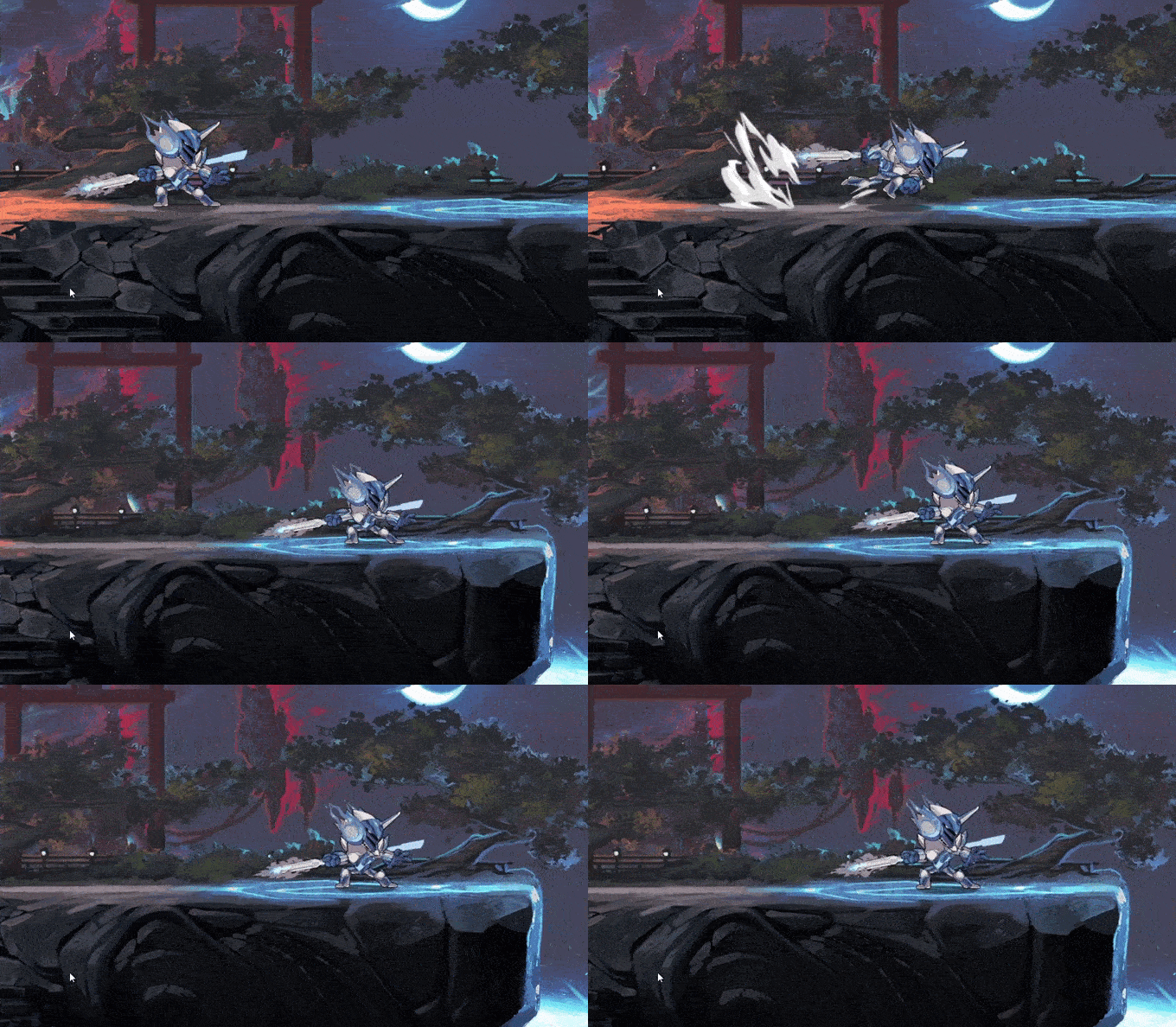
1. 在键盘上找到【SHIFT】键 2. 在键盘上找到【SPACE】键(空格键) 3. 同时按下【SPACE】和【SHIFT】键,在角色脚下召唤龙卷风,以极快的速度将你推离地面 4. 加上方向键【A】或【D】

--
--
--
--
--
--
--
--

特罗斯是个有趣的角色,我们可以用他做很多事。 在本指南中,我会介绍这个角色的秘密技巧。这个技巧很难复制,需要多年练习。 那么,我们来看看这套复杂的连招组合。 使用【Ssig】,可以说你已经成功一半了。 祝各位好运! 特罗斯与连招

--
--
--
--
--
--

本教程将教你如何跳跃。 步骤1: 按下键盘上的空格键或W键与上方向键。

--
--

别管了,不值得 如何应对垃圾信息发送者 如何解决对阵垃圾信息发送者时的自动失败问题

--
--

The undisputed best guide for Brawlhalla available. Walks through all the steps to becoming diamond while also attempting to teach good habits along the way. Be aware that players might be slightly better than their showcased rank in certain areas; a gold opponent might be plat worthy and so on. Read ahead or be creative to gain the advantage on these players. - Intended for ranked 1v1s only. - Training Room is entirely optional, not mandatory. - No specific combos/legends will be taught. Updated for Patch 7.09 Edit 2025: Attempted to streamline a lot of the concepts. Also tried removing some repetitions and make it a more fluent read. Still only updated for 7.09 Start Settings Before entering a game, go into settings and change the following. Controls: Disable "Pick up with Light Attack”. This will increase the range at which we can pick up weapons and reduce misinputs. Controls: remove all bindings for "Jump + Aim Up". Then set a new binding for "Aim Up" and a separate one for "Jump". This is because we don't always wanna be jumping and aiming up simultaneously. The short explanation is that this change makes a lot of techniques easier. Controls: advanced options: enable “Prioritize Neutral Over Side” (this option might not exist depending on our controller). This will slightly increase the speed and decrease the difficulty of certain inputs. Controls: advanced options: disable “Out of Jumps Recovery”. This avoids a common misinput that can easily cost games. Preferences: I highly recommend changing the queue waiting options from “Bot Match” to "Training Mode". You won't need to actually use the training room, but “bot match” forces you into a Free For All while waiting in queue, which will 100% create some very very very bad habits. When playing vs bots, you will often trick your brain into thinking your awful gameplay also works on real players. Just don't. Tap out of the game instead and entertain yourself elsewhere if you must. Ranked anxiety If you're anxious about losing rank and you've already tried to not think about it, you can try thinking of it as your own training room. Imagine the players are bots (most of them play like bots anyways). Your current skill level is completely irrelevant. Your sole focus should be on getting better. You need to accept that you're genuinely bad at the game. Not a single player below diamond is decent at the game. Elo isn't even an accurate measurement of skill level anyways; it's an approximate guideline. Losing 50 elo doesn't mean you got worse all of a sudden. Losing 200 on the other hand might mean something has changed that you need to adapt to. The only thing that truly matters is potential. Every participant who's ever been anything has had to practice at some point. Ranked fatigue If you're constantly trying to improve, you'll get bored very quickly. Do improvement-sessions and do separate fun-sessions. Get comfortable and relax. Efficient improvement Don't try to learn everything all at once. Just play the game and occasionally aim to learn one specific thing at a time. Focus all your attention on that specific thing and put the rest of your gameplay on autopilot. This will ensure you see results much faster. Other modes If you wanna reach diamond fast, I suggest avoiding other modes as much as possible. They play vastly different from the 1v1 ranked experience even if it isn't noticeable at first glance. The closest alternative (experimental 1v1) tend to have more aggression than regular ranked for example. Choosing Your Legend You want to pick someone you like. Someone that just feels right. Maybe you like their looks. Maybe you like their stats or their attacks feel. Maybe someone did a cool combo on you that you want to recreate. Ignore tier lists. Ignore haters. None of it matters when you're only aiming for diamond. Importantly, you want to pick one you can stick with. We're trying to create muscle memory which will get confused if you start swapping around. The legends themselves also want to be played differently from each other. Not to mention, learning multiple weapons properly can be quite the challenge if you're busy learning the basics simultaneously. At the end of the day (this should be self-explanatory but somehow isn't) you definitely won't get better or see different results from swapping legends. You get results through mastery and dedication. Stats The stats can help us understand a bit about the legend and their preferred playstyle. The first stat is strength and can be found just below your legend by the red sword. It adds bonus damage and extra knockback to each of your moves, thus requiring less hits to KO. This helps in all aspects of the game, but especially good when you have guaranteed hits. It can alternatively be translated to "pressure" (not to be confused with "aggression"). A legend with high strength doesn't need to commit a lot to get their damage and kills. To the right of strength is defense. It reduces all damage and all knockback, allowing you to take more hits. This is best translated as "reducing pressure". Despite the name, it can work offensively as well by allowing the player to make more mistakes (and take more risks) without the fear of dying instantly. High defense means you will spend less time in the air and more time on stage controlling it. Below strength is dexterity. This "increases attack speed". Note that this is irrelevant in regards to combos 99% of the time. Dexterity makes missing an attack feel slightly less clunky, allowing the user to act slightly earlier than they normally would after a miss. Players that love making people rage about "spam" will love this stat. Calculated spam through precise spacing is the name of the game with this stat. Last, in the bottom right, we have movement speed. This stat tends to decide the pace of the game, but not quite in the way you think. Our maximum speed won't increase to the point where it's relevant because we'll be utilizing movement techniques a lot. Small movement, walking and air speed on the other hand benefit a lot from this (note that walking is not the same as running). Because it boosts air speed by a lot, it's especially helpful while returning from off-stage. In essence, speed sets the pace for the game, but not above a certain threshold. It decides who gets to move first, not who gets to move the fastest. Levelling up any legend will unlock up to 4 stances for that specific legend. These stances will move one stat point around. Just like legends, you shouldn't swap around with these too much. Stats tie in with muscle memory and swapping around messes with that. Try them out, but ultimately choose one and stick with it. Signatures Each legend has 6 attacks that are unique to them. These are called signatures. Each signature has their own intended use and these vary widely across legends. Understanding the unique properties of these will also reveal more about your legend's preferred playstyle. More on this later. For now, just note that each signature is performed by pressing the heavy attack while on the ground. Silver to Gold - General Gameplan The only thing required to reach gold is understanding the very basics of the game. I don’t recommend you read everything from silver to gold (that'd be information overload). Instead, just play the game and come look if you feel confused. Brawlhalla is a game centered around movement so you want to get comfortable moving around a lot. The movement system is extremely liberal compared to other games and even influences attacks in different ways. Spam movement options until you're familiar enough to do it without thinking. Spam them even if you are. They are your most important tool at all times. While you're at it, get familiar with your specific legend, how they feel to play and how they tie in with your own unique playstyle. E.g. a player who's bad at securing their kills might not benefit from playing a legend with low strength and no ways to kill reliably. While learning, you also want to remember you main goal: staying on the stage. There's no prize for who can chase the longest or deal the most damage. You only care about staying on the stage, and this in turn means forcing the enemy off it. When you are in control of the stage, you can utilize more of the stage. Use the space that you control to confuse the enemy. If you only control a small spot you'll quickly become predictable. When you land a hit on the enemy or otherwise force them into the air, you want to really pester them and keep them airborne. Keep knocking them into the air or continuously threaten them until they get scared of landing. The same thing applies if they're knocked off the stage. Keep removing their safe zones by attacking or threatening with attacks. Staying above the enemy while off-stage will keep you safe most of the time. In regards to which attacks you should be using, focus on the ones that feels the most responsive and allows you to move during or after a miss. The slower clunkier ones (like combo starters) are also useful, but they require some planning ahead to ensure they don't miss. This will often involve baiting/confusing with movement, threatening with other moves, or simply using them after landing another attack first. In regards to defense, you can easily avoid most stuff through good movement and dodges. Do not panic when you get hit and do not mash dodge. Don't recklessly attempt a counterattack either. Just jump back on the stage and get into a safe position. Fight back if you must, but usually, people don't understand that you can just jump back on the stage. A more proactive form of defense is to change up your position a lot. You should see a lot more opportunities to land counterattacks. Try not to be overly creative; moving too far away from the fight or using a slow move might give the enemy enough time to evade. In the beginning, applying the perfect reaction and response isn't too important. You'll slowly figure that out along the way and you shouldn't attempt to be theoretically perfect. Theoretically perfect equals predictable. It's necessary to stray away from the perfect path every now and then (as long as you remember that you are doing so). Sometimes forfeiting stage control doesn't "feel" right. Sometimes it's too difficult for a specific player to regain that lost stage control or sometimes doing the correct response proves too difficult. As long as you don't play at turtle speed and hit your attacks somewhat consistently, you'll eventually get to gold automatically. Hitting your moves becomes way easier if you understand your surroundings so take notes along the way. If you're still struggling, you might be more predictable or inconsistent than you thought. I know without even seeing your gameplay that you are using (and missing) way too many signatures. Be observant and identify these bad habits early on. Notice which areas could use a bit of improvement even when winning. That's how you become a master at your craft. The speed of your gameplay (not movement, but precision of your inputs) develops and improves over time, so just focus on doing it correctly for now. Silver to Gold - Movement Brawlhalla uses a very liberal and straight forward movement system compared to other fighting games. Because of this, most of the skill in Brawlhalla is showcased through movement. Additionally, every attack requires some sort of movement knowledge to be used optimally; either through the use of general movement mechanics or through the attack's unique built-in properties. Brawlhalla is also faster than most other games in general. Luckily, basic movement mechanics like dodges, dashes, fast falls and jumps allows you to keep up the pace for the most part. Practice them A LOT. Jumps You can jump once on the ground and twice in the air. Getting hit will refresh one air jump; touching the ground restores both. Doing a jump and holding the jump input performs a full jump; tapping it performs a short hop. Be careful not to confuse the grounded jump for an air jump. Getting knocked into the stage does not count as touching. Fast falling Press down at the peak of a jump. This used to require a specific timing, but should now (alledgedly) be more forgiving. You can also perform a fast fall after you've increased your verticality through other means. To cancel a fast fall, simply stop holding the down input. Sounds simple enough, but with the perfect timing, this drastically speeds up your aerial mobility. It's oddly enough, the most difficult of the basic movement options. Mix and match short hops and full jumps for the best results. Despite being a seemingly boring option, this is a very powerful tool and one you are forced to master. It is basically the only thing alongside jumps that prevents you from being a practice dummy while airborne. Dodges & Dashes The button that you used for dodge is the most important button in the entire game. All our best options come from this button. Make sure you have it bound to a key you are comfortable pressing a lot. Pressing dodge causes our legend to flash white and briefly turn invincible. The dodge is then put on a small cooldown. You can hold a direction while doing this. Grounded dodges have shorter cooldowns. Using it in the air and touching the ground will refresh this cooldown faster. Grabbing a wall will refresh our air jumps and slightly refresh our dodge cooldown. Note that getting launched into the wall/stage does not count as touching it. Use dodge to evade incoming attacks, but try not to spam it. Neutral dodges last longer than other dodges, but briefly lock you in place. The neutral dodge is mostly used to ensure the invincibility when preparing an immediate counterattack, while the directional dodges are used to create distance. Dodging sideways on the ground will cause us to dash without invincibility instead. Dashing forward (the direction our legend is facing) covers more ground. Dodging directly downwards while standing on the ground will instead cause a forward dash (you can also do it sideways, but I highly suggest you use this shortcut instead). A back dash is significantly shorter, slower and more difficult to act after than a forward dash. You might as well get used to dashing around the stage, because you'll be doing it at least 80% of the match. It is crucial for every aspect of the game, even air movement (momentum) and recovering from off-stage (dashing immediately after returning to stage) ironically enough. Sprinting and Momentum By walking in a direction, your character will slowly build up speed until they reach max, which is called running (or sprinting). Faster legends are of course faster, but the time until max is achieved is the same for everyone. Some will have lower speed. Dashing grants you a big boost in momentum. A backdash basically doesn't grant any and doesn't allow for a very smooth transitioning into run, but allows for a follow-up forward dash. Throughout a match, try to notice how momentum affects you. Note that air-movement doesn't allow for big bursts of momentum in general. On the Wall When holding onto the wall you have 3 options Slide down the wall by using gravity - don't press anything Move into the air - tap the direction opposite from the wall Perform a wall jump into the air - jump with no additional input. This jump does not count as an air jump. A wall jump can be angled by holding forward or back during the jump itself.Note that dodges are disabled while holding onto the wall! Any dodges will get disabled if you dodge into the wall. Attacks are also disabled on the wall, but your attacks won't get cancelled by moving onto the wall while performing it. You will have to move away from the wall to access dodge and attacks. Note that you don't need to move a lot for this. The wall is kinda a semi-safe spot. Like a checkpoint in other games. But unlike other games, enemies will try to kill your at this spot. The primary thing you want to master is to move away from the wall to access dodge. Also be aware that it's easy to confuse wall-jumps with air-jumps. Wall-jumps needs to be performed while still holding onto the wall. Wall-jumps are more restrictive in regards to movement but allows us to to save an air jump. Moving into the air and then air jumping are more liberate in comparison. Wall slip If you've performed 5 air actions [air jumps, wall jumps, recoveries] an exclamation mark will appear above you. Note that air dodges and grabbing the wall does not count towards this. The amount will continue to rise until you've touched ground, hit the enemy or received a hit. At 9 actions, 3 of these marks will show and you'll enter wall slip. During wall slip, all jumps except wall jumps, all dodges and any recovery attempt (aerial neutral heavy) are disabled. Wall slip can't be removed as easily as the exclamation marks. The only way to remove wall slip is to touch the ground. Any hit taken while in wall slip basically means death. You can still use other attacks aside from your recovery, but you'll basically just fall down even if you manage to hit them. Platforms You can stand on them or go through them by holding down. You can do this both in the air and on the ground. You can notably be knocked through them without holding down. They count as ground and not a wall. Silver to Gold - Attacks Endlag & cooldowns Whenever you miss an attack, most of your options will be briefly disabled even after the animation has finished. This is called endlag and differs with each attack. Despite the endlag, a lot of moves in Brawlhalla allow for movement during the animation and some even after. Because Brawlhalla is so fast, learning to utilize movement while attacking is paramount for mastering attacks in this game. Endlag is not the same as cooldowns. A cooldown is the amount of time you need to wait before attempting that same attack. Each attack has their own unique cooldown. Cooldowns are very easy to forget and dismiss, but don't. It will come back to haunt you. To summarize: endlag decides when you can act again. Cooldowns decide when you can spam again. If an attack has short endlag, but a long cooldown, you can't use that same attack for a while, but a different attack can still be used briefly after the initial. You'll develop a feeling for this as you play. Similar traits With that out of the way, lets dive into each of the attacks. They tend to share a lot of traits. Here are some general guidelines that are true ~90% of the times. Be careful not to play each weapon the exact same way though. Neutral Attacks on the ground (Neutral Light or nLight) are your fastest, but the least rewarding attack. They often lack either range, follow-up potential and/or lock you in place during the entire animation leaving you wide open to attacks. All this means they're mostly quite defensive in nature. Side Light Attacks on the ground (Side Light or sLight) and Down light attacks on the ground (down lights) aren't completely set in stone, but one of these will always be your main combo starter and the other one will often be great at controlling or creating space. Try to use these a lot. Neutral Attacks in the air (Neutral Air or nAir) are good for controlling air space. They're often our fastest attack in the air and a great option if you wanna juggle your opponent and keep them airborne. Side Light Attacks in the air (Side Air or sAir) is usually an effective way to knock a damaged foe off the stage. They’re often slightly slower than the average attack, but either have great range or other traits to compensate. Down Light Attacks in the air (Down Air or dAir) will always hit somewhere below you. They're a somewhat safe way to apply pressure to an off-stage opponent as long as you aren't too predictable. They also usually have long reach, making them difficult to contest. Down Heavy in the air (Ground Pound) will always hit somewhere below you. Similarly to dAir, it's used to pressure off-stage enemies. They usually have worse priority and better knockback. If it lands on a damaged opponent off-stage it will usually lead to a KO. They're easy to recognize when used from a distance, but their descending speed varies from weapon to weapon. They're typically not forgiving to miss either. Don’t be afraid to use these occasionally. Try to practice different distances and test the limits of your weapons' groundpounds. Some of these have two different versions depending on whether you hold or release the heavy input. Holding it will cause the attack to only start if you make contact with the enemy. Releasing the input will use the attack early and can be used to deter overeager enemies. Neutral Heavy Attacks in the air (Recovery) always hit somewhere above and will always move your legend upwards. Any recovery beyond the 1st will spend an air jump and barely grant any upwards travel, but is otherwise mostly identical. Getting these interrupted will play a special sound and show some stars close to your head. This indicates the loss of the regular version. Losing this means losing your best option of upwards carry. Getting hit in the air after using your recovery will result in the same situation basically, but without the special sound and stars. You can always regain the regular version by touching the ground or a wall. Grounded Heavy Attacks (Signatures or Sigs) are attacks that are unique to each legend. They deal lackluster damage compared to combos and are riskier than other attacks. A lot of these are also slow and clunky. These tend to have high knockback which is why you often see bad players spam these. Despite their bad reputation and many flaws, these shouldn't be slept on. While they share most of their weaknesses, each one have unique strengths. Don't spam these, but definitely familiarise yourself with these (if you reach double digits you've definitely used too many). Try to figure out their intended use, because most signatures are actually quite good when used properly. Do they take up a lot of space? Are they great at keeping the opponent at a distance? Do they have high knockback? Are they faster than one would expect? Are you in danger after missing one? Can you counterattack after missing? Do they alter your movement or position? Do they hit enemies on platforms? Scythe and Battle Boots have more attacks than the other weapons. These are performed by inputting a specific direction while the attack animation plays. Not all their attacks have multiple versions, though. Some signatures share this trait as well. Greatsword has a unique combo mechanic and is generally not recommended for new players. If you are a beginner and want to use it, I suggest watching a tutorial on it beforehand. It kinda feels like the cancel system from most 2D Fighting Games. Unlike 2D fighters, some of the CDs are shared across the combos. Which means you have to be very attentive in choosing your movement and attacks on this weapon. Silver to Gold - Game States The Neutral If nobody is getting hit and nobody is in immediate range to threaten anyone, neither player is in advantage or disadvantage. This is called neutral. Decisions here are called the neutral game. Whenever a player gets into disadvantage, their primary focus should be on returning to the neutral. When a player gets into disadvantage it's referred to as breaking the neutral. Whenever you hear people complain about the game being too passive, they're referring to how difficult it can be to break the neutral. Basic Offense Landing a hit briefly stuns the enemy and almost always knocks them airborne. This state is called advantage. Airborne opponents have fewer options: aerial attacks are slower; dashes are unavailable; and gravity forces them towards the ground. Because the hit itself also briefly stuns your victim, any immediate follow-ups will now be slightly more difficult for them to contest. This forces them to back off or commit to a fast counter. The bigger the disadvantage, the faster the counter needs to be. Sometimes there simply isn't enough time for a counter. Note that some attacks are useless when not used in advantage Your job in advantage is to make it a nightmare for the enemy to escape your advantage. Notably, you don't need to over-commit to do this; the simply threat of an attack can often be enough to force out a mistake. As long as the enemy hasn't touched the ground or gained any form of momentum, you're still in advantage. Keeping them airborne is also advantage. Basic Punishment The extremely simplified way to punish an opponent is to avoid their incoming attack, wait for it to miss and then hitting the enemy with an attack immediately after the miss. You're basically letting them know that they can't just swing mindlessly. Beginners should use a fast attack to make sure the opponent doesn't have time to move away. Combine this with movement options for better results. EdgeGuards If you manage to knock the enemy off the stage, do not let them back on the stage for free. Your main objective now is to farm some free damage or keep them either off-stage or airborne. Do not get confused either. Your objective is to intercept them, not chase them. It's very comparative to a soccer goal. You want your goalie to defend the goal for the most part. Be very aware that you shouldn't be mindlessly mashing signatures at this point. Your light attacks (preferably grounded) are more than sufficient for this. With some practice you can even get some big combos during this time. A simple double jump tends to be a trend in low elo. If you see this happen, make sure to either use an attack high enough to reach or jump before attacking to gain that extra height. This might seem self-explanatory, but history says otherwise. Another common option in this elo is to dodge towards the center right when they enter your attack range, dodging through you and your attack. When this happens, stay calm. Pretend you're going to hit them, then turn around and wait out the dodge. Time your attack properly and you should have gotten a free hit. You're not invincible when edgeguarding. Stand too close to the edge and you'll be prone to being counterattacked. If you suspect a counterattack, simply stand a bit further back or be ready to move. As long as your opponent knows you might hit them, you're doing great. The edgeguard situation literally doesn't stop the until both players return to neutral - aka safely on the ground at a safe distance from each other with equal momentum. This basically means, as long as your opponent fears getting hit by you, you're the one controlling the fight. The only way for the enemy to escape the edgeguard is to move out of your attack range, have you miss an attack or land a hit on you. This isn't as easy at it sounds. Enemies attempting to hit you will have a hard time doing so since they have no momentum. All this makes raw movement way more effective than one would think. As long as you stay in control of the pace and keep threatening them, they can't do anything. Your edgeguard isn't mute just because they touch the ground either. As long as they don't feel safe, they still can't do anything. A weird technique is when the edgeguarding player lets their enemy land, but still pressures them. The edgeguarder will stay just out of reach of counterattacks by running away, which means the edgeguarder can always attack, but the enemy can't. This means getting chased across the stage can sometimes be defined as a prolonged edgeguard. This is not only hilarious, but also very difficult to do. If you prefer to be more aggressive, try to count how many options your opponent has left (air jumps, recovery, air dodge, distance from stage/wall) to assess how pressured they are. The more pressured they are, the more threatening you become. Remember, this is still not a chase. You're occupying space that they want to enter. In the most extreme cases, the enemy runs out of options completely. Here they'll have no choice but to head directly towards the stage/wall or fall to their deaths. One (proper) hit in this situation is basically a free K.O. Don't ignore that they can save themselves by hitting you though. Missing attacks Whenever any player misses an attack, they're put into disadvantage. However, this disadvantage is slightly different. The player is briefly prevented from using other attacks and movement is often limited, but not disabled. The severity of disadvantage depends on the move missed. Sometimes position combined with a miss will create such a big disadvantage that you are forced to eat an attack. This is known as getting punished for using an unsafe move. Basic Defense If you get hit, you're in the same state as mentioned above in [Offense] except in reverse; you’re now the one in disadvantage and most likely airborne. Your main objective now becomes survival and not getting hit for free (aim to return to Neutral). Notably, you don’t need to attack for this. Simply land on the stage and attempt to create distance or gain momentum. Utilize platforms if the stage allows it (but the main objective is still center on the actual stage). This doesn't mean you should never counterattack, but be aware that these attacks are very risky and often not necessary. If you feel like your opponent is carelessly chasing you, do attempt a counterattack every now and then to show that you're still present. A unique thing about this state is that an enemy's missed attacks while you're in disadvantage typically puts you in advantage, but only very slight advantage. Don't confuse slight advantage with the same advantage you got from landing a hit. Returning to stage If you get knocked off-stage; you're put into big disadvantage. The most important thing to do now is not panic; panicking will only get you killed. The only thing on your mind should be to get back without getting hit. If you’re a new player simply jump twice. Hold down each jump to extend the distance. If you're still not back on stage you can use your recovery (aerial neutral heavy). If you fear your opponent might attack you, you can dodge or use movement to evade most attacks. You also have the option to grab the wall, maybe wait a bit for your dodge to recharge or stall a bit. Over time you’ll learn to use a less predictable pattern, but this is a good start. Just like before, you want to return to stage without risking too much. Return to Neutral. You can and should attack enemies trying to hinder your return if the opportunity presents itself. Just remember that it's much riskier now: your attacks are much easier to avoid and any hit puts you further in disadvantage, not to mention losing your recovery will really screw you over. Make sure they hit. Silver to Gold - Weapons & Gadgets Gadgets I'm not gonna teach you about gadgets because I've disabled gadgets in my games. They're fun, but doesn't belong in a proper competitive setting. You can disable them as well by entering the lobby, picking your legend and going to [Settings] -> [Lobby]. Weapon Throws You can throw a weapon by pressing and releasing the weapon pickup button. You can charge any throw and change the throw direction until released. Aside from charge time, weapon throws are entirely based on your legend's momentum when releasing the button. This means precise movement can be used to angle it into some very creative setups. This sounds a bit complicated but is actually fairly easy once you've gotten a feel for it. If you get hit shortly after throwing a weapon, that thrown weapon will lose its attack properties and go right through enemies. It's as if you never threw it. Make sure to stay unpredictable to avoid this scenario. Each weapon has its own unique size and properties when thrown. Test out what your specific weapons are great at. If the enemy is throwing weapons, note that they can't go through platforms. Weapon Health Weapons have their own invisible health and will drop from your hands when it's depleted. Weapon health will deplete whenever you take damage while holding them. If you're afraid your weapon might "die" while you're holding it, you can just swap to another. Preferably prematurely. Picking up Weapons Weapon will spawn in a fixed timer if there aren't already two on the map at the same time. They (allegedly) tend to spawn slightly closer to the center of the map. The weapons cycle between each other (if you're playing Brynn and pick up an Axe, your next weapon will always be the Spear). Weapons as a Resource Weapons are a resource and therefore something you should be managing. You can deny newly spawned weapons by quickly throwing away your weapon and grabbing the new one. You can also delay new weapon spawns since they'll only spawn if there are less than two on the stage. To delay them, throw your current weapon upwards and grab the newly spawned one. Repeat until you're holding the one you want. You want to ensure that the weapon stays airborne for as long as possible to get the maximum amount of delay. Charge the throw and hold it for as long as possible (make sure you don't take damage doing this or the whole point is kinda moot). Platforms are usually higher than the main stage, which means you want to avoid these as well. You can jump from high platforms while throwing the weapon to gain extra height, then during the jump you move to an area that the platform isn't covering. This seems tryhard, but why not take the free advantage? Silver to Gold - Damage, Landing KOs Under revision Entering Gold - Punishment Congratulations on reaching gold. In silver, we talked about basic punishment. Let's add a few more details. Why now? Because this is how you're gonna beat all the spammers that reside down here. What is punishment? Punishment is basically capitalizing on an enemy's mistake. It's a signal, to tell your opponent that they made a mistake. We'll only be focusing on punishing an enemy's missed attacks. This is called whiff punishment. Other forms of punishment do exist, but won't be covered. How do I punish? You punish by evading an attack, then then counterattacking before the enemy has time to evade your counterattack. This means, you want to be close enough for the enemy to think they're realistically gonna hit you. No decent player will throw out a move that has 0% chance of hitting. Over time, you'll naturally learn the approximate max ranges of the moves and at which ranges they're commonly used at. You can then abuse this knowledge, by hovering around the max ranges. When can I punish? Real matches aren't as straight forward as simply pressing the attack button whenever you see the enemy miss. It's a skill to know when a move is punishable (with an insanely high skill floor and ceiling); something that you can't practice in the training room either. While learning when you can punish you mainly want to focus on three simple aspects. The space between you and your opponent - You want the space between the two of you to be as small as possible after the attack has missed. If you were ready to punish or not - You want to react immediately (which is either done by being mentally alert or automatically through muscle memory). The move that you're using to counterattack with - You want the fastest move with enough range to actually hit If you attempt a punish, but think one of these areas could be improved, there's nothing to complain about. If you thought all 3 of them were basically perfect, but you still didn't get the punish, you should probably try a different approach. Maybe one that doesn't involve whiff punishment. Optimizing and understanding punishment To shorten the journey, I've summarized the most important aspects into the following golden rules of punishment: In Brawlhalla, grounded punishment is much easier, more consistent and usually leads to better combos. Completely grounded (non-gravity cancelled) punishment has longer reach since you can use a dash to extend your range. Other movement options can also help. A common intermediate level strategy is to gravity cancel to enable grounded punishment options. The best punish depends on the game state. You usually want a combo for more dage, but sometimes you don't need the damage. Maybe you'd rather have an edgeguard opportunity in which case you punish by knocking the enemy off the stage. Maybe you want to attempt the KO against a heavily damaged foe. It all depends on the game state. A small punish is better than no punish. The fastest moves are trivial pokes. They might be trivial, but they're fast. Sometimes you don't have the time to go for the best punish. Sometimes you panic. Sometimes you won't even bother to hit them with a poke; sometimes you want to use movement can be to steal map control and threaten an attack (without necessarily performing one). Punishment is never done proactively, but sometimes you need to take a proactive step to be able to punish at all. Some attacks are safe which means they can't be punished with an attack. However, the important takeaway is that these moves are only safe when you're in certain positions. This means that in order to punish these, you'll need to prematurely position in a way that allows for a punish. Nobody is always in the perfect position, but over time, you'll get better at recognizing patterns and punish opportunities. You'll be ready for the attack, and thus are able to use slower, better moves. For example: your opponent uses a move with a lot of horizontal range. Moving horizontally away from it will reduce the risk of you getting hit, but in return you will be giving up stage control and punish opportunity. If you instead moved vertically by (dash) jumping towards the attacker, you'll be in a much better position for the aftermath. If your immediate thought was "but this is risky", you're completely right; this is risky; but it's not reckless as long as you know what you're doing. You're taking a low risk for a reward. Moves that cover large areas are often left wide open from other angles. You need to take this proactive step to effectively punish these moves. This all means you'll be making a choice of whether to stay safe or forfeit your safety for a punish opportunity. A neutral dodge can serve the same function but is much riskier and more difficult to do. On a quick side note: remember that you aren’t hindered from doing proactive moves just because punishment is reactive. Not everything needs to be a punish. Punishment is a form of defense; it’s a way of getting your opponent to stop performing a certain action. Use time to punish safe attacks. After somebody uses a safe attack, they will ALWAYS be locked into the animation (even if just briefly). This stunlock will always persist briefly afterwards too. This means, that your attacks might not be able to reach them, but you still have time on your side. You can use movement to punish in this situation. By moving closer you're threatening an attack. Bad players will panic. Good players knows they're cooked and forfeits stage control. If you've ever heard somebody whine about spam, they're essentially announcing that they don't understand this aspect of punishment. Safe attacks are very powerful. Learning which of your own attacks are safe can be enough to climb a rank. Just don't use them too excessively or the enemy will catch on. Finishing thoughts Do not try to punish everything, especially if you're unsure. It’s more important to read your opponent properly than to attempt to punish everything. If you do, you'll just end up too confused to be able to perform your punishes properly or end up getting baited into a trap. This is especially important since a very common strategy in Brawlhalla is to bait for punishes and wait for the punish to inevitably fail (this is called a parry). If you get confused you'll get parried. A lot. Despite this, you should try to punish some stuff that you are unsure about. if you don't try, you won't learn. Attempt punishes in fancy ways and you might learn something. If you're a player that likes to be proactive Punishment can sound a bit boring. Who wants to sit around and wait for a punish opportunity? While you can't really avoid punishment since it's so centric to Brawlhalla, you can tune your gameplay towards proactivity. This means you want to play aggressive until you've put your opponent enemy in a position where they'll either respond with frustration or with a panicked reaction - these mistakes can then be punished. This utilizes punishment in a proactive aggressive manner. Alternatively, you can do what is called a "hard read". This is basically just a premature punishment but it only covers a single defensive response. This is best utilized after landing one hit or getting close enough for multiple attack options. You're 100% certain that this will land and thus you just let it rip. These can be quite explosive when performed correctly, but can feel rather unintuitive when first starting out since you're often just aiming for the air. This is obviously less effective than using moves that cover multiple defensive options, but have the benefits of being much more rewarding. Gold to Low Plat - Special Movement These are the most common techniques that you will see. It is not required to use all of these, but it is required to understand what’s going on to avoid confusing yourself. If you really really don't wanna bother, stick to dashes and dash jumps. Chase dodges are also basically mandatory for aggressive players. Gravity Cancel The first and most iconic tech in Brawlhalla. It is performed by inputting an attack during a neutral dodge in mid-air. This will cancel the dodge invincibility, but allow you to perform any grounded attack while still mid-air. Gravity cancel is best used as a way to hit both grounded and jump height by aiming your horizontal attacks at head level. Therefore, some attacks certainly benefit from this more than others.It can also be used to make some quirky combos and allow you to position in some very unexpected locations. Gravity Cancels can also be a great addition to your punishment game, since it grants you access to your best combo starters. All in all, a good option, but also one you shouldn't overestimate since it spends your dodge. It is arguable if you need to master it to climb, but it's such low effort to master it that you might as well. It also helps some weapons with combos. Chase Dodge Whenever you land an attack (except throws/projectiles), you can press dodge and you'll be slingshot towards the enemy with very high velocity and slightly longer invincibility than a regular dodge. You gotta be fast with the dodge input though. This is called a chase dodge [CDodge] and is shown with rings around your legend. You can only CDodge towards the enemy or directly downwards/upwards. These vertical CDodges can be delayed slightly compared to other CDodges. You cannot CDodge backwards so you need to be facing the way you want to go. If you're off-stage, you can Cdodge directly horizontally towards the stage too. Lastly, you can cancel a CDodge with an attack if you input the attack within 1/3 of a second after inputting the CDodge. This forfeits the invincibility but retains the momentum. There's a big difference between grounded CDodges and aerial ones. Grounded ones can only be performed if you're touching the ground at the end of the attack. Grounded ones also put your dodge on a shorter cooldown than aerial ones. After performing a grounded CDodge, you can perform another CDodge for free no matter your location by cancelling the first (just press the button twice). Apart from being free, this chained CDodge follows the same rules as any other CDodge would (with the exception that you can't use your first CDodge directly upwards, then chain one directly downwards). Chase dodges takes priority over dashes input-wise. This means landing an attack on the ground and pressing forward + dodge won't give you a dash, but rather a CDodge (note that Cdodges can be input before a dash). Here's where that previously mentioned shortcut becomes relevant. If you want to perform a forward dash, you need to input dodge + down. This is obviously irrelevant in the air. Be careful not to confuse the CDodge with your regular dodge. They're two different resources. Despite this, CDodge puts your normal dodge on cooldown exactly as if a normal dodge was used. You can notably hold 2 charges of CDodge. This means, that after using the first CDodge or after using your regular dodge, you still have one CDodges left if you manage to land an attack. CDodges is an essential tool to master for any aggressive player since it allows for an effortless way to continue offense and reposition. They're technically spammable due to the low risk, but try not to do so. The biggest caveat is that you can't easily act out of a CDodge compared to a regular dash. You have to commit to the attack by cancelling the CDodge earlier. You're also flung much further than a regular dash. This means, chase dodges are a safe but also committal option, while dashes lets you react at a slower pace. Dash Cancels and Dash Jumps A forward dash can be cancelled with either a jump (including short hops), attack, dodge or a dash in the opposite direction. When cancelling with a jump you'll retain the momentum. Note the huge difference between a short hop and full jump while dash jumping. You usually don't want to cancel with dodge, but the option is there. Fast falling after a dash jump lets you touch the ground faster and allows for repeated dash jumps. If you cancel it with a dash in the opposite direction, you’ll get a dash dance. This can be chained repeatedly, but each consecutive use decreases responsiveness. Dash cancels, dash jumps and (singular) dash dances can be very simple but effective movement options. Singular dash dances can effectively bait out trigger happy enemies. Slide Charge If you attempt to dash and slide beyond the edge or platform, but input a signature before you become airborne, you’ll perform a slide charge. These signatures are just like normal signatures, except holding the signature will charge it while falling through the air. These aren’t too useful aside from a few specific scenarios and require your opponent to basically stay completely idle during their recovery attempt. The distance this will carry you is determined by your momentum. Unlike gravity cancel, this tech is so slow and telegraphed that it is easily countered and often not worth thinking about. It can be fun nonetheless and some legends have some very scary slide charges when done properly. Note that you can also turn around while inputting the signature which adds a bit of utility. Directional Influence You can curve yourself while getting knocked back. This can most importantly be used to survive when hit by strong attacks that would usually knock you out. Note that I said curve, not steer. Most of the time you just want to curve towards the corners to ensure your survival. This is known as Drift DI if you've played other platform fighters. Gold to Low Plat - Offense True Combos It is not required to learn any crazy combos or strings if you just wanna reach diamond. That being said, you need to know reliable singular follow-ups for your favorite attacks and how to land these somewhat consistently. When a follow-up can't be avoided the two attacks form a true combo. You can typically learn these by watching opponents with the same weapons perform them on you or simply do a quick Youtube search. If you're performing a combo that you know is true, but your opponent keeps dodging/evading, you might not be making your attacks at the proper timings. Notice I used the word "timings" and not "speed". Every move have a different optimal window for follow-up inputs. This means, that mashing isn't the most effective way to consistently perform a true combo. While you don't need to enter training mode to perfect this, it'll certainly help speed up the process if you're struggling. The replay system also has the same feature, letting you see whether or not your combo was true when you performed it. Strings Follow-ups that can be dodged/evaded are called strings. These require you to know where the opponent will be sent to after getting hit by your attack. You will need to follow in that specific direction and then guess their defensive option. Try to recognize which follow-ups work well and which don’t. This is simply a matter of making a mental note of either "ok, that worked" or "did he evade that intentionally?". All players are different, so blindly following a YouTube combo guide won’t get you anywhere (but they can give you a great starting point). Most importantly though, if you land a hit on your opponent, always remember, you aren’t in a hurry to land a follow-up, they are in a hurry to avoid it. Sometimes, your position is so good that enemies are forced to go ruin their own position in order to avoid your follow-ups. While not ideal, this is the next best scenario. Damage Scaling & Juggling When trying to follow-up, generally speaking, the more damaged an enemy is, the longer you'll need to wait before attempting to follow up with another hit. You will need to use this time to reposition instead. This is because damage amplifies the knockback (damage scaling). Some attacks are specifically designed to start combos. These are attacks designed to keep the enemy very close after the hit even at higher damages. But even though these moves are less affected by damage scaling, you'll notice they still force you to change up your combos at some point. Juggling is the art of continuously hitting airborne enemies to keep them airborne. Even when not part of a true combo, landing a single hit on an enemy is enough to put their momentum to a halt and gravity will be forcing them downwards. You then have the option to camp on the ground or chase after them. Doesn't matter which one you choose as long as you don't let them land for free. When chasing, remember that gravity will work in your favor and force them downwards. Timing your attack with their descend becomes essential, but this is obviously easier said than done. Notice how much you need to commit to actually reach your target. If you knock them near you, you can chase with a single grounded jump. If you knock them far, you can use a chase dodge directly upwards. You will then often have time to reposition with an airjump. Remember that you have another chase dodge if you hit them after exhausting your first. This is useful if you want to go for kills off the top. When camping, utilize dashes, dash jumps and regular grounded jumps to keep the enemies on their toes. As long as you're close to the ground, they can never feel safe. Importantly, don't let them build up any momentum. Reacting to dodges If you want to be real sweaty and a combo demon, try learning the visual cues of the different dodges. Watch them happen, then react. Some weapons gets much scarier when applying this technique, but it also requires a lot more practice than I'm personally willing to put in. Gold to Low Plat - EdgeGuards Off-stage is a very difficult but crucial aspect of Brawlhalla. It is mandatory to get comfortable off-stage. I suggest you challenge yourself to use as few air jumps as possible while hanging in the air. You can easily exist off-stage for quite a while by letting yourself fall, chase dodge upwards after landing attacks, constantly jumping on and off the wall and mixing in your recovery. (Before we get into it I want to give a shout-out to [dash + short hop] -> [fast fall] -> [ground pound]. It's not exactly beginner-friendly inputs and easily evaded by any decent player, but hilarious to occasionally use and always seem to tilt the enemy. As an added bonus, it's one of your primary punishment option for punishing an enemy making a mistake while also being a surprise attack. It's really effective at catching enemies trying to rush to the wall. Try to maximize the coverage by aiming slightly away from the wall, so that the enemy can't move away easily, while still hitting anyone grabbing the wall.) EdgeGuards On Stage Anyways, positioning is key to edgeguards. You ideally want to stand in a spot where they have no way of hitting you with your back against the center of the stage. This allows you to evade incoming attacks and react to enemy mistakes. Remember, you know approximately where the enemy is gonna be (at the edge of the stage). They're forced to come up at some point. For you, it's mostly just a matter of timing. However, if you stand too close to the edge, your opponent gets an opportunity for a counterattack. This is mostly relevant if you use a move with a tiny amount of built-in movement. You normally wouldn't notice such a tiny movement, but it gets infinitely more noticeable at the edge. Pay attention and you'll know which moves does this. . When edgeguarding, the enemy is at such a heavy disadvantage that you should have no trouble evading their attacks when attempting to do so. Try to remember your enemy's off-stage disadvantages: they can't easily increase momentum; no dash; limited to 2 air jumps; they're forced to return to the stage or wall and choosing the wall will completely halt their momentum and disable their dodge + attacks. Impatient, frustrated and lesser talented players will often forget about these limitations and attempt to play the game like normal. They swing, you evade, they miss, you punish. Sometimes, enemies will make it back to stage, but still in immediate danger of getting hit. At this point, you should continue pressure and prolong your advantage. Either hit or continue threatening. Something as simple as standing closer to the center after they make it back is enough to continue pressure. At all stages of this long advantage state, you can resort to simply mimic enemy movement until they've exhausted their options. Off-stage EdgeGuards When you edgeguard off-stage, you still want the biggest advantage possible. Try to enter off-stage with as many options as possible. This can be ensured in if you knock the enemy very far. You now have plenty of time to position properly. Do make sure you don't enter off-stage to quickly. You don't want to overextend and be forced to exhaust your own options prematurely. Delay your approach slightly if there's basically no way for you to land a hit anyways. Another method is hit the enemy with a combo and then literally drag them off-stage. This method has the additional option of chasing them with a grounded chase dodge into an airborne (downwards) chain dodge. The speed at which this happens will catch a lot of players by surprise. There's also the scenario where the opponent (mistakenly) messes up an important movement option. Treat this just like a movement error on-stage and punish them through movement to take away their available space. You're limiting the enemy's space, forcing them into uncomfortable positions, even if you don't decide to attack. Some players will actually get scared from good movement alone and suicide. Once you're out there, you'll quickly notice off-stage edgeguards are very different from on-stage ones. For starters, there's a much shorter timer on everything, since gravity will pull you down. Don't panic. You can circumvent a lot of this internal pressure by making a plan before engaging. Most importantly, you want to remember, you aren't the one being pressured and you don't aim to throw yourself into disadvantage. Your only aim is to keep the enemy in disadvantage. You also got other stuff going for you: the enemy is forced to return to stage first or just literally lose their life (assuming you didn't rush off-stage and burn your options); any hit you land becomes much more dangerous for them; and it's very difficult for to counterattack you, especially if you stay above. There's a lot going on when edgeguarding, so let's try to simplify it by solely focusing on two aspects. 1) Intercepting the enemy's recovery 2) Hitting the enemy right when they touch the wall. If you manage to intercept the enemy's recovery they're most likely screwed and will be forced to rush straight to the wall. Knowing your opponent's recovery helps a lot with this. Can your character safely hit them during the attack or do you need to hit them during the startup before the actual hit comes out? Do you have any options that can reliably beat it? The priority order is less relevant because this is mostly a question about attack ranges and how fast your attacks are. Some attacks have very big hitboxes while keeping yourself safe. Contesting a recovery can be daunting. Luckily, you get certain benefits. Gravity will work in your favor and often move you closer to your opponent, letting you preserve your options. Let yourself fall with gravity. When you finally do land that hit, you can access your CDodge, allowing for chases or an easy return back to stage (CDodge upwards). Players tend to go for the wall when thrown very or when they literally have no other option. You need to be able to consistently prevent a wall touch so that they can't refresh their options. If you can't prevent the wall touch you want to attempt a hit right when when they make contact with it. Timing your descend in tandem with this while also masking your intent can be a bit difficult, but there's no way around it. Doing this makes the wall a scary place to be and will likely get a lot of players to rush towards the stage, which in turn makes for some easy on-stage edgeguards. Pay attention when you get close to your attack range and check if the enemy starts rushing towards the stage. You can sometimes drop below them and hit them on their way up. It's not as rewarding, but it's free damage. Weapon throws Offensively, you have two main options. The 1st is that you throw it after knocking your opponent very far off-stage. Try to time it so that the weapons hit right the enemy stops flying. This should give that extra nudge required to get the kill. The other option is to use throws to interrupt attacks that you know you cannot realistically contest (typically recovery or signatures). However, a weapon throw on a lightly damaged enemy won't accomplish a lot on its own so be sure to time it so that you can immediately follow up with another hit. Defensively, think of them as shields. Throw them to protect you and try to make them last a long time. Upwards while on/near the wall to deter reckless aggression, downwards when you're trying to land safely (not directly downwards, but rather diagonally). Gold to Low Plat - Defense Defensive movement - Dodges, jumps & fast falls Like mentioned, after getting hit, you want to return to neutral. The dodge is obviously a strong option, but you want to be clever about using it. If you just mash dodge immediately, you'll get destroyed. At the very least, you want to be unpredictable with the dodge direction (but getting rid of the habit entirely is obviously preferred). Generally speaking, you should reserve dodge for intentional evasion. The dodge is fast enough to be used on reaction with some practice. Even if you guess wrong, getting used to pressing dodge to evade with intent instead of automatically mashing it will go miles for you. You also have the option to fast fall and jump. These are slightly slower than a dodge and require you to time the inputs carefully (and the timing differs with each attack you get hit by). You can check this timing by unironically mashing dodge after getting hit and see how fast it activates. Then you know the exact timing for next time you get hit by that same attack. If you're close to the ground or a platform a simple dash can sometimes get you out of a sticky situation But let's say you haven't gotten hit. Let's say you're trying to approach from neutral, but still wanna exert defensive movement. In this case, you want to primarily (not solely) focus on avoiding the attacks that pose the biggest threat followed by the ones your enemy has been spamming. Which attack does the enemy start with when doing a combo? Which attacks can kill you or force you far off-stage? When you get more damaged, you'll find that almost all attacks pose a huge threat. You can't avoid them all. At this point, fast attacks are more difficult to evade than slow ones and should therefore be slightly prioritized. Fast attacks does tend to not be as dangerous because they usually don't kill, but despite that, getting that first hit in is usually all it takes. Focus on finding an opening, then commit to your decision. With that being said, most low level players tend to spam slow attacks when they see you are within kill-range. If you're so heavily damaged that any hit will kill you, a play that would normally kill you from one hit suddenly becomes equivalent to just playing the game normally. Abuse this to make creative plays with little risk. Panic Moves This is what people mean when they say you are mashing. If you're ever put in disadvantage, you can do what is called a panic move. These are attacks that are either fast or move you away from the threat. Doing a gravity cancel first can access your grounded and often faster attacks, but with obvious risks involved. If you're feeling confident, you can try other options than just your very fastest. Sometimes you need that slight extra range or that increased kill power. Panic moves are inherently risky. They're always done prematurely in disadvantage often by spending your dodge and halting your momentum. Despite these risks, panic moves are necessary to force your opponent to respect you. Use a few, but place them well. They're rarely better than defensive movement though. I'd estimate they're the best option 5% of the time on average. There is an exception to this rule. Whenever you're highly damaged, you get knocked further back due to damage scaling. This automatically creates distance between the two of you, allowing you to use some slower moves. Gold to Low Plat - Returning to Stage As mentioned before, your sole focus should be safely returning to stage. The options you got are somewhat limited but can be summarized as the following: stalling, grabbing the wall, counterattacking, jumping over and back on stage, landing on stage, dodging the edgeguard, tanking the hit. If you get knocked really far you can, in a pinch, spend your dodge to stop your momentum. Stalling Let's start with stalling because that's the easiest to explain. You don't need to rush towards the stage most of the time. You can usually get away with staying in the air briefly. This is useful against impatient enemies trying to intercept your return. Along with your recovery, a lot of moves will discreetly alter your momentum. Some will even move you. Something as simple as halting your momentum can help you become more unpredictable. When stringing moves together remember that the move's cooldowns might longer than its endlag. Switching up moves even if the other move doesn't help with movement can therefore be beneficial. Be careful though. You're essentially exhausting your own options while stalling. Grabbing the wall If you choose to grab the wall, you will halt most of your momentum, but your air jumps will get refreshed and your dodge gets its cooldown shortened. While on the wall, your options get altered a bit. You can only: stall (slide along the wall with gravity), move into the air, walljump. Jumping over enemies becomes a lot more difficult and dodges/attacks are obviously disabled. It can be difficult to stay unpredictable when limited like this, so it's important that you don't let the wall stop your flow completely. Generally speaking, moving into the air is the least risky and most responsive option available to you and doesn't limit your trajectory like a walljump would. If you move out far enough, you might even be able to generate some momentum. You can also move back and forth between the wall and air. Sliding down the wall is mostly used when you really need to create some space some space and are afraid to move into the air for a fast fall. Just like you'd utilize the entire stage, you should learn to utilize the entire wall and not just the risky top part. Counterattacks You should already know that you're in big disadvantage. However this disadvantage is big. Any attack you use is infinitely more risky than attacks in neutral. Try to avoid using any. But you also have limited space to work with which means an overeager enemy can easily hit the entire area around you. So you'd need to evade the attack and also make it back to stage. This isn't impossible, but fairly predictable and difficult to do. There's no need to put yourself in an awful situation like this. In this scenario, you need to use an attack to deter overeager aggression. Sometimes the enemy will mess up and just grant you a free hit. It's usually not necessary to attempt the hit (and it could be a bait), but you do want it if it's completely free. Some moves are better than others for counterattacking in these situations. Big attacks that are difficult to evade and don't need momentum to increase their range is prefered. The exception to this is when the enemy is very close. Here you'd resort to using the faster attacks. Weapon throws is a somewhat safe way to defend yourself without committing a lot. Bonus points if you can catch the weapon afterwards. Landing on stage Sometimes, the enemy will be scared of a certain counterattack. They will give up some space to keep themselves safe and out of your reach. This is your ticket to touching the stage. Even touching the stage once grants you brand new options compared to being trapped in the air. This works with platforms too, but they have the downside being keeping you somewhat airborne and therefore in difficult positions to contest any incoming attacks. Dashing, attacking, waiting and going airborne again are much better for your survival rate than simply praying the enemy doesn't land their hit. Just don't make the mistake of thinking you're back to neutral just because you touched the stage briefly. Jumping over Sometimes, enemies will be very focused on intercepting you at the edge or preventing you from landing near it. You can often get away with simply jumping over them and back onto stage. It's difficult to evade an attack if they predict you're gonna do this, but simply getting back safely on the stage without committing more than a single airjump is amazing. Dodging A lot of players tend to dodge through an edgeguarding enemy's attack. This is insanely risky and even intermediate players start to pick up on this very fast. This is also done so much that a lot of players tend to practice for this specific scenario. This is a habit you want to completely remove from your gameplay. Always dodge with intent or on reaction. Learning to get back on the stage without using dodge is always prefered. Tanking the Hit Getting hit restores 1 air jump. Even weapon throws does this. This means that if you're worried about getting killed while being very lightly damaged, you can simply jump back into the enemy and eat their attack head on. As long as you aren't committing more than an air jump, you should easily be able to live. This isn't a good option, because you're sacrificing hp, but it's much better than dying for no reason. I'm Pressing, but Nothing Happens? Sometimes after getting hit, you’ll feel like you input a move and the character didn’t respond at all (this is most noticeable off-stage but present at all stages of the game). If this happens, it either means you made your input before the previous attack had time to finish or because you were still getting stunned because you got hit. It’s just a timing thing and different moves require different timings. Refer to above [Defensive Movement] to learn this timing. Gold to Low Plat - Priority/Clashes Attacks needs to hit the legend, not their weapons or animations. If the attack effects are big, chances are the attack will beat out smaller attacks pretty consistently. Shorter range attacks are often faster to compensate, which means getting into close range is a race against time if you're trying to contest by priority. Pay attention to where the legend is located during the animation. Whenever two attacks hit the legends at the very same time (clash), they check for priority. The highest priority will simply delete the lower priority attack from existence during this interaction. If both hits are of the same priority you'll both hit each other; you'll clash. Note that some moves are comprised of multiple hits even if they don't look like it. This is important because clashing moves only registers the first hit. Multi-hit moves are therefore often weaker and the knockback gets weird when only one of the hits connect. These multiple-hit moves become much weaker while clashing, because their strength is only shown when the entire thing hits, not just the first part. This also means you can get send to some unexpected places by these multiple-hit moves. From highest to lowest, the priority during clashes goes: Signatures will beat everything Gravity Cancelled Signatures Light Attacks Gravity Cancelled Light Attacks Aerial Attacks, Recovery, Ground Pound Unarmed attacks have an especially bad priority in that they follow the priority order, but always lose vs a weapon. The clash priority is only relevant when an actual clash occurs, both attacks need to hit the opposing legend at the same time. This means your signature can still lose to a light attack simply by having worse range. Platinum Climb - Advanced Movement This is the place where you really need to speed up your gameplay. All the knowledge you've accumulated throughout your journey should be put to use here. Most players here won't be fooled easily either, so don't fall into predictable habits. It is not required to master all of these techniques, but they will greatly aid in staying unpredictable. Mastering a few is heavily advised and I'd feel very surprised if you reach high plat without using any of them. If you've already mastered some, try chaining them together or combining them with other movement options. Backwards Movement & Turnaround Attacks You can dash backwards, but backwards dashes won't boost your momentum as much and covers less distance than a forward dash. You can’t dash jump backwards either, but you can dash backwards, then press neutral jump to let your momentum carry your jump backwards. Backdashes stuns you very briefly. Using a dash locks you into the dash animation. You normally don't notice because dashes can be cancelled into so many options. Turning around isn't one of the cancel options though, but luckily there is a workaround. By inputting some special inputs, you can use an attack and turn you around immediately. These inputs can also be used right before slide charging and is called a reverse slide charge. This tech is mostly useful for creating momentum shifts to your character when the enemy doesn't expect it (which definitely shouldn't be underrated). Inputs for turnaround attacks are as follows Up+back+attack = turn around neutral input back+attack = turn around side input down+back+attack = turn around down input Because dashes are shorter when backturned, you want to be able to do turnaround dashes and dash jumps as well. The inputs for these are Back (hold), down + dash -> forward (the initial direction you pressed) Back (hold), down + dash -> jump -> forward (the initial direction you pressed) X-Pivot Some attacks will perform a small slide, when using the turn-around version immediately after a dash or dash jump. However, this will only occur if the inputs are fast enough and if the move has the ability to x-Pivot. It is very noticeable with blaster neutral air and down air where they will literally bounce in the opposite direction. Just like turnarounds, these can be performed both airborne and grounded. An almost mandatory technique for specific weapons/legends and not completely useless with the rest. This tech sets the middle ground for what Brawlhalla techs have to offer in terms of both difficulty, reward and general usefulness. Aerial Dash Dance You can dash dance while almost airborne. This requires you to stand at a specific length from the edge, then dash out towards the edge so you just barely touch the ground, then immediately dash back. On the stage this mostly doesn't do anything. On a platform however, you will receive a small boost of momentum and end up below the platform. This means you're now flung back, but instead of being on the platform, you're flying towards the ground. If done wrong, you’ll either get an airdodge or a regular dash dance back onto the platform. Once mastered, you can choose to mix it up with a regular dash dance to really confuse the opponent. This is a very useful technique and will often catch a lot of players off guard. Definitely worth learning for maps with platforms. Edge Cancel Use an attack on the stage or platform and let the momentum during endlag slide you over an edge. This cancels some of the endlag from the missed attack. This works with all attacks. Even if you aren't attacking, edge cancelling a dash or dash dance is equally effective at creating confusion. This sounds very simply and often goes unnoticed, but perfecting this is huge. Some weirdly angled attacks can do some insane movement options from this tech. Definitely a tech worth mastering, but also a very difficult one. Don't bother if you aren't feeling it. Platform Cancel If you use an attack or dash while slightly above or below a platform or the stage, your character will teleport the remaining distance onto it. This allows you to use grounded attacks or dashes slightly before you would normally be able to, basically nullifying the disadvantages of being airborne. This requires some practice to get consistent, but is probably the most useful technique to speed up your gameplay. It can help make your panic moves less risky, because you won't have to burn your dodge on a gravity cancel. You can also use this technique to dash while airborne if timed properly. This can sometimes grant you a dash after getting hit, allowing you to reset to neutral without committing a lot. You can also use it to recover from off-stage, allowing access to movement in a situation where movement is scarce. Inexperienced players will sometimes perform this tech accidentally when trying to use aerials close to the ground or a platform. This effectively causes platforms to function like a shield; the aerial is attempted, but instead snaps onto the platform and a grounded attack is performed instead. Down air and ground pound are the biggest offenders for this. If you do not wish for an attack to be platform cancelled, simply press and hold the directional input slightly before the attack input. Be very aware that some aerials can hit through a platform, but only if you're holding down the inputs. This also decides if the legend that used the attack will go through the platform. You can combine this tech with a dash do a similar technique to "wavelanding" from other games. You basically perform a platform cancel by cancelling your landing with a dash. Neutral dodge Using a neutral dodge might not seem so advanced, but simply pressing neutral dodge can occasionally be an easy, albeit slightly risky, way to create some confusion. Impatient players will attempt a punish and sometimes whiff in the confusion. Doing a neutral dodge at the perfect distance can create punish opportunities if you cancel the dodge with a gravity cancel. If you gravity cancel it late, it might surprise the enemy. Doing a neutral dodge at the right height (approximately neck level) vastly improves certain attacks since they can now hit both a grounded and jumping opponent. You can even use attacks with built-in mobility to remain unpredictable. Overall, this is a heavily underrated and crazy powerful tool when used correctly, but can be also be an easy bait for yourself if you get too creative. Instant ground pound A really advanced technique with a very mediocre reward. It is performed by back dashing out beyond the edge, then using a forward dash to dash dance back onto the stage and then using ground pound before the forward dash finishes. This will cause you to ground pound off-stage without actually going off-stage. This tech hits lower than using a groundpound on stage normally. It’s somewhat difficult and I have only ever seen like 2 other people do it properly. I don't recommend this unless you really wanna show off. Platinum Climb - How to Predict Understanding your enemy is great for both offense and defense. In both cases, the trick is simply to watch them more than yourself. At this point, your gameplay should be able to run on autopilot while you observe your opponent. When trying to predict a player, don’t always look at the individual scenarios. Instead, think of the bigger picture. Is the enemy particularly good with one of his weapons? Do they use a particular move? Are they left vulnerable a lot? What is their most immediate reaction to getting hit? What looks to be their overall gameplan? You also want to make smaller mental notes of why they made the response they made. Is it a bad habit, a panicked response, a miss-input or a poorly executed mindgame? Pairs Start off by thinking of very action in pairs; a starter and a follow-up. For example; most lower level players mash a panicked dodge after getting hit. Getting hit is Action 1 Dodging is Action 2We know that getting hit results in a disadvantageous position and dodging is an easy form of defence. We can therefore conclude that this player doesn't like to think a lot about defense, but they are aware of being put into disadvantage. We now "know" their response and the required event. We've read them. We now simply need to recreate the event. How much you want to commit solely depends on how sure you are of your read. Some weapons/legends can easily and safely cover multiple dodges, while others are great at catching specific ones. Defensively By watching your opponent more than yourself, you'll eventually notice patterns in their gameplay. You’ll learn to spot when somebody is attempting to position for a specific move (this obviously requires you to know their options). The most infamous example is when scythe players constantly hover just slightly above ground in an attempt to land their dAir. Once you've understood their goal, you can start applying the proper response. You basically just want to move out of the way, but without just forfeiting stage control. You want to stay relevant and make them think you're still clueless. Move in and out of the danger zone to trick them into using it. Alternatively, if you know a move of yours will beat theirs (range/priority) you can try to contest by using yours right when they use theirs. A really tricky, but very effective way to punish a very predictable opponent is with the neutral dodge. Neutral dodges lasts for a long time and can be and can be cancelled into a gravity cancel punish. In the end, the only language the enemy will understand is violence. Make them pay for even considering that move to begin with. Show them that you were waiting for it since yesterday. If they don't learn, simply show them again. Train them like the dog they are. Offensively Along the same vein, you want to train your opponent into doing what you want. You basically want to control your enemy's movement. Start off by showing 1 or two options. You usually want these to be your very best. Try to avoid committing a lot while just gathering info. Use safe moves with little risk of getting punished and use movement to keep the enemy guessing. If you decide to go for more explosive options, try to use the ones that actually kill and are fast enough to force into a panic. Moves that they need to prematurely evade (moves that literally come out in an instant). With all this being said, your best moves are obviously the ones that hit most consistently. Assuming you're actually hitting, the enemy will slowly start to evade those specific attacks. Even positioning for the attack without actually using it can sometimes bait the enemy into evading. Now you can account for that and hit the areas that the opponent try to escape towards. When two attacks hit two different areas, it's called a mix-up and you've probably heard it mentioned before. Mix-ups are always done prematurely and not on reaction. Legend Specifics Some legends have built-in 50/50 mix-ups. These are legends with two moves that perfectly compliment each other. One covers half the options and the other covers the rest. To avoid these 50/50s entirely, the defending player need to give up stage control. There is no direct counter to these, but it's often not worth using for the opponent either. You generally want an attack to be 90% certain to hit. Therefore, don't be predictable and you'll be fine against these. If you feel like 50/50 legends overwhelm you, try to take away the initiative before they get the chance to apply this 50/50 pressure. You can also try throwing your weapon to interrupt. Platinum Climb - Layered Offense A very common mistake I see is when players use a singular attack (typically at max range) as their entire offense. The opponent moves out of the way and their offense is basically over. Sometimes they even get punished after missing. In this section, I'll teach you some ways to add a few more layers to your offense. As a golden rule: if your offense is beaten by the same easy option, you're better off not using an attack altogether. Weapon Throws Weapon throws is the only truly ranged option in Brawlhalla, but lacks damage and advantage on-hit compared to regular attacks. Make sure you follow up fast to not waste the hit. Sometimes you want to intentionally slow down your own throw to reduce the time before the follow-up (try throwing it diagonally into the stage). By angling it right, you can also just use them to cover an aggressive play (aim for your own future position to interrupt counterattacks). If you find yourself airborne and simply want to return to the ground without having to fear any enemies waiting below, throw them downwards to ensure a safe landing. When done right, weapon throws allows for a lot of creativity and a lot of true combos. Losing your weapon isn’t disastrous, but also not ideal. Therefore, I suggest using weapon throws exclusively as a way to improve your edgeguards when trying to incorporate them into your gameplay. This is the easiest way to get familiar with these without having to invest too much thought. Making Your Attacks Safe Since Brawlhalla doesn't have a block option the majority skill is showcased through precise positioning. First off, try to intentionally use an attack at too short of a range. Intentionally miss it. As you do this, make you sure land right outside the enemy's punish range after the attack is finished. Bad players won't register you are too far away for a counterattack and mindlessly swing at you. If done right, they’ll miss (often right in front of you), and you now have all the options you could dream of. Next, try to do the opposite and overshoot an attack. You can use a move that let's you retain momentum throughout the attack to make it easier in the beginning. Just like above, we’re baiting the enemy into missing. This is different from the method above since it's easier to create momentum than to backdash attacks. From my experience, this tend to catch autopilot punishment. Players will sometimes prematurely position for their preferred punish. When you overshoot an attack like this, the position that your opponent autopiloted towards shouldn't allow for a punish; and because most players do their punishment from muscle memory, you'll easily bait out a lot of whiffs with this method. A 3rd option is to simply change up the timing. At this point, enemies tend to get frustrated with you. You've outsmarted them 3x different ways. They'll start to get twitchy, overly aggressive impatient. Sometimes they'll do things prematurely because they can't figure you out and simply wants to prevent the mind game all together. Against this kind of frustration, utilize very small movement (or immediately stopping all movement). We're essentially faking an advance. With all these tools, the enemy can't punish any moves. We've changed up our position, moves or timing and they can't take initiative because our movement might not even be real; their only option left is to be patient, retreat or take an unnecessary risk. A lot of players start spamming sigs at this point. Buffer Inputs A bit of an advanced technique. It's possible to queue up inputs by inputting them just before the endlag from attacks subsides. This shouldn't be ignored, but is somewhat lackluster compared to other techs. It's definitely most noticeable while playing greatsword - its gameplay basically requires the user to buffer movement after using an attack. It's also fairly difficult to do and requires some practice to get a handle on. Abuse Advantage Somewhat self-explanatory, but it is really important that you get the most out of your advantage when you have it. Being able to recognize a favourable position and making your opponent work to get out of it goes a very long way for your aggression. Pay attention to the enemy's movement and momentum and you can really make their life miserable. Even the worst aggressive players can annoy their enemies while in advantage. Aggression in disadvantage should always be a surprise. Use the whole stage If you always approach from approximately the same distance, you'll just be giving your opponent free damage. Instead, utilize the whole stage to either build momentum or take good positions. When you're moving around like this, it's much harder to tell when you will go for an offensive approach. But I just wanna spam my sig at max range At least move close enough for it to cover the remainder of the stage. This will force the enemy into the air or approach you. Some sigs come out really fast, others move you around and some can create momentum instantaneously. Try to abuse these properties when choosing a signature for your offense as it helps with the surprise factor. But most importantly, make sure your signature actually does more than a basic combo if it lands. And make sure it lands. Hardstuck Mid Plat - The Scythe Elo If you’ve come this far, you’ve reached what I call “Scythe/Parry Elo”. This rank is plagued by overly defensive- and/or tryhard scythe players. They usually only know 1-2 combos they watched on youtube, but that's about the extent of their skill tbh. Most of these are fanboys of a certain pro and luckily not too difficult to beat. They do require a different approach compared to what you've encountered up until now though. Air Control A lot of scythe players like to hover in the air with fast falls and jumps so lets learn how to control the air properly. You only really control areas that you are threatening with attacks. If an area is completely out of your reach, you are not controlling it. Momentum helps a lot with stage control because you're affecting more of the stage and increasing the range of some attacks. Momentum also allows for mix-ups and alterations in position. The issue is, in the air, you cannot easily create bursts of momentum, only utilize the momentum you've already built. To account for this, you need to accumulate momentum while grounded so you can use and potentially alter it in the air. Momentum is also great if you decide to stay grounded. I can't teach you how to hit your moves, but stay moving and you'll start to see a lot more of your moves hit. If you still can't hit, maybe you need to take a step back and figure out where your moves actually hit and how fast/close you realistically need to be. There's a big difference between max range and practical range. Max range is used for punishment only, where as practical range is the range you can cover before the enemy starts to react. But what if the enemy tries to turtle in the air? They jump far above you and you can't reach them. Do NOT waste your jumps trying to reach them. Gravity will force them downwards and they are airborne while you are grounded. They cannot create momentum and their attacks are slower with worse priority. They are already pressured. You don't need to exhaust your own options trying to catch them. If they're only a single jump height away, you can go for it (because a grounded jump is doesn't use an air jump). Platforms are also great for accessing higher areas without exhausting your own options. Generally speaking, you want to keep the enemy airborne at all cost while you stay grounded. You basically just need a single hit that holds them in the air. Look at [Offense] above for more info on juggling, but that's basically the gist of it. Some moves are designed to counter aerial approaches. Time them properly and juggling should be a breeze. Utilizing Momentum Brawlhalla is very much centered around movement, but nothing is more important than momentum. Momentum effectively grant a lot of moves extra range (some a lot more). Some attacks will grant you momentum while other might allow you to alter your momentum while using the attack. If an attack allows you to continue its momentum on miss, it'll often be very safe to use. Like mentioned earlier, when you hold a direction, you will gradually build up momentum until you start sprinting. Dashes and chases dodges can also grant huge bursts of momentum almost instantaneously. High speed legends are great at building up momentum faster, which is why they're usually the one with initiative in neutral. Do remember that getting hit usually stops all momentum. Basically, move around a lot and you should have much less trouble against these scythe players. Bonus points if you can figure out how to stop enemy momentum without touching them. Failed punishment Players in this rank will typically abuse a poor punishment game. You'll see them miss a lot, but this is often done intentionally. They're missing attacks at safe ranges to bait you into doing a bad punish. You inevitably miss and are left wide open. This technique is referred to as a parry. If you see your regular punishers miss, it might mean you've been using them incorrectly. When this happens you need to find a faster punish, react faster, position properly, use different moves combined with movement or resort to using raw movement as punishment (see punishment section). You can also do a fake punish, where you basically just miss at a safe range, but make it seem like a failed punish attempt. Momentum also helps with your punishment game. Refer to above. Autopiloting I believe the most common mistake in this rank is when players are just autopiloting throughout the entire match without even realizing. Constantly doing the same dodge, the same approach, the same follow-up etc. Predictable gameplay gets you killed vs any decent player, but scythe tend to showcase their punishment a bit more than other weapons. Common autopiloting signs to watch out for: Spamming attacks at absolute max range. I already talked a bit about practical range vs max range, but essentially, most players move when they see you attack. Don't use attacks that will miss if the enemy isn't completely afk. Instead, think of a 3x3 area with your opponent as the center. Note that covering the entire remainder of the stage with an attack will force an opponent airborne. Missing signatures. If you aren't hitting, why even use it. You're threatening a lot more by not using it. This also ties in with the point about max range. Dodging towards the center (through the enemy) after getting hit or pushed closed to the edge. It's understandable that you don't want to be thrown off-stage, but people tend to practice a lot for this specific dodge due to how common it is. Showing your intent to your opponent without even knowing. For example: you're always using a certain move at a certain range or you're always trying to get into a specific range. Move around more. A lot more. All in all, these sorts of strategies might’ve worked vs beginners, but you're not a beginner anymore. Trolling these players Since most of these players barely know how to actually play the game, you can often get away with a very passive playstyle. These players rely on their parry to start their offense, but if you never attack, there's nothing to parry. Simply take map control and use fast movement to mess with them. You'll notice they're get visibly frustrated. This isn't really optimal nor viable, but hilarious enough to deserve a mention. High Plat to Diamond Git gut or play at the end of the season To Be Added Maybe I will maybe I won't Positioning through aggression Which moves to be afraid of Defensive but still relevant Understanding your moves

--
--